
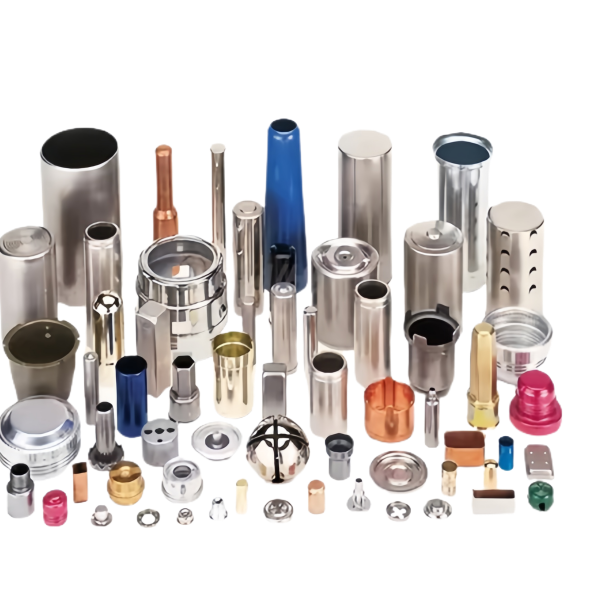
An assorted order of deep drawn cups, tubes and anodized sleeves spans three geometries that share one draw route but finish very differently. The cups and tubes are structural; the sleeves are long, thin and anodised, and the anodise is the whole point of the sleeve. We run the family from one draw philosophy and then diverge at finishing, so the customer gets matched parts with matched colour and one lot to trace. This page explains how we keep a family that finishes three different ways from drifting into three different qualities.
Drawing long sleeves without a seam or wrinkle
A sleeve is a deep, narrow draw – essentially a long tube with thin wall – and the failure modes are wrinkling at the open end and a seam-like fold where material piles up. We draw sleeves with a long, gentle punch and a close-clearance blank holder so the wall stays taut, and we anneal between draws because the length means more total reduction than a cup sees. A sleeve that wrinkles at the mouth is a sleeve that will not accept its mate, and that is the sleeve’s only job.
Sleeve straightness is checked on a V-block because a bowed sleeve will not slip over its mate, which is the sleeve’s only function, and a bow that passes a diameter gauge fails the V-block every time. We control the wall-to-length ratio so the sleeve does not buckle under its own draw length, adding an anneal rather than forcing one pass, because a forced pass buckles the sleeve and the buckle is invisible until assembly. The open end is trimmed square and deburred, since a ragged sleeve mouth scores the part it slides onto and a score is a wear groove from day one.
- Sleeve straightness is checked on a V-block because a bowed sleeve will not slip over its mate.
- We control the wall-to-length ratio so the sleeve does not buckle under its own draw length, adding an anneal rather than forcing one pass.
- The open end is trimmed square and deburred, since a ragged sleeve mouth scores the part it slides onto.
- We anneal between draws on long sleeves specifically because the length drives the total reduction past the limit.
Anodize thickness control on a thin ID sleeve
A sleeve’s inside diameter is usually the working surface, and anodise grows it outward, so a 25 micron coat adds 50 microns to the ID and can lock the slip fit. We machine the ID with the anodise allowance removed, then coat, so the finished bore lands on the drawing. For hard-coat at 40 to 60 microns we prefer to mask, coat and then diamond-hone the bore true, because predicting hard-coat growth to a few microns on a long bore is less reliable than cutting it after.
We ask for the anodise class and thickness and subtract double it from the machined ID, because both bore faces grow, and forgetting the second face locks the sleeve on its mate. Coating thickness is measured on the ID with a bore-mounted probe, not assumed from the OD reading, because anodise grows unevenly along a long bore and the OD number lies about the ID. We mask the ends where a seal or press-fit sits, because an unbroken coating there can bridge and leak or prevent press-in, and a sleeve that will not press in is a sleeve the customer cannot use.
- We ask for the anodise class and thickness and subtract double it from the machined ID, because both bore faces grow.
- Coating thickness is measured on the ID with a bore-mounted probe, not assumed from the OD reading.
- We mask the ends where a seal or press-fit sits, because an unbroken coating there can bridge and leak or prevent press-in.
- For hard-coat we hone after coating rather than trust the calculation, because the growth varies along the bore.
Why tubes and cups share a draw route but differ in trim
A tube and a cup start the same way – a shell drawn from a blank – and only the trim and the end finish separate them. We draw both on the same stage plan to save tooling, then trim the tube square at both ends while the cup gets a formed mouth or a flange. Sharing the draw keeps the wall behaviour identical across the family, which is why the tube and the cup from one lot always match in wall and temper.
The shared draw is logged once and referenced by both part numbers, so a process change propagates consistently and the tube does not drift from the cup. Tube ends are cut square to a tight length tolerance because a tube is usually a spacer or locator, not a container, and a tube that is 0.2 mm off length throws the whole stack. We note where a tube needs a chamfer for assembly and add it as a separate small operation rather than a dodgy trim, because a trim that tries to chamfer leaves a ragged edge that jams on insertion.
- The shared draw is logged once and referenced by both part numbers, so a process change propagates consistently.
- Tube ends are cut square to a tight length tolerance because a tube is usually a spacer or locator, not a container.
- We note where a tube needs a chamfer for assembly and add it as a separate small operation rather than a dodgy trim.
- We keep the tube and cup on the same heat so their anodise or plate colour matches across the family.
Holding concentricity on a long anodized sleeve
A long sleeve that is not concentric will bind partway on, and the anodise only magnifies the error since it adds to the thick side more in effect. We draw the sleeve true, then if the ID is critical we hone it concentric after coating. Runout is held to a few hundredths so the sleeve slides its full length without a tight spot, because a tight spot on a long sleeve is a sleeve that seizes halfway and that is the failure the customer remembers.
Concentricity is checked by rotating the sleeve on centres and reading the OD against the ID, or by a CMM scan, because a single diameter reading at one point hides the bow. We keep the draw clearances tight so the as-drawn sleeve is already close, limiting how much hone is needed after coat, because a sleeve that needs a lot of hone after coat was drawn badly and the coat just exposes it. For a press-fit sleeve we build the interference into the pre-coat ID and verify the post-coat fit with a ring gauge, because a press-fit that is off by the coating thickness is a sleeve that either falls out or cracks its mate.
- Concentricity is checked by rotating the sleeve on centres and reading the OD against the ID, or by a CMM scan.
- We keep the draw clearances tight so the as-drawn sleeve is already close, limiting how much hone is needed after coat.
- For a press-fit sleeve we build the interference into the pre-coat ID and verify the post-coat fit with a ring gauge.
- We flag any sleeve whose length-to-ID ratio pushes the straightness past what a draw can hold, and propose a post-coat straighten.
Hard-coat versus decorative anodize for a sleeve
The sleeve’s service decides the anodise. A decorative anodise at 5 to 15 microns is for colour and light wear; a hard-coat at 40 to 60 microns is for abrasion and a wear surface, and it changes the dimension enough to need post-machining. We quote the class from the function and warn when hard-coat will move the fit, because a customer who specs hard-coat without allowing for growth gets a sleeve that will not fit, and blames the anodiser.
We colour-match assorted sleeves in the family from one anodise bath so the set looks like one programme, because a sleeve that is a different shade from its mate is a visible defect on an assembled product. Hard-coat is sealed and we verify coating weight, because an under-built hard coat wears through in service and the customer sees the base metal where they expected a wear surface. Where the sleeve slides, we specify a low-friction sealed anodise and confirm the post-coat ID by gauge, because a sliding sleeve with the wrong friction is a sleeve that galls its mate.
- We colour-match assorted sleeves in the family from one anodise bath so the set looks like one programme.
- Hard-coat is sealed and we verify coating weight, because an under-built hard coat wears through in service.
- Where the sleeve slides, we specify a low-friction sealed anodise and confirm the post-coat ID by gauge.
- We quote decorative and hard-coat side by side when the function is unclear, because the price and the fit differ a lot.
How we verify anodized sleeves and assorted tubes
The assorted family is verified for the draw commonalities and the anodise specifics, because the sleeve’s value is in its coating and its fit. We release the lot only when the sleeves pass both the geometry and the coating checks, since a sleeve that is round but uncoated-right is still a reject.
- Sleeve straightness on a V-block and concentricity by centres or CMM scan.
- Anodise thickness measured on the ID bore and the OD, with the pre-coat calculation confirmed.
- Tube squareness and length checked, since tubes locate rather than contain.
- Material heat logged across the family for matched colour and finish.
- Hard-coat weight and seal verified where specified.
- Single lot label tying cups, tubes and sleeves to one process record.
The design decisions behind a part like this — draw ratio, wall thinning, radii and trim — are worked through with numbers in our deep drawn covers guide, and the Precision Deep Drawn Parts pages collect the rest of the family.
Specifications
| Item | Assorted Deep Drawn Cups Tubes and Anodized Sleeves |
|---|---|
| Brand | AUNOV |
| Designing | Send the drawing, or a sample we can measure, DFM feedback is returned with the quote. |
| Tooling | Every die designed and built in our toolroom, stored under your part number. |
| Samples | Pre-production samples ship with dimensional data and material certification. |
| Materials | The stock list runs carbon steel (SPCC / DC01), 304 / 316 stainless steel, aluminium, brass and copper, per the drawing. |
| Surface finish | Zinc, nickel or chrome plating, e-coat, powder coat, anodising or passivation, per the drawing. |
| Processing | Deep drawing in stages, in-line annealing where needed, with piercing and finish machining under the same roof. |
| Equipment | Mechanical presses 5-250 T and hydraulic presses 250-500 T, CNC turning centres, climate-controlled CMM room. |
| Tolerance | +/-0.1 mm as-drawn, machined features held to +/-0.03 mm. |
| Delivery terms | FOB standard, DDP offered for EU and US, T/T and L/C accepted, D/P for established customers, blanket orders and call-offs supported. |
Frequently Asked Questions
How are long sleeves drawn without a seam or wrinkle?
A sleeve is a deep, narrow draw; the open end wrinkles and material piles into a fold if the wall goes slack. A long gentle punch with a close-clearance blank holder keeps the wall taut, and interstage annealing handles the greater total reduction of a long part.
Why does anodise thickness matter on a thin inside-diameter sleeve?
Anodising grows the coating on the ID, so a sleeve that was in band as drawn may be tight after finishing; the ID is sized for the finished state. Straightness is checked on a V-block because a bowed sleeve will not slip over its mate even if it passes a diameter gauge.
When is hard-coat anodise chosen over decorative for a sleeve?
Hard-coat is chosen where the sleeve needs wear resistance and dielectric isolation, and decorative anodise is for corrosion and appearance. The choice decides how much ID growth must be absorbed in the draw.
How are anodized sleeves and assorted tubes verified?
Concentricity and anodise build-up are measured so the coated dimension stays in band, and the typical minimum order is 1,000 pieces with a 24-hour quotation.
Related Products


Request a Quote for This Part
Send a drawing or sketch — get material advice, tooling cost and a per-piece price within 24 hours (working days).