
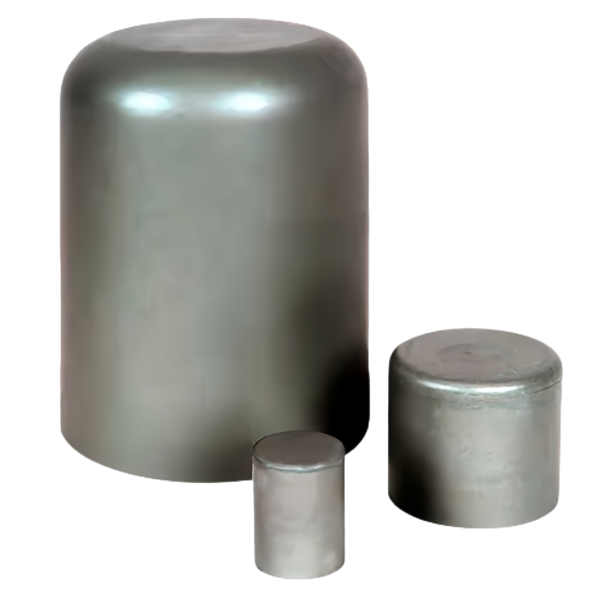
A steel deep drawn dome cup is defined by its bottom – a spherical or elliptical cap rather than a flat base – and that curved bottom is what makes the part useful for pivots, rollers and pressure ends, and what makes it hard to draw. We supply these as an assorted set of sizes from one draw philosophy, so a customer who needs 20 mm, 35 mm and 50 mm domes gets parts that behave the same way, just scaled. This page covers the five engineering problems that are specific to a domed bottom and that a flat-bottom cup never has to solve.
Controlling the dome radius across nested sizes
The dome radius is a functional surface: it may bear against a ball, seat a roller or form a pressure end, so its radius has to be right and consistent across the size set. We draw slightly under radius and then restrike the cap in a matched punch-and-die pair sized per diameter, because a single draw leaves the radius proud at the pole and shy at the tangent, and a radius that is wrong at either end is a part that does not seat. The restrike fixes both in one controlled hit.
Radius is verified with a dedicated radius gauge or a CMM scan of the cap profile, not by a caliper across the pole, because a caliper reads a chord, not a radius, and a chord measurement hides a pole that is proud by 0.1 mm. Across the size set we hold the radius-to-diameter ratio constant where the function demands it, so a 20 mm and a 50 mm dome are geometrically similar and the customer’s mating part scales without re-deriving the seat. We archive the restrike punch offset per size so a re-order of the 35 mm dome starts from the proven setting, not a fresh guess.
- Radius is verified with a dedicated radius gauge or a CMM scan of the cap profile, not by a caliper across the pole.
- Across the size set we hold the radius-to-diameter ratio constant where the function demands it, so a 20 mm and a 50 mm dome are geometrically similar.
- We archive the restrike punch offset per size so a re-order of the 35 mm dome starts from the proven setting.
- We tell the customer the pole-tolerance we hold, because a dome spec without a pole tolerance is a seat that will not match.
Why a spherical bottom needs a restrike, not a single draw
A deep dome pulled in one pass stretches the pole thinner than the tangent and leaves a wrinkle risk at the rim. Splitting the work into a draw that sets the wall and a restrike that sets the cap lets each operation do one job well. The draw controls wall thinning; the restrike controls shape, and trying to do both at once is why cheap dome cups come out with a thin pole and a wavy rim.
We budget the draw to about 60 percent of the final cap depth and the restrike for the remaining 40 percent, which keeps pole thinning under 15 percent. The restrike is run on the 5 to 250 T mechanical press where the tonnage for a small dome is easy to control; larger domes move to the hydraulic press for a softer hit that does not mark the cap. After restrike we section the pole on the first article to confirm the wall did not thin into the reject band, because a thin pole is the one thing that fails a dome under load and the one thing invisible from outside.
- We budget the draw to about 60 percent of the final cap depth and the restrike for the remaining 40 percent, which keeps pole thinning under 15 percent.
- The restrike is run on the 5 to 250 T mechanical press where the tonnage for a small dome is easy to control; larger domes move to the hydraulic press for a softer hit.
- After restrike we section the pole on the first article to confirm the wall did not thin into the reject band.
- We reject the single-draw shortcut even when the dome looks shallow, because the pole thinning it causes shows up only under load.
Stacking and nesting: what the taper angle must hold
Dome cups are often supplied to nest inside one another for packaging or to stack in an assembly, and that only works if the sidewall taper is held. We draw the wall with a deliberate 1 to 2 degree taper and hold it to +/-0.3 degree so a 50 mm dome seats cleanly into the next without binding or rattling. The taper is a functional dimension even when the drawing treats it as a note, because a dome that rattles in its neighbour is a dome that fails the pack.
Taper is checked with a conical gauge at first article and by a nest-fit check where the customer stacks the set, because a gauge number and an actual stack are not the same thing. Too much taper and the dome rattles in its bore; too little and it jams on extraction, so we tune it to the stated fit rather than to what the die happens to make. For assorted sizes we verify that the largest nests into the next size with the agreed clearance, because that is the property the customer actually uses, and a dome that passes every gauge but will not nest is still a reject.
- Taper is checked with a conical gauge at first article and by a nest-fit check where the customer stacks the set.
- Too much taper and the dome rattles in its bore; too little and it jams on extraction, so we tune it to the stated fit.
- For assorted sizes we verify that the largest nests into the next size with the agreed clearance, because that is the property the customer actually uses.
- We hold the taper even on the smallest dome, because a tiny dome with a wrong taper jams just as badly as a big one.
Holding wall thickness where the dome meets the rim
The tangent where the dome blends into the cylindrical wall is the section that sees the most stretch, and it is where thinning and wrinkling both try to appear. We control it by tapering the blank holder load through the draw and by keeping the punch-nose radius generous enough to let material flow rather than tear, because a tight nose radius is the usual cause of a torn tangent on a dome.
Wall is micro-sectioned at the tangent on the first article and compared to the 85 percent blank-thickness floor we hold for domes, which is a touch higher than for straight shells because the tangent is the structural corner of the part. If the part sees pressure, we thicken the blank locally by stepping the blank edge, a trick we use rather than over-speccing the whole cup, because stepping the edge adds metal only where the load is. SPCC is our default for domes because its draw behaviour is forgiving at the tangent; we move to 304 only when corrosion dictates, and we warn that 304 needs a touch more care at the tangent.
- Wall is micro-sectioned at the tangent on the first article and compared to the 85 percent blank-thickness floor we hold for domes.
- If the part sees pressure, we thicken the blank locally by stepping the blank edge, a trick we use rather than over-speccing the whole cup.
- SPCC is our default for domes because its draw behaviour is forgiving at the tangent; we move to 304 only when corrosion dictates.
- We log the blank-holder load taper per size, because an even holder on a dome over-wrinkles the rim and a heavy one tears the tangent.
Carbon steel grade choice for a domed cup
Most dome cups are structural or low-corrosion and run happily in SPCC or DC01, which draws smoothly and plates cleanly. The grade decision is about the finish and the load: a domed cup under rolling load wants a consistent temper so it does not dent, while a plated domed cup wants a clean surface so the plate adheres. We quote SPCC for the bulk of dome cups and note where a higher-temper grade would resist denting in transit, because a dome that dents in the box is a dome the customer rejects on receipt.
For any domed cup that sees weather we move to zinc or e-coat and say which, because the bare steel grade alone is not the protection, and a bare SPCC dome left in a damp warehouse is a rusty dome by shipping. The grade is recorded on the job card so a re-order pulls the same temper and the dome springs the same way off the restrike, because a temper change shifts the pole recovery and the seat drifts a few microns that the customer’s ball notices.
- We quote SPCC for the bulk of dome cups and note where a higher-temper grade would resist denting in transit.
- For any domed cup that sees weather we move to zinc or e-coat and say which, because the bare steel grade alone is not the protection.
- The grade is recorded on the job card so a re-order pulls the same temper and the dome springs the same way.
- We flag when a dome is specified in a grade that draws poorly at the tangent, and propose SPCC unless corrosion forces otherwise.
How we verify domed cups in an assorted set
An assorted set is verified shape by shape but judged as a set, because the customer cares about the nesting and the shared behaviour as much as any single dome. We release the set only when every size passes and the nest-fit is confirmed across the run.
- Cap radius scanned on the CMM or radius gauge for every size in the set.
- Pole and tangent wall thickness sectioned on the first article of each size.
- Taper angle checked and a physical nest-fit confirmed across adjacent sizes.
- Surface and any plate or e-coat measured for thickness and adhesion.
- Dimensional report issued per size but bound to one assorted-set lot number.
- Retained samples of all sizes kept together so the set can be re-compared later.
Draw ratio, wall thinning, radii and trim — the design decisions behind a part like this are worked through with numbers in our deep drawn covers guide, and the Precision Deep Drawn Parts pages collect the rest of the family.
Specifications
| Item | Steel Deep Drawn Dome Cups Assorted Sizes |
|---|---|
| Brand | AUNOV |
| Designing | Send drawings, or send a sample to be measured, you get a DFM review together with the quotation. |
| Tooling | Every die designed and built in our toolroom, each die held against your part number. |
| Samples | First-article samples of the cup ship with a full dimensional report and mill certificate. |
| Materials | Stock for this part leads with carbon steel (SPCC / DC01), alongside 304 / 316 stainless steel, aluminium, brass and copper, per the drawing. |
| Surface finish | Plating, e-coat, powder coating, anodising or passivation, fixed at the drawing review. |
| Processing | Multi-stage drawing, annealed in line where wall thinning calls for it, then pierced and machined in house. |
| Equipment | Mechanical presses 5-250 T and hydraulic presses 250-500 T, CNC cells plus a temperature-controlled CMM room. |
| Tolerance | Drawn tolerances held to +/-0.1 mm, with machined features to +/-0.03 mm. |
| Delivery terms | FOB standard, DDP offered for EU and US, T/T or L/C, with D/P for repeat business, call-off schedules supported. |
Frequently Asked Questions
Why does a domed cup need a restrike, not a single draw?
A single draw leaves the radius proud at the pole and shy at the tangent, so a dome that must bear against a ball, seat a roller, or form a pressure end will not seat correctly. A restrike in a matched punch-and-die pair sized per diameter fixes both ends in one controlled hit, and the radius is checked with a radius gauge or a CMM profile scan, not a caliper across the pole.
How are assorted dome sizes kept geometrically similar?
Where the function demands it, the radius-to-diameter ratio is held constant across the size set so a 20 mm and a 50 mm dome are geometrically similar and the mating part scales without re-deriving the seat. The restrike punch offset is archived per size so a repeat order of any dome starts from the proven setting.
Which steel is used for deep drawn dome cups?
Carbon steel in SPCC and DC01 grades is typical, with the grade matched to the duty and the wall at the dome-to-rim junction held by the draw. Mill certificates and heat numbers accompany the first article so the shipped cups trace to the coil.
How is nesting and stacking controlled on dome cups?
The taper angle is held so the cups nest and stack predictably across the set, and the critical dimensions are checked on the CMM at first article. Because the radius and taper are archived per size, a mixed re-order of domes reproduces the same nesting behaviour as the original release.
Related Products


Request a Quote for This Part
Send a drawing or sketch — get material advice, tooling cost and a per-piece price within 24 hours (working days).