
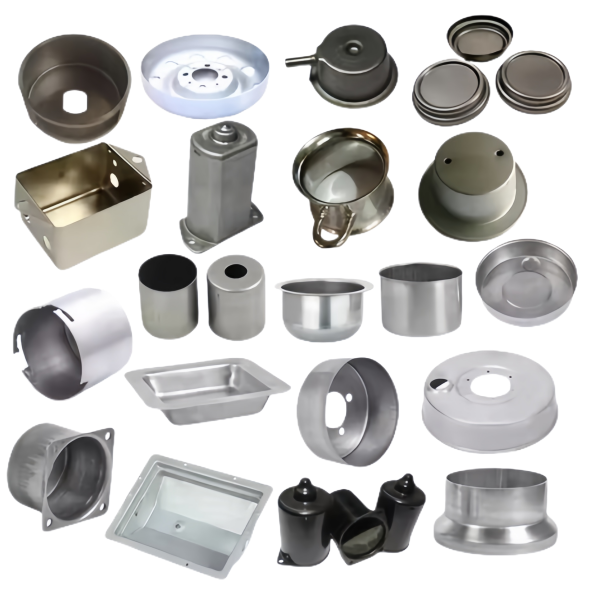
An assorted order of deep drawn shells, covers and trays is not eight products, it is one programme with eight shapes. The saving comes from sharing tooling inserts, material and setups across the family, but the risk is that a mixed shipment drifts part-to-part. We run these as a single controlled lot so the shells, covers and trays that ship together were made under one process record, not eight disconnected ones. This page explains how we keep an assorted family both cheap and consistent, which is harder than it sounds because the shapes pull against each other in the press.
Running a mixed family from shared tooling inserts
Most of an assorted family shares a blank diameter, a draw stage count and a trim philosophy even when the final shapes differ. We build a common die base and swap the punch-and-die inserts per shape, so the expensive guide and bolster are amortised across the whole family. A cover and a tray that share a 60 mm blank can run on the same base with a different insert in minutes, which is the entire economic case for ordering them together rather than as separate jobs.
We map the family on a single process sheet that lists every insert and its setting, so a change of shape is a documented swap, not a new job, and a setter cannot accidentally run last week’s offset on this week’s insert. Common inserts are kept under the programme number, not the individual part number, so a cover re-order reuses the same steel. Where two shapes truly cannot share an insert we say so and price the extra insert, rather than forcing a poor shared geometry that makes both parts worse.
- We map the family on a single process sheet that lists every insert and its setting, so a change of shape is a documented swap, not a new job.
- Common inserts are kept under the programme number, not the individual part number, so a cover re-order reuses the same steel.
- Where two shapes truly cannot share an insert we say so and price the extra insert, rather than forcing a poor shared geometry.
- We schedule the shape changes so the press never sits cold waiting on an insert that is still being dressed.
Flatness discipline for shallow trays and covers
Shallow trays and covers are where flatness bites: a 1 mm draw with a 120 mm flange will oil-can if the blank holder is uneven, and a warped tray will not stack. We hold flange flatness to 0.15 mm by balancing holder pressure and by trimming after the final restrike, never before, because trimming a stressed part lets it spring into a shape the drawing never allowed. The restrike is what locks the flatness in; the trim is just the cleanup.
Trays are flatness-checked on a surface plate with feeler gauges at first article and by a go/no-go fixture on the line. For nesting trays we control the rim squareness so a stack of fifty does not lean, which customers discover only when the stack topples in transit and a hundred trays scatter. Covers that bolt down are given a slight pre-load flatness so the gasket compresses evenly rather than pinching at one corner, because a corner pinch is a leak the customer blames on the gasket, not on the cover’s flatness.
- Trays are flatness-checked on a surface plate with feeler gauges at first article and by a go/no-go fixture on the line.
- For nesting trays we control the rim squareness so a stack of fifty does not lean, which customers discover only when the stack topples in transit.
- Covers that bolt down are given a slight pre-load flatness so the gasket compresses evenly rather than pinching at one corner.
- We trim after the restrike, never before, because trimming a stressed part lets it spring out of flat.
Why a kit of shells is quoted as one programme
Quoting each shape alone hides the real cost and the real saving. We quote the assorted family as one programme with a shared setup fee, because the press changeover between shapes is minutes, not hours, when they share a base. The unit price per shape then reflects only its extra insert and its material weight, which is the honest way to show the customer where the money goes.
Call-off schedules work well here: we cut all inserts once, then draw the family in the mix the customer releases, keeping one heat of material for colour match across the set. We flag any shape whose volume is too low to justify its insert, and propose dropping it to a machined or purchased item instead, because a shape that runs fifty pieces a year does not earn its insert and the customer pays for idle steel. The programme view lets us have that conversation before the toolroom cuts anything.
- The quotation lists each shape with its own unit price but a single combined tooling line, so the customer sees where the money goes.
- Call-off schedules work well here: we cut all inserts once, then draw the family in the mix the customer releases, keeping one heat of material for colour match.
- We flag any shape whose volume is too low to justify its insert, and propose dropping it to a machined or purchased item instead.
- We hold the combined setup fee flat across the family, so adding a low-volume shape costs only its insert, not a whole new setup.
Material pooling across an assorted order
When the family runs in SPCC or 304, we buy one coil for the whole order so every shell and tray comes from the same heat and the same temper. That matters for finish: a zinc plate or a passivate looks identical only when the substrate is identical, and a finish colour mismatch across an assorted kit is visible the moment the parts sit together on a bench. Pooling also cuts the scrap that comes from setting up eight separate coil ends.
We log the single heat number across all shapes in the job card, so a finish complaint can be traced to one substrate rather than a guess at which shape drifted. Gapless nesting of the different blank shapes on the coil is planned per order to lift yield above what eight separate runs would achieve. Where one shape needs 316 and the rest need 304, we split the pool and label the 316 parts so they never get the wrong passivation bath, because a 316 part run through a 304 bath is a compliance failure nobody can see until it pits.
- We log the single heat number across all shapes in the job card, so a finish complaint can be traced to one substrate.
- Gapless nesting of the different blank shapes on the coil is planned per order to lift yield above what eight separate runs would achieve.
- Where one shape needs 316 and the rest need 304, we split the pool and label the 316 parts so they never get the wrong passivation bath.
- We confirm the temper is identical across the pooled coil, because a temper shift changes how the draw lands and how the finish looks.
Traceability when one shipment holds ten shapes
A mixed carton is a traceability trap: if one tray is wrong, which ones are safe? We pack assorted orders with a single lot label that ties every shape in the box to one process record and one inspection, so a field issue can be isolated to the lot, not guessed shape by shape. Each shape carries its own part number etched or labelled, but the outer carton carries the shared lot and heat, which is the unit a quality auditor actually opens.
The first-article report covers every shape in the family, with a separate dimensional line per shape, not one averaged number that hides a single bad tray behind nine good ones. We keep the retained samples of all shapes from the lot together, so a comparison years later still has the matching set, which has saved more than one customer from a mystery drift in an old programme. Traceability on an assorted order is not bureaucracy; it is the only way the kit stays a kit.
- Each shape carries its own part number etched or labelled, but the outer carton carries the shared lot and heat.
- The first-article report covers every shape in the family, with a separate dimensional line per shape, not one averaged number.
- We keep the retained samples of all shapes from the lot together, so a comparison years later still has the matching set.
- The lot label, job card and retained samples all carry one number, so an audit closes in minutes rather than days.
How we verify an assorted shells and trays batch
Verification for a mixed family is stricter than for a single part, because a miss on any one shape spoils the kit. We verify the lot, not just samples of the biggest piece, and we release only when every shape in the lot passes its own line.
- Dimensional first article on every shape in the family, each with its own CMM line.
- Flatness check on every tray and cover using the plate and go/no-go fixture.
- Material heat confirmed once for the pooled coil and recorded across all shapes.
- Finish thickness and adhesion checked on a representative piece of each shape that carries the finish.
- Lot labelling verified so the carton, the job card and the retained samples all share one number.
- Pack-out audit counting each shape against the order mix before the carton is sealed.
If you are comparing this part with a machined or welded alternative, the guide to deep drawn covers lays out where drawing wins, where it loses, and what it costs either way.
Specifications
| Item | Assorted Deep Drawn Shells Covers and Trays |
|---|---|
| Brand | AUNOV |
| Designing | Send the drawing, or a sample we can measure, our engineers reply with a manufacturability assessment and pricing. |
| Tooling | Tooling designed and cut in house, held and maintained under your part number. |
| Samples | Sample parts arrive with a full dimensional report and material certification. |
| Materials | Stock covers carbon steel (SPCC / DC01), 304 / 316 stainless steel, aluminium, brass and copper, and the grade is fixed at the drawing review. |
| Surface finish | Finish options: plating, e-coat, powder coating, anodising or passivation, per your print. |
| Processing | Progressive deep draw stages with in-line annealing as the draw ratio demands, pierced and finish-machined on the same floor. |
| Equipment | Mechanical presses 5-250 T and hydraulic presses 250-500 T, CNC turning centres and a climate-controlled CMM room. |
| Tolerance | As-drawn tolerance +/-0.1 mm, +/-0.03 mm on machined features. |
| Delivery terms | Prices FOB, with DDP for EU and US on request, T/T and L/C; D/P on repeat accounts, scheduled call-offs welcome. |
Frequently Asked Questions
How can a mixed family run from shared tooling?
Most of a family shares a blank diameter, draw stage count and trim philosophy; a common die base with per-shape punch-and-die inserts amortises the expensive guide and bolster across all shapes. A cover and tray on one base swap inserts in minutes.
Why is flatness discipline important for shallow trays and covers?
Shallow parts live or die on flatness and flange squareness, which a trim that locates off the wrong datum can undo. Flatness is specified and checked on the first article rather than assumed from the dimension report.
How is traceability kept when one shipment holds ten shapes?
A single process sheet lists every insert and its setting, inserts are kept under the programme number, and a change of shape is a documented swap. Material is pooled by grade with the batch record following the shipment.
How is an assorted shells-and-trays batch quoted and verified?
The kit is quoted as one programme rather than ten jobs, with CMM first articles confirming each shape. The typical minimum order is 1,000 pieces with a 24-hour quotation.
Related Products


Request a Quote for This Part
Send a drawing or sketch — get material advice, tooling cost and a per-piece price within 24 hours (working days).