
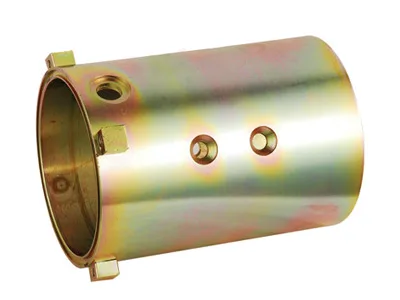
A cylinder can is the workhorse shape of deep drawing
The deep drawn cylinder can – a plain closed-end or open cylindrical shell – is the shape against which every drawing shop calibrates its capability. It has no corners, no flanges, and no features to hide behind: either the die makes a round, straight, uniform-wall cylinder or it does not. Because it is so simple, it is also the shape on which process engineering has the most leverage, and that is why we treat cylinder cans as a family with its own rules.
This page is about the process route and the production economics of cylinder cans – how many draws a can needs, how wall thickness behaves, and where the cost actually sits at volume.
How many draws does a can need?
The number of drawing operations is set by the total draw ratio – blank diameter divided by finished diameter – and by the material’s formability:
| Total ratio ≤ 1.8-2.0 | Single draw. Typical for shallow cans and for the more formable aluminium grades. |
|---|---|
| Ratio 2.0-3.5 | Two draws, with the second (redraw) reducing the diameter further. Most motor and pump cans fall here. |
| Ratio 3.5-5.0 | Three draws; austenitic stainless steel tolerates this without an anneal, ferritic grades generally do not. |
| Ratio > 5.0 | Multiple draws with inter-anneals between passes; the part usually becomes a tube-drawing job rather than a cup job. |
The practical reduction limits we work to for each pass: about 45-50% area reduction on the first draw for stainless steel, and 25-35% on subsequent redraws. Push a redraw past that and the wall thins, ears appear, or the base tears. These are not arbitrary numbers – they come from the material’s strain-hardening behaviour, and they are why a part that looks trivial on a drawing can need three operations.
Wall thickness: what the process actually delivers
A drawn cylinder does not have a single wall thickness; it has a profile. Along the wall, thickness typically thins from the base toward the open end, and the amount is governed by die clearance and by how the material slides over the punch:
- Die clearance is set as a percentage of sheet thickness – commonly 8-12% per side for stainless steel. Too little clearance ironing-thins the wall and over-works the surface; too much lets the wall wrinkle or the diameter drift.
- Blank-holder force controls how much material is drawn in versus stretched. Higher force improves flatness of the base and reduces wrinkling but thins the wall; we tune it to hit the customer’s thickness band, not to a nominal.
- Punch nose radius should not fall below about 2× thickness for stainless steel; below that the base fractures.
Because thickness is a distribution, we specify it as a band and a profile rather than a single number, and we verify by sectioning samples – the only honest way to know what the die is doing.
Earing, wrinkles, and the defects a cylinder reveals
Three defects are characteristic of this shape and tell you a lot about process control:
- Earing – a scalloped rim from planar anisotropy in the rolled strip. If the customer needs a square rim, the ear must be trimmed after drawing; controlling strip texture reduces but rarely eliminates it.
- Wrinkling in the wall – from insufficient blank-holder force or too much clearance. It shows as a wavy wall and a loose diameter.
- Orange peel – surface roughening from a coarse grain structure stretched past its limit. A finer grain size keeps the surface smooth through heavy draws.
All three are visible on a sectioned or lit sample long before they reach the customer, which is why lot sampling on a cylinder can is both cheap and informative.
Where the cost sits
At volume, a cylinder can’s cost is dominated by material, not by machine time – a progressive die runs at tens of strokes per minute, so labour and press time per piece are small. The cost drivers, in order:
- Material grade and utilisation. The blank layout on the strip sets how much metal is scrap; a well-nested layout can move cost more than any process change.
- Number of operations. Each additional draw adds tooling cost and a press stroke, and can force an anneal.
- Secondary features. A pierced base, a coined rim, or a formed flange each add a station, and stations add tooling and cycle time.
- Annual volume. The progressive die is a fixed cost; the higher the volume, the more it can be amortised, which is why the same part can be economic at 200,000 pieces and uneconomic at 20,000.
Tooling route: progressive die versus transfer
For a cylinder can at automotive volume, a progressive die running from coil is almost always right: it combines blanking, drawing, redrawing, trimming, and any piercing in one strip and delivers a finished part every stroke. For lower volume or large cans, a transfer press or single-station tooling with manual handling is more sensible, because a progressive die cannot be justified. We recommend the route based on the annual volume and the can size, and we will say plainly when a progressive die does not pay.
Uniformity, and what we actually deliver
Can you make a can with a perfectly uniform wall? No drawn can is perfectly uniform; we deliver a controlled profile within a band and give you the sectioned data so your design accounts for it.
How deep can a single-draw can go? About 1.5× diameter for stainless steel, a little more for aluminium. Beyond that it is a redraw part.
Do you anneal between draws? Only when the ratio or the material demands it; austenitic stainless steel often goes three passes without one, ferritic and some aluminium grades need a stress relief sooner.
How do you hold the diameter over a long can? Through die clearance control and, for long cans, a guided redraw punch plus a final sizing pass.
Specifying a cylinder can
Give us the finished diameter, length, wall thickness band, base and rim conditions, material grade, and annual volume. With those we can pick the number of draws, set the die clearance and blank-holder strategy, choose the tooling route, and quote honestly – including telling you when a simpler part geometry would save you money without changing the function.
The engineering calls behind a part like this — draw ratio, wall thinning, radii and trim — each get worked examples in our deep drawn covers guide; the Precision Deep Drawn Parts pages gather the rest of the family.
Specifications
| Item | Deep Drawn Cylinder Can |
|---|---|
| Brand | AUNOV |
| Designing | Quotation follows the print, not a catalogue – unusual walls, threads or tolerances are feasibility-checked first; the same drawing is used for every repeat order. |
| Tooling | Our toolroom covers die design, wire-cut EDM and maintenance, so a die can be re-cut against the approved drawing, and the die remains dedicated to your part. |
| Samples | Production does not start until the sample report has been signed off. |
| Materials | Carbon steel (SPCC / DC01), 304 / 316 stainless steel, aluminium, brass and copper – the grade is matched to the duty of this can. |
| Surface finish | Zinc, nickel or chrome plating, anodising, passivation or e-coat; masking and laser marking available where needed. |
| Processing | Coil blanking and progressive drawing, coining on the final station where the print calls for it; first articles verify the whole flow before the run is released. |
| Equipment | Press shop running 5-250 T mechanical and 250-500 T hydraulic presses, annealing ovens on site, with CNC turning centres for secondary operations and CMM inspection. |
| Tolerance | +/-0.05 mm on drawn diameters, tighter bands confirmed against the drawing; capability is checked on the first article before the run continues. |
| Delivery terms | CIF or DDP, with FOB available, payment by T/T, L/C at sight or D/P; repeat orders reuse the approved first article. |
Frequently Asked Questions
How many draws does a cylinder can take before it needs annealing between them?
It follows the total reduction from blank to finished can. Shallow cans come out in one reducing operation, but past roughly two diameters of depth the accumulated work hardening leaves too little ductility to continue, and the material has to be softened before the draw resumes. Annealing restores formability at the cost of a furnace pass and cleaning, so where volume justifies it the alternative is choosing a starting temper that tolerates more work. Either way, the stage plan is set from the geometry rather than discovered on the shop floor.
Can earing be eliminated, or only budgeted for?
Only budgeted for. Earing comes from directional properties in the rolled sheet, so material travels further in some directions than others and the rim arrives scalloped instead of level. Grain control and blank orientation reduce it, but the practical answer is trim allowance: enough height above the finished line that the ears are removed rather than measured. That allowance costs material on every part, which is why it appears in costing as yield rather than on the drawing as a tolerance.
Progressive die or transfer die – what decides it?
Volume, and how freely the part can move. A progressive die carries the part on a strip from station to station, which suits high volume, keeps handling out of the process and holds concentricity well, but limits what shapes can be formed between stations. A transfer die moves separate blanks between presses or stations, permitting redrawing, annealing between stages and forms that cannot stay attached to a carrier. The tooling spend amortises very differently, so the same part can be economic at 200,000 pieces and uneconomic at 20,000 purely because of the route it needs.
Why is a plain cylinder often used to judge a drawing supplier’s real capability?
Because there is nowhere to hide. A cylinder has no corners, flanges or features to absorb error, so concentricity, wall distribution and consistency are all visible in the finished part. Drawn diameters are routinely held inside +/-0.05 mm on this kind of geometry, and a shop that cannot demonstrate that on a simple can will not do better on something complicated.
Related Products



Request a Quote for This Part
Send a drawing or sketch — get material advice, tooling cost and a per-piece price within 24 hours (working days).