
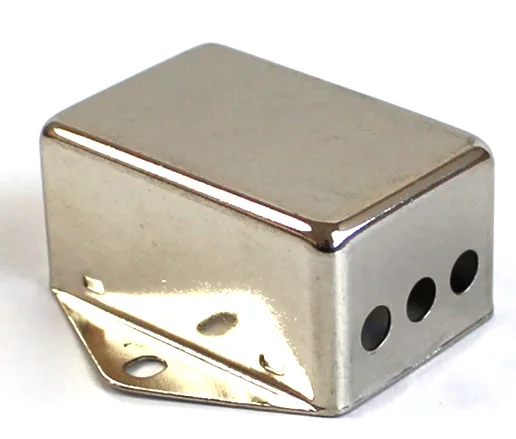
Custom stainless steel and aluminium deep drawn parts for industrial equipment
Industrial machinery is where deep drawing quietly earns its keep: pump and valve internals, bearing housings, wear caps, sensor pockets, hydraulic accumulators, conveyor components – parts that live with vibration, abrasion, wash-down and years of duty cycles. This page covers how we run custom drawn stainless steel and aluminium parts for industrial programs, where the requirements are less about appearance and almost entirely about consistency across large volumes and long service lives.
The two metals divide the work naturally. Stainless Steel (304, 316L, 430) takes the wet, chemical and food-adjacent duties. Aluminium (3003, 5052, 6061-compatible designs) takes the weight-sensitive, thermally active and corrosion-tolerant duties. Most industrial customers run both in the same machine – and both from the same supplier, so tolerance philosophy matches across the build.
What industrial duty changes about the part
A consumer part fails when it stops looking good. An industrial part fails when a tolerance drifts, a wall thins below fatigue margin, or a surface wears past a seal. So the engineering questions we ask at RFQ are specific:
- Duty cycle and load path. A housing that sees 10 million pressure cycles needs a fatigue-minded design: generous radii, ironed walls, no drawn feature that becomes a crack initiator. We size radii against the cycle count you state.
- Media and temperature. 316L below 60 °C for chlorides; 304 to 300 °C; aluminium only where temperature stays under about 150 °C continuous. State the media, not just “water” – glycol, brine and cleaning chemicals each change the grade.
- Assembly force. Press-fit shells get sized ODs (±0.05 mm) and a roundness commitment; bolted flanges get coined faces. The fit concept decides which tolerances matter, and we ask about it before quoting.
- Field service. Parts a technician will remove get curled rims and marked orientations; parts welded in place get weld-grade material with controlled sulphur so the seam behaves.
Volume flexibility without quality drift
Industrial demand is lumpy: a machine program runs 400 units a month for two years, then doubles for a launch. Our tooling answer is to build the die for the end volume and run it at whatever rate the year needs – hard tooling at 400 a month costs barely more per piece than at 1,200, and the parts are identical. For genuinely small programs, the soft-tooled prototype route carries the design until volume justifies hard dies. What we do not do is quote a soft-tooled part and quietly substitute it for the hard-tooled one later; the route is named on the drawing and the purchase order.
Traceability matters at industrial scale because the customer’s quality system audits ours: coil heat numbers through EN 10204 3.1 certificates into the shipping documents, SPC charts on key characteristics available on request, and PPAP documentation where the machine is safety-relevant.
Secondary operations under the same roof
Industrial parts are rarely finished at the press. In-house: CNC turning and milling for bearing seats, seal grooves and threaded ports; piercing and coining in-die; welding of bosses and brackets where assembly demands it; surface treatment through long-term partners – e-coat, powder, zinc-nickel plating, anodising, passivation. Consolidating the chain means one PO, one quality system, and no finger-pointing between a drawing vendor and a machining vendor when a fit is off by 0.1 mm.
Representative industrial parts we draw
- Hydraulic cartridge valve shells in 304, sized and honed for seal fits.
- Conveyor roller end caps and bearing cups in SPCC, zinc-plated, millions per year.
- Pump wear rings and thrust washers in 316L for chemical duty.
- Pneumatic cylinder end caps in aluminium 6063-compatible designs, anodised.
- Sensor pockets and thermowell protectors in 316L, drawn deep with closed domed ends.
Tolerances we commit to on industrial work
- Formed dimensions ±0.10 mm as-drawn, ±0.05 mm sized.
- Machined fits ±0.02-0.03 mm with roundness 0.01 mm where seals run.
- Flange flatness 0.1 mm coined; gasket faces Ra 1.6 µm or better.
- Wall thickness: nominal per drawing, minimum stated on the quote, verified by ultrasonic sampling per AQL.
Questions industrial buyers ask us
Can you hold our program through a material substitution?
Yes, and we engineer it: substituting 304 for 430, or steel for aluminium, changes the draw sequence and sometimes the coatings – we re-run the formability review and present the comparison before you approve the change, not after production starts.
How do you handle a part that is deep and also needs tight machined features?
Draw it to tolerance, then machine the critical features in-house on the same floor. The quotation shows the two operations separately so you can see exactly what the machining buys.
What happens when our volumes triple next year?
The die was designed for it. Rate changes are a scheduling matter, not a re-engineering matter – that is the point of building hard tooling for the end state from the start.
Duty, load cycles and volume – what we need first
Send drawings, the duty description (load cycles, media, temperature), and annual volume. The quotation names the material route, die sequence, committed tolerances and certificate package – the full engineering basis, with tooling cost separated from piece price.
Not sure whether to draw, machine or weld this geometry? The guide to deep drawn covers compares the three routes and shows where each one wins; the full Precision Deep Drawn Parts range is linked from the overview page.
Specifications
| Item | Deep Drawn Enclosure Box with Side Flange Holes |
|---|---|
| Brand | AUNOV |
| Designing | Quotation follows the print, not a catalogue – a manufacturability review comes back with the quotation; the approved drawing is kept as the controlled master. |
| Tooling | Tooling is built and held under your part number, so die cost stays transparent, and ownership is confirmed on the quotation. |
| Samples | Free samples are available on standard items, with reports attached. |
| Materials | Standard stock: carbon steel (SPCC / DC01), 304 / 316 stainless steel, aluminium, brass; mill certificates and heat numbers accompany the first article. |
| Surface finish | Surface treatment matched to the duty: plating, coating or polishing; the agreed finish travels with the part number. |
| Processing | Deep drawing on maintained presses, blank size and lubrication logged per run; in-process checks sit between stages, not only at the end. |
| Equipment | Mechanical presses 5-250 T plus 250-500 T hydraulics, with in-line annealing, with in-house toolmaking to keep dies and fixtures maintained. |
| Tolerance | +/-0.05 mm on drawn diameters, tighter bands confirmed against the drawing; finer bands confirmed from capability data before quoting. |
| Delivery terms | FOB Ningbo or Shanghai, payment by T/T or L/C, quoted in USD or EUR; repeat orders reuse the approved first article. |
Related Products



Request a Quote for This Part
Send a drawing or sketch — get material advice, tooling cost and a per-piece price within 24 hours (working days).