
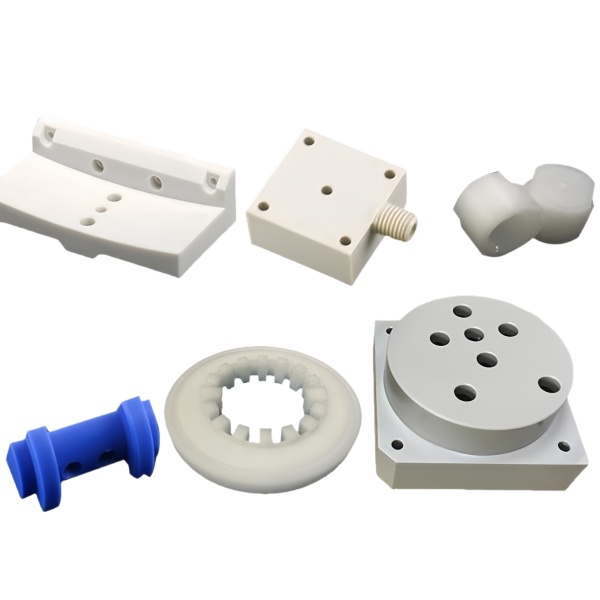
Nylon’s moisture absorption makes it the only common engineering plastic that changes size in service
A machined nylon part—a gear, a plate, a guide, a wear strip—absorbs moisture from the air continuously until it reaches equilibrium with its environment: up to 2.5–3 % by weight at 50 % relative humidity, more in direct water contact. The absorbed water swells the polymer: roughly 0.3–0.5 % linear growth at 50 % RH equilibrium, up to 1 % or more in water. On a 100 mm gear’s pitch diameter, that is 0.3–1.0 mm of dimensional change after machining—enough to close a running clearance that was correct when the part left the dry machine shop.
We manage this at two levels. In machining: parts are roughed, stress-relieved (2 hours at 80 °C or 24 hours ambient), then finish-machined—stabilizing what we can before the final cut. In design: for any nylon part with a functional fit (gear bore, guide rail clearance), we either machine the part at its service-moisture condition (condition the blank at 50 % RH for 48–72 hours before final machining, so the finished part is already at service size) or design the clearance for the fully swollen condition. For customers who cannot tolerate the drift at all, we propose acetal (POM) as the substitute: 0.2 % moisture absorption, dimensionally stable, at a modest loss of toughness.
Plastic gear tooth loading is limited by root stress and temperature, not by wear
A machined plastic gear fails by tooth root fatigue or by softening from frictional heat long before it wears out its tooth flanks. The frictional heat point deserves the attention: a nylon gear meshing at moderate speed generates heat at the tooth contact faster than the gear’s bulk can dissipate it, and nylon’s strength drops by roughly half between 20 °C and 100 °C. A gear that runs quietly for ten minutes can begin to deform at tooth twenty-five.
We calculate tooth root stress per standard gear formulas but with polymer allowables (bending stress limits 15–40 MPa depending on grade, versus 200+ MPa for steel), and we flag designs where the calculated tooth temperature rise—using the gear’s mesh power loss and the material’s thermal conductivity (nylon ≈ 0.25 W/m·K, 200× worse than steel)—exceeds 30 °C above ambient. Above that margin, the design needs either a lower mesh load, lubrication (even occasional grease extends polymer gear life dramatically), or a material upgrade (cast nylon with internal lubricant, or PEEK for high-temperature meshes).
Machining plastic plates without melt marks is a feeds-and-speeds discipline
A machined plastic plate—carrier plate, insulator, fixture sub-plate—shows its machining quality on every visible surface. Melt marks (smears of re-solidified plastic where the tool rubbed instead of cutting) come from too-slow feeds or dull tools generating heat above the plastic’s softening point: nylon softens around 200 °C but local rubbing heat crosses that easily with a dull tool at low feed.
Our parameters for unfilled nylon and acetal: sharp carbide (or better, high-rake HSS for one-off work), generous feed per tooth (0.1–0.2 mm), moderate surface speed, and air blast instead of coolant for most cuts (coolant is fine for nylon and acetal, but air keeps chips dry and avoids the micro-cracking that some coolants induce in stressed plastics). Depths of cut are limited to 1–2 mm for finishing passes. The visible result: surfaces that look injection-molded, with no white stress marks at edges and no smeared corners.
Press-fitting metal inserts into plastic plates: the boss rules from plastics, not metals
When a plastic plate carries metal inserts (threaded bushings, dowels), the plastic boss around the insert carries the entire press-fit expansion load. The rules come from plastic design: boss OD at least 2× the insert diameter, the boss’s wall free of weld lines or gate marks (in machined-from-plate parts, free of any drilled-through defects), and the press-fit interference kept light (0.02–0.05 mm) because plastic’s modulus is 1/100th of metal’s—the same interference that a metal boss shrugs off will split a plastic boss.
For higher retention, we use knurled or hex-body inserts designed for plastics (the knurls bite the plastic and mechanically lock, so retention does not rely on hoop stress alone), and we recommend ultrasonic or heat insertion where the customer’s assembly process supports it. A straight press-fit knurled insert into a machined plastic bore holds 2–3× the torque of a smooth insert at the same interference.
How we verify machined plastic and nylon parts before shipping
- Dimensional after stabilization: All functional dimensions measured after the parts have rested post-machining (24 hours minimum for nylon, to let absorbed machining-related stresses and any moisture conditioning equilibrate).
- Gear parameters: Measurement over pins for tooth thickness, runout on an arbor (0.05 mm TIR typical for machined polymer gears), and a mesh check with a master gear at first article—roll feel and backlash both recorded.
- Visual: No melt marks, no white stress crazing at holes and edges, no chatter on faces. Color uniform for black parts (gray streaks indicate machining heat).
- Insert retention (if applicable): One part per 50 pulled/torqued to spec: insert must not move; boss must not crack (10× inspection after test).
- Material verification: Density or burn test per lot where the grade matters (nylon vs. acetal mix-ups are invisible to the eye but behave oppositely in moisture).
CNC Machining Parts is the parent range for parts like this one; the overview page gathers the tooling logic, finishing options and tolerance notes that apply across the family.
Specifications
| Item | Machined Plastic and Nylon Parts with Plates and Gears |
|---|---|
| Brand | AUNOV |
| Designing | Share your print, or send a part to be measured, DFM feedback is returned with the quote. |
| Tooling | Dies designed and built in our own toolroom, each die held against your part number. |
| Samples | Sample parts arrive with a dimensional report and material certificate. |
| Materials | Carbon steel (SPCC / DC01), 304 / 316 stainless steel, aluminium, brass and copper, with the final grade confirmed at the drawing review. |
| Surface finish | Finish options: plating, e-coat, powder coating, anodising or passivation, as called out on your print. |
| Processing | Staged deep drawing with in-line annealing where needed, pierced and finish-machined on the same floor. |
| Equipment | 5-250 T mechanical presses plus 250-500 T hydraulic presses, in-house CNC cells and a temperature-controlled inspection room. |
| Tolerance | As-drawn tolerance +/-0.1 mm, machined features held to +/-0.03 mm. |
| Delivery terms | Prices FOB, with DDP for EU and US on request, payment T/T or L/C, D/P for repeat accounts, call-off scheduling supported. |
Related Products



Request a Quote for This Part
Send a drawing or sketch — get material advice, tooling cost and a per-piece price within 24 hours (working days).