
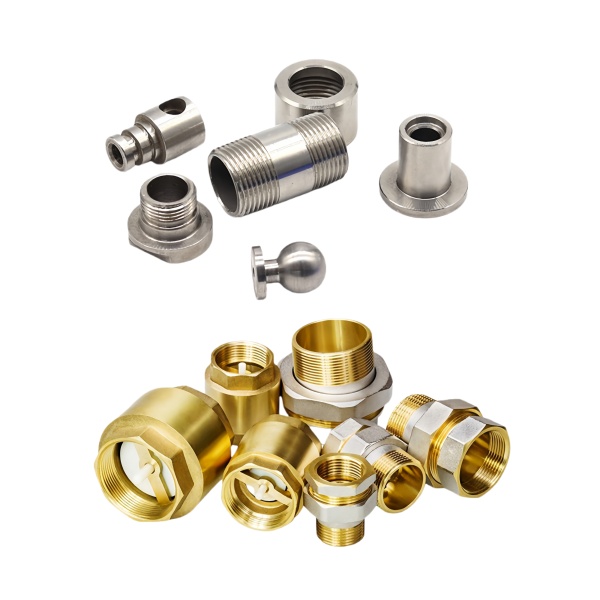
In a mixed brass-and-steel fittings order, the routing card is the quality system
An assorted fittings order—brass and steel, multiple thread standards, dozens of part numbers—has one dominant quality risk: the wrong part in the right bag. Brass looks like brass across part numbers; steel looks like steel; and a 1/4 NPT steel nipple installed where a 1/4 BSPT brass nipple was intended neither seals nor comes out cleanly.
Our production control runs on per-part-number routing cards: each card travels with its batch through the shop, records the machine setups, and terminates at a kitting station where every bag is filled against the card, weighed (bag + parts against a computed expected weight—brass and steel differ by ~15 % density, so weight catches alloy mix-ups even when geometry doesn’t), and labeled. The kit’s total part count is verified against the PO line-by-line before the box closes. This is unglamorous, and it is why assorted orders ship right.
Brass and steel versions of the “same” fitting are not interchangeable, and the drawing should say so
Customers often request one fitting design in both alloys to evaluate or to serve two environments. The two versions are not the same part in different colors: the steel version can be made thinner-walled (3× the strength) or kept identical for envelope compatibility, and the choice changes pressure ratings, torque values, and corrosion behavior. Identical geometry in the two alloys yields two different fittings in every functional sense except dimensions.
When we build dual-alloy lots, each version gets its own drawing revision (with its own pressure rating and torque table), its own material certificate set, and alloy identification is machined into each part (laser or dot-peen alloy code on the hex). The kit documents list the two versions on separate lines with explicit “not interchangeable” notes—experience says that without the note, somebody downstream will treat the steel version as an upgrade drop-in for the brass and torque it like brass, stripping the softer part.
Thread standards across an assortment: NPT, BSPT, and metric must be segregated at gauging
A mixed fitting lot that spans thread standards is a gauging trap: a 1/4 NPT ring gauge will nearly fit a 1/4 BSPT fitting (same nominal size, different pitch and taper), and a hurried gauge pass can wave a wrong-standard fitting through. NPT (27 TPI, 1°47′ taper) versus BSPT (19 TPI, 1°47′) differ in pitch by 40 %—the gauge will bind after two threads, but “binds after two threads” reads as “tight” to a tired inspector.
Our gauging station keeps thread standards in physically separate, color-coded gauge boxes, and each routing card lists its parts’ thread standard in a box that the inspector initials. Mixed-standard kits are gauged standard-by-standard, never intermixed on the bench. The first-article for each part number gets an optical comparator check of thread form and pitch as the authoritative verification.
Surface treatment segregation: plated steel parts and bare brass parts cannot share a bag
Steel fittings in an assortment usually carry zinc or nickel plating for corrosion protection; the brass fittings are bare (or lacquered). Plated and bare parts in direct contact in one bag is a cosmetic defect factory: the plating’s chemistry residues and edge sharpness mark the brass surfaces during transit.
We bag plated steel and bare brass in separate inner bags within the kit, with VCI (vapor corrosion inhibitor) paper in the steel bags (bare steel in a sealed bag with any moisture rusts; VCI prevents it for 12+ months in storage). The kit drawing shows which line items live in which inner bag, so the customer’s kitting or assembly stations can locate parts without opening everything.
How we verify an assorted fittings order before shipping
- Per-part-number verification: Each line item gauged per its own routing card—threads (go/no-go, correct standard’s gauge), hex sizes, lengths, and material certification on file.
- Alloy verification: Weight check per bag against computed expected weight (catches brass/steel mix-ups); spot conductivity or spark testing where a mix-up is suspected.
- Kit completeness: Line-by-line count against the PO; each bag’s label carries part number, alloy, thread standard, quantity, and PO line reference.
- Documentation: Consolidated CoC listing every line item with its material cert reference; a photo reference sheet (each part against a scale) for the customer’s receiving inspection; torque/ pressure data for any line item that carries a rating.
CNC Machining Parts is the parent range for parts like this one; the overview page gathers the tooling logic, finishing options and tolerance notes that apply across the family.
Galvanic isolation when brass and steel share an assembly
An assortment that mixes brass and steel fittings will, if installed together in a wet environment, set up a galvanic cell that eats the less noble metal. We call this out in the kit documentation and, where the service is wet, recommend isolation washers or a dielectric compound at the joint. The point is not to avoid mixing the two in one order, which is often convenient, but to make sure the buyer knows the joint needs a barrier. We would rather flag the risk on the print than ship a mixed kit that corrodes in the field and gets blamed on the parts.
Telling them apart in the bin
Brass and steel fittings that look alike in a tote get separated by marking or by a physical difference we build into the shape, because a line that grabs the steel part for a brass-only joint has a problem the inspection note cannot catch. We color-code the packaging and, where the geometry allows, give the two versions a distinct flat or shoulder so they cannot be swapped by feel. Identification that survives the bin is worth more than a perfect drawing that gets ignored on the bench.
Specifications
| Item | Brass and Steel CNC Machined Fittings Assortment |
|---|---|
| Brand | AUNOV |
| Designing | Share your print, or send a part to be measured, you get a DFM review together with the quotation. |
| Tooling | Every die designed and built in our toolroom, held under your part number. |
| Samples | Approval samples of the fitting ship with a dimensional report and material certificate. |
| Materials | Brass leads the stock list for this part, alongside carbon steel (SPCC / DC01), 304 / 316 stainless steel, aluminium and copper, with the final grade confirmed at the drawing review. |
| Surface finish | Surface treatment per the drawing: plating, e-coat, powder coating, anodising, passivation, selected against the drawing requirement. |
| Processing | Staged deep drawing with in-line annealing where needed, then pierced and machined in house. |
| Equipment | Our press floor runs 5-250 T mechanical and 250-500 T hydraulic presses, CNC turning and milling cells, a climate-controlled CMM room. |
| Tolerance | As-drawn tolerance +/-0.1 mm, with machined features to +/-0.03 mm. |
| Delivery terms | Standard terms FOB, DDP offered to EU and US, T/T and L/C; D/P on repeat accounts, blanket orders and call-offs supported. |
Related Products


Request a Quote for This Part
Send a drawing or sketch — get material advice, tooling cost and a per-piece price within 24 hours (working days).