
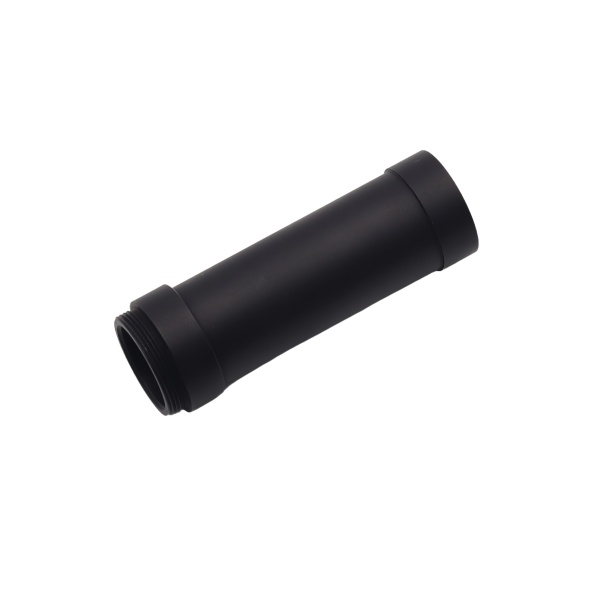
Polymer selection for a protective sleeve is driven by wear mode and temperature, not just appearance
A black polymer CNC machined protective sleeve is a close-tolerance bushing turned from stock polymer rod or plate to protect a shaft, cable, sensor, or fitting from wear, impact, and contamination. A black polymer protective sleeve—a cover that shields a shaft, cable, sensor, or fitting from impact, abrasion, and contamination—must survive the specific wear environment it will encounter. “Black plastic” on a drawing gives the manufacturer latitude that can lead to premature failure if the wrong polymer is chosen.
The common candidates and their sweet spots:
- Acetal / POM (black): The default choice for machined sleeves. Low friction (µ ≈ 0.2 against steel), good dimensional stability (absorbs < 0.2 % moisture), stiffness adequate for press-fit retention. Continuous service temperature 100 °C. Machines beautifully—chips break clean, tolerances of ±0.02 mm are routine.
- Nylon / PA66: Better impact toughness than acetal but absorbs moisture (up to 2.5 % by weight) and swells ~0.5 % linearly in humid service—bad for a sleeve that must retain a precise bore. Choose only when impact resistance outranks dimensional stability, or specify glass-filled PA66-GF30 which absorbs less.
- PEEK: For temperatures to 250 °C, aggressive chemicals, or sterile/autoclave service. 10–20× the material cost of acetal; machining requires sharp carbide and patience (it work-hardens locally and melts if feeds are too low). Reserve for genuinely demanding applications.
- PTFE: The lowest friction available but soft—creeps under sustained clamp load and is a poor choice for a sleeve that must hold position mechanically. Used where non-stick or chemical inertness dominates.
Machining-induced stress in polymers causes dimensional drift days after the part passes inspection
Polymers, unlike metals, creep and relax residual stresses at room temperature. A protective sleeve machined aggressively—heavy cuts, dull tools, insufficient coolant—carries locked-in stress from the deformed surface layers. Over the following days, the stress relaxes and the part moves: a bore that measured 20.00 mm on Thursday can measure 19.96 mm the following week as the surface layers relax and close the bore.
We control this in two ways. First, machining parameters: sharp tools, moderate feeds, and air blast or coolant to keep cutting temperature well below the polymer’s heat-deflection point (for acetal, keeping the cut below 60 °C prevents local softening). Second, a stress-relief stabilization: parts rest a minimum of 24 hours at room temperature (or 2 hours at 80 °C for accelerated relief) before final dimensional inspection. Only dimensions measured after stabilization are recorded on the inspection report—measurements taken fresh off the machine are provisional.
The fit between the sleeve and the component it protects determines retention and removability
A protective sleeve typically slides over the protected component (a slip fit) or presses on (light interference, 0.02–0.10 mm on typical diameters). The design tension is between retention (the sleeve must not fall off in service, especially under vibration) and removability (the sleeve must come off for maintenance without tools that damage the protected surface).
For a slip-fit sleeve that must resist vibration without adhesives, we specify the diametral clearance at the tight end of the practical range: 0.03–0.08 mm for diameters 10–50 mm. Below 0.03 mm, assembly becomes sensitive to alignment and thermal growth; above 0.08 mm, the sleeve rattles. For positive retention, a single circumferential internal groove with a mating O-ring (70 Shore A nitrile) on the protected component provides snap retention with clean removability—cheaper and more reliable than adhesives, which contaminate surfaces and impede re-installation.
UV and environmental exposure limits which black polymers survive outdoor service
“Black” comes from carbon black pigment in most engineering polymers—conveniently, carbon black is also an excellent UV stabilizer. A carbon-black-pigmented acetal or nylon retains most of its mechanical properties after years of outdoor exposure, whereas natural (unpigmented) grades embrittle within months.
The exceptions to know:
- POM (acetal): UV degradation is surface-limited (chalky appearance, loss of surface gloss) but mechanical properties degrade slowly. Suitable for outdoor use with the understanding that surfaces will dull; structural integrity holds for 3–5 years.
- PA66 (nylon): Combined UV + moisture exposure is the killer: UV embrittles the surface while moisture cycling cracks it. For outdoor use, specify UV-stabilized grades (with hindered amine light stabilizers added to the carbon black).
- PVDF / PTFE: Inherently UV-stable (used for architectural cladding and solar-panel backsheets). If the sleeve must survive 10+ years outdoors with no maintenance, PVDF justifies its 4–6× cost premium over acetal.
How we verify a machined polymer sleeve batch before shipping
Inspection protocol for polymer sleeves:
- Dimensional check after stabilization: Bore, OD, and length measured at least 24 hours after machining (see above). Bore tolerance ±0.05 mm typical; tighter specs (±0.02 mm) achievable on request at additional inspection cost.
- Fit check on master component: One sleeve per 50 assembled onto a master pin/tube machined to the mating component’s maximum material condition. Acceptance: slides on with light hand force, no wobble detectable by feel, removes cleanly.
- Visual grading: Surface finish (no melt marks, no chatter), color uniformity (black without gray streaks from machining heat), edge quality (no burrs—polymer burrs scratch the protected surface, defeating the sleeve’s purpose).
- Material verification: Density check (sink-float test or gravimetric) confirms the polymer family if a mix-up is suspected; for critical applications, a burn test on a sample from each lot (each polymer has a characteristic flame behavior and smell).
The CNC Machining Parts range is the parent for parts like this one; tooling logic, finishing options and tolerance notes for the whole family are gathered on its overview page.
Polymer grade versus the environment it sleeves
A black polymer protective sleeve is chosen for the fluid and the temperature it sees, not for the color, and the grade decides whether it protects or degrades. A sleeve in the wrong polymer goes brittle in the cold or soft in the heat and the shaft it was protecting gets marked or scored. We specify the grade from the service and we note the temperature ceiling on the drawing, because a protective sleeve that fails quietly is worse than no sleeve, since the failure is invisible until the shaft shows it. The polymer is a material decision with a real limit, not a neutral choice.
Slip fit versus press fit on the shaft
A sleeve that slips on is easy to fit and easy to take off, but it can rotate and wear; a sleeve that is pressed on stays put but needs a controlled interference that the shaft survives. We pick the fit from whether the sleeve must move with the shaft or just cover it, and we hold the bore and the shaft so the interference is right without crushing the polymer. A press fit that is too tight cracks the sleeve on installation, and a slip fit that is too loose walks off, so the tolerance is set to the function and confirmed on the first article.
Specifications
| Item | Black Polymer CNC Machined Protective Sleeve |
|---|---|
| Brand | AUNOV |
| Designing | Send us your 2D drawing, or mail a sample for measurement, DFM feedback is returned with the quote. |
| Tooling | Dies engineered and produced in our own toolroom, with your part number on the tool record. |
| Samples | Pre-production samples ship with dimensional data plus material certs. |
| Materials | Materials held: carbon steel (SPCC / DC01), 304 / 316 stainless steel, aluminium, brass, copper, per the drawing. |
| Surface finish | Zinc, nickel or chrome plating, e-coat, powder coat, anodising or passivation, per the drawing. |
| Processing | Multi-stage drawing, annealed in line where wall thinning calls for it, pierced and machined on the same floor. |
| Equipment | Our press floor runs 5-250 T mechanical and 250-500 T hydraulic presses, CNC cells plus a temperature-controlled CMM room. |
| Tolerance | As-drawn tolerance +/-0.1 mm, with machined features to +/-0.03 mm. |
| Delivery terms | FOB is standard; DDP offered for EU and US, T/T or L/C, with D/P for repeat business, scheduled call-offs welcome. |
Related Products



Frequently Asked Questions
Which polymer should I choose for a CNC machined protective sleeve?
It depends on the wear mode and temperature, not appearance. Acetal (POM) is the default for machined sleeves – low friction (about 0.2 against steel), good dimensional stability, and a 100 °C service ceiling. Choose PA66 for impact, PEEK for 250 °C or sterile service, and PTFE only where non-stick dominates over retention.
How do you stop machining stress from distorting a polymer sleeve after delivery?
We machine with sharp tools and moderate feeds, keep the cut below the polymer’s heat-deflection point, then rest parts a minimum of 24 hours at room temperature (or 2 hours at 80 °C) before final inspection. Only dimensions measured after stabilization are recorded on the report.
What is the difference between a slip fit and a press fit for a protective sleeve?
A slip-fit sleeve slides over the component with 0.03-0.08 mm clearance on diameters of 10-50 mm; a press fit uses 0.02-0.10 mm interference. For vibration resistance without adhesives, a circumferential groove with a mating O-ring gives snap retention and clean removability.
Can a black polymer sleeve be used outdoors?
Usually yes – carbon-black pigment is also a UV stabilizer. Carbon-black acetal or nylon keep most properties for years outdoors, though surfaces dull; PA66 needs UV-stabilized grades, and for 10+ years with no maintenance PVDF justifies its premium.
What tolerances can a machined polymer sleeve hold?
On acetal, bores of +/-0.02 mm are routine, but the number that matters is the bore measured after stress-relief stabilization, not fresh off the machine, because polymers relax at room temperature.
Request a Quote for This Part
Send a drawing or sketch — get material advice, tooling cost and a per-piece price within 24 hours (working days).