
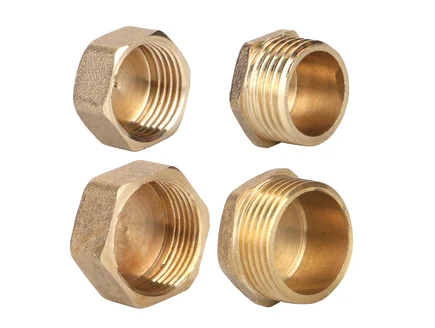
A brass hex bushing is a plain part whose only real function is to be the right piece of metal between a bolt and something it must not touch. It carries no load beyond clamping, it locates nothing, and it looks like a spacer. That apparent simplicity is what makes it easy to specify badly, because a hex bushing has four requirements and only one of them is its length.
The four are: the thread, the inside diameter, the outside hex, and the corrosion behaviour. And the corrosion behaviour is the one that decides whether the part should be brass at all.
Why brass, and when it is the wrong answer
H62 and H65 in 0.8 to 4.0 mm, selected for conductivity, fine surface detail and corrosion resistance. So the case for brass rests on four properties, and each of them has a boundary.
- Corrosion resistance. Brass resists ordinary atmospheric and moisture attack far better than steel, which is why bushings in damp locations are brass. Its specific weakness is dezincification – the leaching of zinc from a brass with high zinc content when it is exposed to acidic or slightly saline water. The leached part becomes porous and brittle, and a dezincified bushing can fail without any visible warning. So the brass grade and the environment have to be checked against each other, not assumed.
- Conductivity. Brass is a good conductor, better than steel by a wide margin, and a bushing between a bolt and an aluminium or electronic part is sometimes specified for conduction. If conduction is the actual purpose, the drawing should say so, because the requirement is electrical and it is measurable in a way that a mechanical drawing does not capture.
- Machinability and detail. Brass cuts beautifully and takes fine detail, which is why it is the material for small precisely-sized parts. This is the property that makes the alternatives awkward rather than impossible.
- Ductility. Brass deforms rather than cracks, which is a benefit on a bushing that has to take a slight interference and a liability if the bushing is expected to hold a load.
When brass is the wrong answer: on a very hot part, where brass loses strength; where a steel fastener will be in continuous contact, because the galvanic couple will corrode the steel around the bushing rather than the bushing itself; and where the environment is strongly acidic or saline, where dezincification is likely. In the last case the answer is a bronze, a stainless steel, or sometimes a nylon.
The thread, which is what a bushing is actually for
A hex bushing exists to give a bolt something to screw into that is not the thing you are trying to hold. That makes the thread the whole function, and the requirements on it are different from a nut’s.
- The thread is female and it is the softer element. A bolt into a brass bushing: the bolt is steel and the bushing is brass, so under any significant load the bushing’s thread will strip before the bolt’s does. That is acceptable as long as the bushing is designed as the sacrificial element, but it has to be a decision. In a design where the bushing must be re-usable and the bolt is replaced, this matters.
- Thread engagement is the strength limit, and on a bushing the available engagement is set by its height. A short bushing gives few engaged turns and a low load capacity, and a long bushing gives many. So the bushing’s height is a strength dimension and not just a spacing dimension, and it should be chosen against the clamp load rather than only against the gap.
- The thread class matters for assembly torque. A fine-pitch thread gives more engagement height for the same nut height and a finer adjustment, and it is often the better choice for a small bushing – but a fine thread has lower stripping strength per engaged turn, so the two effects have to be balanced rather than assumed.
- A brass thread has a real and specific advantage here: a slightly mismatched thread will seat rather than jam, and a brass bushing can accept a small thread tolerance variation without failing. This tolerance of small mismatch is one of the reasons brass is used rather than steel, and it is worth remembering before over-specifying the thread.
The inside diameter, and the distinction that matters
The bore of a hex bushing is one of three different things, and confusing them is the most common specification error on this part.
- A clearance bore for the fastener. The bushing is on the bolt but the bolt does not pass through it – the bore only has to clear the bolt. Then the bore’s job is to clear the fastener shank, and the tolerance is a normal clearance and the surface finish is unimportant.
- A pilot bore for a screw. A self-tapping or thread-forming screw runs into the bushing and forms its own thread in the brass. Here the bore’s size is the fastener’s thread-forming specification and it is a process requirement, not a fit.
- A precision bore that receives a pin or a shaft. Now the bushing is functioning as a guide bearing and the bore is a running or sliding fit with a roundness requirement and a surface finish requirement, and it is no longer a spacer.
Stating which of the three it is takes one clause and it changes what has to be held. A clearance bore at +0.05 is fine; a guide bore at +0.05 with a roundness requirement is a different part; and a thread-forming bore needs to know the fastener.
One brass-specific note on the bore: a brass bore will gall against a steel pin or a steel fastener rather than smear as aluminium does, which is generally preferable, but it will still pick up material over time. If the bore is a running fit, a surface finish requirement is warranted and a lubricant or a plating is worth considering.
The hex, and it is more than a wrench interface
The hex on a brass bushing does three things, and they do not always point the same way.
- It is the wrench interface. Width across flats is the assembly dimension, and it has to be within the tolerance for the wrench or the corners will round. On a small bushing, a 10 mm hex across flats with a wrench meant for 11 mm will be rounded, and a rounded hex cannot be undone without damaging the part.
- It is the specified thickness. Brass bushings are commonly specified by nominal size and nominal length – “M6 x 20” – and the length is normally the body length excluding the thread or including it depending on the convention. That convention has to be stated, because a 3 mm difference decides whether the bushing reaches through the plate it is filling.
- It is a size choice driven by torque and by space. A larger hex gives more torque capacity and a smaller hex fits into a tighter access. On a bushing in a confined assembly, the hex is often the dimension that limits the design rather than the bore.
Two brass-specific notes on the hex: brass deforms, so a hex that is tightened repeatedly can deform at the corners and lose its flat-to-flat dimensions – which matters on a bushing that will be removed and replaced. And a rolled or extruded hex is not the same as a machined one: a formed hex has residual stress in the corners and a slightly different shape, and the machined one has a flat, fully-formed corner with an intact surface. For a small brass bushing the machined hex is normally the better answer and the difference is small enough that it needs saying.
H62 for threads and wear, H65 where ductility matters more
H62 and H65, and the difference between them on this part is worth a sentence:
- H62 – higher zinc, harder, stronger, better for threads and for wear. The default for a mechanical bushing.
- H65 – lower zinc, more ductile, more corrosion-resistant and notably better against dezincification. The right choice in a wet or mildly acidic environment.
Plating, powder coating, anodising or polishing per the print, with masking and laser marking available. On brass the finish decisions are:
- Plating a brass thread is usually a mistake. It changes the fit and it will flake at the thread’s roots. If a plated bushing is needed, the thread should be masked or the plating specified as a controlled thin band.
- A plating on the hex is common for appearance and for solderability, and it has the same width-across-flats consequence as on a nut.
- Passivation is not applicable to brass in the way it is to stainless steel; the equivalent is a lacquer or a chemical brightening, and either will change the surface’s friction behaviour if the bore is a running fit.
- Laser marking is the right identification method on a small brass part because it does not add thickness and does not affect any fit.
Tolerance and the process note
This route lists coil-fed stamping with deburring and in-process checks between stages, on 5 to 250 tonne presses with progressive and compound dies and in-house toolmaking, at +/-0.03 mm on pierced holes and +/-0.1 mm on formed sections. On a hex bushing, which is the correct route and why:
- Stamped hex bushings are made from strip in a progressive die – pierced, formed to the hex, cut out – and they are the right answer at volume for a plain spacer-type bushing. The toolmaker’s job is a compound die that forms the hex and pierces the bore, and the tolerance band follows from the material and the feed rather than from the tooling quality.
- Machined hex bushings are made from round or hex bar on a turning centre or with a mill, and they are the right answer when the bore needs to be a fit, when the hex needs to hold a wrench repeatedly, or at low volume where a die does not amortise.
- Hybrid – stamp the hex blank and machine the bore – is common and effective, and it puts the tight tolerance where it is cheap to hold.
On the tolerance allocation: the bore is the tight dimension, the width across flats is next because it is the wrench interface, and the length is a general-band dimension unless it is coordinating a stack. Formed sections on a stamped version are the ones that will move with the material lot, so they should not be asked to carry a tight band unless the part is inspected by lot.
A bore fit is only as good as the measurement convention you state
- Bore diameter and roundness, with the measurement convention stated, on every part if it is a fit.
- Thread gauging where the bushing is threaded – go/no-go minimum and maximum, or the pitch diameter.
- Width across flats, both dimensions, and the corner condition. This is a wrench fit.
- Length, with the convention for whether the thread is included stated.
- Flatness of the seating faces where the bushing clamps against something, because a bushing that does not sit flat loads the bolt unevenly.
- Deburr condition verified on every part. On brass this is both a handling requirement and a safety one – brass burrs are sharp and they will cut the assembler’s fingers as well as damage the mating face.
- Plating thickness and adhesion, with the masked thread and bore verified.
To carry load, or to isolate two metals
Is this bushing there to carry load, or to isolate two metals? Those are different parts with the same shape. If it carries load – a high clamp force, a vibration, a structural joint – then the height is a strength dimension, the thread’s engagement and grade matter, and steel is usually the better material with brass reserved for the corrosion requirement. If it is there to stop a steel fastener from touching an aluminium or a plastic component, and the clamp load is modest, then brass is exactly right and the requirements are the thread, the bore’s clearance, the hex for assembly, and the plating to control the galvanic couple. The second case is by far the more common one and it is the reason brass is specified at all. Saying which of the two it is at enquiry stage costs one sentence and it settles the material, the length, the thread class and the finish in one go.
Custom Metal Stamping Parts is the range this part sits under; the overview page pulls together the tooling logic, finishing options and tolerance notes that apply across the family.
Specifications
| Item | Brass Hex Bushings and Pipe Inserts |
|---|---|
| Brand | AUNOV |
| Designing | Driven by your drawing or a physical sample – DFM notes are returned before any tooling is cut; changes are priced before they are made. |
| Tooling | Die design and toolmaking stay in house, so no tooling step is outsourced, and the charge is refundable against agreed volumes. |
| Samples | Sample parts are measured and reported before submission, so any deviation is corrected at sample stage. |
| Materials | H62 / H65 brass, 0.8-4.0 mm, selected for conductivity, fine surface detail and corrosion resistance on this bushing. |
| Surface finish | Plating, powder coating, anodising or polishing, per the print; masking and laser marking available where needed. |
| Processing | Coil-fed stamping, deburred and finished to the print; in-process checks sit between stages, not only at the end. |
| Equipment | 5-250 T presses running progressive and compound dies, with in-house toolmaking to keep dies and fixtures maintained. |
| Tolerance | +/-0.03 mm on pierced holes, +/-0.1 mm on formed sections; critical dimensions carry CMM data with the shipment. |
| Delivery terms | FOB with DDP offered for EU and US addresses; payment T/T or L/C, freight quoted to destination. |
Related Products


Request a Quote for This Part
Send a drawing or sketch — get material advice, tooling cost and a per-piece price within 24 hours (working days).