
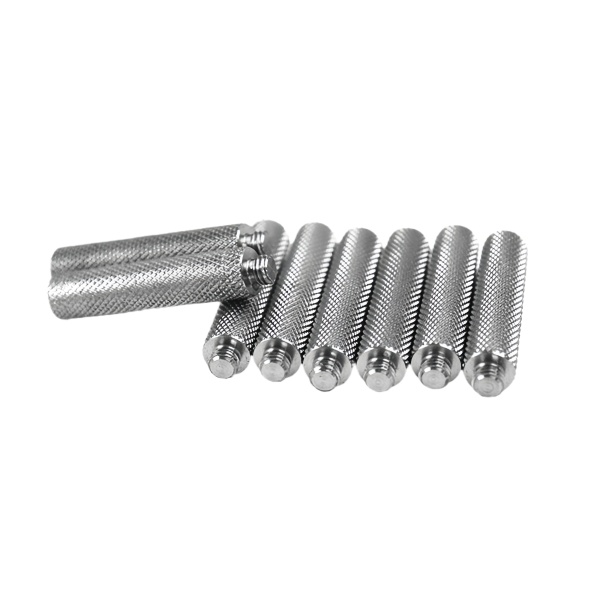
Knurl pattern and depth determine the torque transmission capability of a threaded plug
A knurled threaded plug—a blind hole plug, a pipe end cap, or a pressure fitting with a knurled outer surface for hand-tightening—relies on the knurl for grip during assembly and disassembly. The knurl does not typically carry the primary sealing load (that’s the job of the threads and the seat), but it must transmit enough torque to tighten or loosen the plug without rounding the knurl or requiring tools.
The torque capacity of a straight knurl (parallel to the axis) is approximately T = µ × F × D_k/2, where µ is the coefficient of friction between the knurl and the operator’s glove or hand (typically 0.4–0.8 depending on knurl sharpness and cleanliness), F is the gripping force (roughly 50–100 N for an average adult’s grip on a 20–30 mm diameter cylinder), and D_k is the knurl outer diameter. For a 25 mm OD plug with a coarse diamond knurl (µ ≈ 0.7) gripped at 75 N, the transmittable torque is about 0.7 × 75 × 0.0125 = 0.66 N·m—enough for a M12 plug torqued to 10 N·m if the threads are lubricated but not enough for a dry M12 plug torqued to 25 N·m. If higher torque is needed, we add a hex or socket wrench feature in addition to the knurl.
Thread engagement length in a blind plug determines the pressure rating before thread strip
A threaded plug that seals internal pressure—whether it is a hydraulic test port plug, a bleed screw, or an end cap for a pressure vessel—transmits the pressure load to the threads that engage the parent body. The total axial force from internal pressure is F = P × A, where P is the internal pressure and A is the sealed area (π × D²/4 for a flat-end plug sealing against pressure). This force must be carried by the shear area of the engaged threads: A_shear = π × d × L_e × n_threads × K_shear, where d is the pitch diameter, L_e is the engagement length, n_threads is the number of threads per unit length (1/pitch), and K_shear is the fraction of thread area that actually carries shear load (typically 0.5–0.7 for standard thread forms).
For a M16 × 1.5 plug with 12 mm of engagement in a 316 stainless steel body at 10 MPa internal pressure: the axial force is 10 × π × 16²/4 ≈ 2010 N. The thread shear area (assuming K_shear = 0.6) is π × 15.3 × 12 × (1/1.5) × 0.6 ≈ 230 mm². The shear stress is 2010 / 230 = 8.7 MPa, which is well below the shear yield strength of 316 stainless steel (~140 MPa). This plug has a safety factor of roughly 16× against thread stripping at 10 MPa—more than adequate. At 50 MPa, the safety factor drops to ~3.2×, still acceptable but approaching the minimum we recommend (3.0× for static pressure, 4.0× for cyclic pressure).
The sealing face under the plug head must be perpendicular to the thread axis within a tight tolerance
Where the plug head (or the shoulder of the plug) contacts the mating surface to form a seal—whether that seal is metal-to-metal, O-ring, or gasketed—the perpendicularity of that contact surface relative to the thread axis determines whether the seal is uniform around the circumference or concentrated on one side. A perpendicularity error of 1° on a M16 plug (seal radius ≈ 10 mm) produces a gap variation of 10 × tan(1°) ≈ 0.17 mm across the seal diameter. If the seal is a metal-to-metal contact designed for 0.02 mm flatness, this 1° angular error means the seal does not contact at all on one side while being heavily loaded on the opposite side—guaranteed leakage under pressure.
We hold the seal-face perpendicularity to 0.5° maximum (0.3° for pressure ratings above 20 MPa) by machining the seal face and the threads in the same setup. The part is held in a collet or chuck that grips the knurled OD (using soft jaws to avoid damaging the knurl), the threads are cut first, and then the seal face is faced in the same operation without unclamping. This ensures that the seal face is perpendicular to the thread axis to within the machine’s positioning accuracy (typically ±0.02 mm over the seal diameter, which translates to < 0.1° perpendicularity for seals smaller than 30 mm).
Knurl type selection (straight vs. diamond vs. convex) affects both grip and cosmetic appearance
The pattern of the knurl affects how the plug looks and feels, as well as how effectively it transmits torque:
- Straight knurl: Parallel ridges running along the axis. Provides good grip when turning the plug axially (the most common hand motion). Looks industrial and functional. Easiest to machine (single-point tool, straightforward toolpath). Our default choice for functional plugs where appearance is secondary.
- Diamond knurl: Cross-hatched pattern (usually 30° or 45° included angle) created by two passes of a straight knurling tool at an angle, or by a dedicated diamond knurling wheel. Provides grip in both axial and rotational directions—useful for plugs that must be turned by fingers from any orientation. Slightly more expensive to machine (two passes or special tool). The most common choice for consumer-facing products where the knurl is also a design element.
- Convex (rounded) knurl: Rounded lobes rather than sharp ridges. Provides comfortable grip without the aggressive “bite” of a sharp knurl. Used on plugs that will be handled frequently by operators (medical equipment, food-processing hardware). Requires a form tool or a specialized rolling operation; more expensive than straight or diamond knurl.
We produce all three types and select based on the customer drawing or, if unspecified, on the application context visible from the rest of the order.
Material choice between 303, 304, and 316 for plugs depends on the fluid environment, not just cost
Threaded plugs are exposed to the same fluid as the system they seal. In hydraulic systems using mineral oil or PAO fluid, any of 303, 304, or 316 stainless steel performs adequately. In systems using water-based fluids (water-glycol, emulsions, or plain water), 316 is strongly preferred because its molybdenum content (2–3 %) provides resistance to pitting corrosion in chloride-containing waters that can attack 304 (which has no molybdenum) within months.
For plugs that will be installed once and never removed (permanent end caps, blanking plugs for unused ports), 303 is often the best choice because its sulfur additions make it machine 30–40 % faster than 304, reducing the per-part cost by 0.10–0.20 USD for a typical M12–M20 plug. The reduced corrosion resistance of 303 compared to 304 is irrelevant if the plug is not exposed to aggressive environments and will not be handled after installation. We default to 303 for all “stainless steel threaded plug” drawings unless 316 is specified or the application involves water or chloride exposure.
How we pressure-test threaded plugs before they ship as finished components
Every threaded plug designated as pressure-retaining receives a hydrostatic proof test at 1.5× the design pressure (or 2.0× for safety-critical applications) held for 10 minutes with no external leakage. The test fixture mimics the actual assembly: the plug is torqued into a master test body (machined to the same thread class and tolerance as the customer’s mating part) using the recommended torque value, and the cavity behind the plug is pressurized through a port in the test body.
Acceptance criteria:
- No visible leakage (droplets, weeping, or mist) from any surface.
- No permanent deformation of the plug (re-measure overall height and seal-face flatness after test; change < 0.02 mm).
- Thread engagement remains full (the plug does not back out under pressure; verify by checking torque before and after test—loss < 5 % is acceptable).
Plugs that fail the pressure test are analyzed for the failure mode: was it the thread stripping (under-designed engagement length), the seal face leaking (perpendicularity error or damage), or the body cracking (material defect or stress concentration)? The finding drives either a process correction (for systematic issues) or a scrap decision (for isolated material defects). Failed parts are never shipped; the batch is placed on hold until root cause is identified and corrected.
Parts like this one sit under the CNC Machining Parts range, whose overview page gathers the tooling logic, finishing options and tolerance notes shared across the family.
Specifications
| Item | Stainless Steel CNC Machined Knurled Threaded Plugs |
|---|---|
| Brand | AUNOV |
| Designing | Send drawings, or send a sample to be measured, the quotation comes back with a manufacturability review attached. |
| Tooling | Tooling designed and cut in house, stored under your part number. |
| Samples | Sample parts arrive with a dimensional report plus material certs. |
| Materials | 304 / 316 stainless steel leads the stock list for this part, alongside carbon steel (SPCC / DC01), aluminium, brass and copper, per the drawing. |
| Surface finish | Zinc, nickel or chrome plating, e-coat, powder coat, anodising or passivation, fixed at the drawing review. |
| Processing | Progressive deep draw stages with in-line annealing as the draw ratio demands, with piercing and finish machining under the same roof. |
| Equipment | 5-250 T mechanical presses plus 250-500 T hydraulic presses, CNC turning centres, climate-controlled CMM room. |
| Tolerance | As-drawn tolerance +/-0.1 mm, +/-0.03 mm on machined features. |
| Delivery terms | Standard terms FOB, DDP offered to EU and US, payment T/T or L/C, D/P for repeat accounts, scheduled call-offs welcome. |
Related Products


Frequently Asked Questions
How does the knurl pattern and depth set the torque a plug can take?
A knurled threaded plug relies on the knurl for grip during assembly and disassembly, and the knurl does not carry the primary sealing load, that is the job of the threads and the seat. For a 25 mm OD plug with a coarse diamond knurl gripped at 75 N, the transmittable torque is about 0.66 newton metres, enough for a lubricated M12 plug torqued to 10 but not a dry one torqued to 25. If higher torque is needed, a hex or socket wrench feature is added in addition to the knurl.
Why does thread engagement length set the pressure rating?
A plug that seals internal pressure transmits the load to the threads engaging the parent body, so the engagement length decides the pressure rating before the thread strips. For an M16 by 1.5 plug with 12 mm of engagement in a 316 stainless steel body at 10 MPa, the axial force is about 2010 N and the shear stress about 8.7 MPa. That is well below the shear yield of 316 stainless steel, roughly 140 MPa, giving a safety factor of about sixteen times against stripping.
Why must the sealing face be perpendicular to the thread axis?
Where the plug head or shoulder contacts the mating surface to seal, the perpendicularity of that face relative to the thread axis decides whether the seal is uniform or concentrated on one side. A perpendicularity error of one degree on an M16 plug produces a gap variation of about 0.17 mm across the seal diameter. Against a metal-to-metal seal designed for 0.02 mm flatness, that one-sided contact guarantees leakage, so we hold the seal-face perpendicularity to 0.5 degree maximum, 0.3 for pressure ratings above 20 MPa.
How are the knurl, the material and the pressure test related?
The part is held in a collet or chuck gripping the knurled OD with soft jaws, the threads are cut first, then the seal face is faced in the same operation without unclamping, which is what holds the perpendicularity. Material choice between 303, 304 and 316 depends on the fluid environment rather than just cost. How we pressure-test threaded plugs before they ship is the acceptance step that verifies the seat and the engagement together.
Request a Quote for This Part
Send a drawing or sketch — get material advice, tooling cost and a per-piece price within 24 hours (working days).