
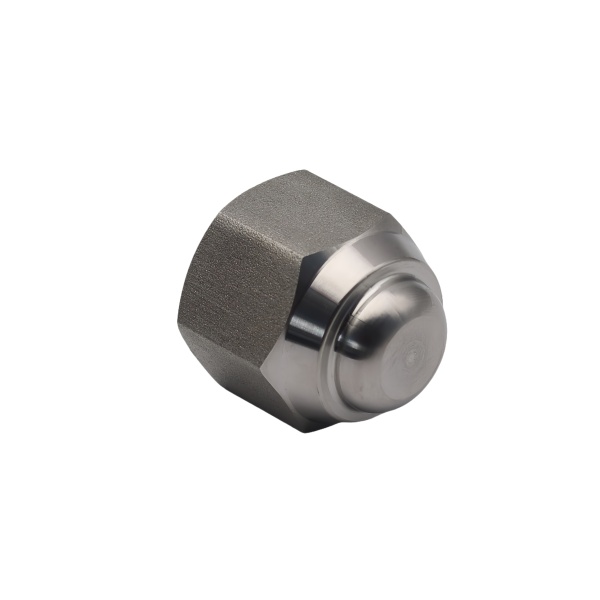
Hex dome cap nut geometry combines the function of a nut and a protective cover
A hex dome cap nut—also known as an acorn nut or dome nut—is a fastener that provides both the clamping function of a standard hex nut and a protective cover over the exposed end of the bolt or stud. The dome portion encloses the bolt’s threaded end, protecting it from damage, corrosion, and accidental contact, while the hex base provides the wrench interface for torque application.
Machining a dome cap nut from solid stainless steel (rather than forming it from a stamped shell) produces a part with superior concentricity between the hex base and the internal thread, thicker wall thickness in the dome for improved impact resistance, and the ability to hold tighter thread tolerances than formed nuts. The trade-off is higher material cost (3–5× the cost of a formed acorn nut) and longer lead time (CNC machining vs. progressive die stamping). We machine these nuts for applications where the formed equivalent cannot meet the requirements: aerospace fasteners, medical device hardware, and high-vibration environments where the nut must not crack under stress-corrosion combined with cyclic loading.
Thread class and pitch diameter tolerance determine the preload consistency across a batch
The internal thread of a dome cap nut is typically specified as 6H (metric) or 2B (unified), which provides a generous tolerance band for the pitch diameter. For general-purpose applications this is adequate, but for critical joints where preload consistency matters (engine mounts, structural connections, pressure vessel studs), we hold the thread to a tighter class: 5H for metric (roughly half the 6H tolerance band) or 3B for unified.
The practical effect of tightening the thread class is visible in the scatter of achieved preload at a given torque. With 6H threads and a M10 nut torqued to 45 N·m, the actual preload typically varies by ±25 % due to friction variation between the nut and the bolt threads. With 5H threads (tighter pitch diameter control), that variation reduces to ±15 % because the thread engagement is more consistent from nut to nut—the pitch diameter doesn’t vary enough to change the thread contact pattern significantly. The added manufacturing cost is minimal (one additional threading pass with a sharper insert or one extra tap operation with a ground tap), but the benefit in preload consistency is substantial for safety-critical joints.
Dome wall thickness at the thinnest point determines impact and crush resistance
The dome of a cap nut is thinnest at the apex (the top of the dome), where the internal thread ends and the solid material transitions to a closed end. This minimum wall thickness is the limiting factor for two failure modes: crushing (when the nut is over-torqued and the dome yields plastically) and impact fracture (when a dropped tool or flying debris strikes the dome).
We design the dome with a minimum wall thickness at the apex of 0.4× the nominal bolt diameter for 316 stainless steel (e.g., 4 mm minimum wall for an M10 nut). This provides a crush strength (the torque at which the dome permanently deforms) of roughly 2.5× the recommended tightening torque, giving a safety margin against over-torquing. For applications where impact resistance is the primary concern (nuts on exposed machinery in industrial environments), we increase the minimum wall to 0.6× the bolt diameter, which roughly doubles the energy absorption capacity before fracture. The added material cost is approximately 0.02 USD per nut in volume production—a small price for preventing field replacement of a damaged nut that may be inaccessible without disassembling the connected equipment.
Hex size relative to the bolt standard determines whether standard tools fit or custom tools are needed
The hex size (width across flats) of a dome cap nut must match the standard wrench size for the corresponding bolt or be large enough to provide adequate torque transmission without rounding the corners. Standard practice is to match the nut’s hex size to the bolt head’s hex size (e.g., M10 bolt uses a 17 mm wrench → M10 nut has 17 mm hex across flats). However, some designs use an oversized hex (one size larger than standard) to provide more wrench engagement surface and reduce the risk of rounding during field assembly where only adjustable wrenches are available.
We machine the hex to the dimension specified on the customer drawing. If the drawing calls out “standard hex per ISO 4032” or “per ASME B18.2.2,” we follow the relevant table. If the drawing is silent, we default to standard hex size but add a note on the traveler recommending oversized hex if the application involves frequent field servicing. The cost difference between standard and oversized hex is negligible (a few seconds of additional milling time on a slightly larger blank), so many customers accept the upgrade when we explain the field-service benefit.
Surface finish inside the dome affects corrosion performance in the enclosed space
The interior surface of the dome—the space that encloses the bolt’s threaded end—is a crevice where moisture can collect and stagnate, especially in outdoor or washdown environments. If this interior surface is left with a rough as-machined finish (Ra 3.2 µm or worse), it provides numerous microscopic crevices where chlorides can concentrate and initiate pitting corrosion on both the nut and the bolt. The corrosion products then expand and can seize the nut onto the bolt, making future removal extremely difficult or impossible without cutting the nut off.
We apply one of three interior treatments depending on the service environment:
- Standard (indoor, dry): No special treatment; the as-machined interior is acceptable because moisture exposure is minimal. Cost: zero.
- General industrial (outdoor, occasional washdown): Passivation per ASTM A967 (nitric acid) after machining, which removes free iron from the surface and enhances the natural chromium oxide layer. Does not change dimensions or appearance significantly. Cost: ~0.01 USD/part.
- Harsh (marine, chemical, food): Interior coating with a thin layer of electroless nickel (5–10 µm) or PTFE impregnation after passivation. The coating seals the surface pores and prevents crevice corrosion initiation. Adds ~0.05–0.10 USD/part depending on batch size.
How we verify that a batch of dome cap nuts will assemble correctly before shipping
Every batch of dome cap nuts receives 100 % dimensional inspection plus a functional go/no-go assembly test:
- Thread verification: Go/no-go plug gauge (6H or specified class) on every nut. Pitch diameter sampling (every 50th part) with thread micrometer.
- Hex size: Go/no-go ring gauge across flats. Verifies that the nut fits the specified wrench size and does not have undersized hex (which would round under torque).
- Dome contour: Profile projector check on first article and after tool change. Verifies that the dome radius is within ±0.1 mm of drawing and that there are no tool marks or gouges on the cosmetic surface.
- Assembly test: One nut per 100 parts is assembled onto a master bolt (ground to nominal pitch diameter) and torqued to spec. Verification: the bolt threads fully engage (no bottom-out before the nut seats), the dome does not contact any obstacle on the bolt or surrounding structure, and the nut can be removed afterward without galling or seizure.
- Material certification: Mill test report confirming 316 or 17-4 PH composition per ASTM A240 or A564. For aerospace orders, we also provide an ICP-OES analysis on one sample per heat.
Parts like this one sit under the CNC Machining Parts range, whose overview page gathers the tooling logic, finishing options and tolerance notes shared across the family.
Specifications
| Item | Stainless Steel CNC Machined Hex Dome Cap Nut |
|---|---|
| Brand | AUNOV |
| Designing | Send us your 2D drawing, or mail a sample for measurement, the quotation comes back with a manufacturability review attached. |
| Tooling | Tooling designed and cut in house, stored under your part number. |
| Samples | Samples for approval come with a dimensional report plus material certs. |
| Materials | Stock for this part leads with 304 / 316 stainless steel, alongside carbon steel (SPCC / DC01), aluminium, brass and copper, per the drawing. |
| Surface finish | Plating, e-coat, powder coating, anodising or passivation, as called out on your print. |
| Processing | Progressive deep draw stages with in-line annealing as the draw ratio demands, then pierced and CNC-machined in house. |
| Equipment | 5-250 T mechanical presses plus 250-500 T hydraulic presses, CNC turning and milling cells, a climate-controlled CMM room. |
| Tolerance | Drawn tolerances held to +/-0.1 mm, machined features held to +/-0.03 mm. |
| Delivery terms | FOB as standard, DDP available for EU and US destinations, payment T/T or L/C, D/P for repeat accounts, scheduled call-offs welcome. |
Related Products



Request a Quote for This Part
Send a drawing or sketch — get material advice, tooling cost and a per-piece price within 24 hours (working days).