
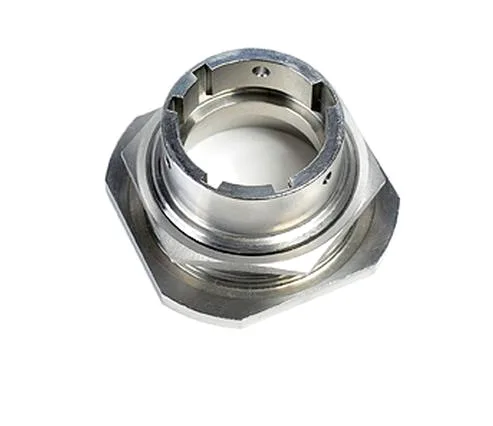
Stainless Steel is not steel that resists rust; it is steel that resists being cut
Every general explanation of stainless steel machining stops at corrosion resistance, and on a production part that is the least useful of its properties. The properties that decide whether a stainless steel part is easy or expensive to machine are work hardening, the tendency to gall, the heat the cut generates, and a cutting environment that is far more abrasive than it looks. A carbon steel part and a 304 part made from the same drawing with the same tools and the same parameters will produce different results, and the difference is entirely down to the material’s behaviour under a cutting edge.
We run turn-mill machining with critical diameters finished in one setup on CNC turning centres with bar feeders and 3- and 4-axis machining centres, secondary operations on CNC turning centres, and CMM inspection. Every stage is logged against your part number, carbon steel in SPCC and DC01 grades plus 304 and 316 stainless steel, aluminium and brass are held on site, and mill certificates and heat numbers accompany the first article. Ground faces are achievable to +/-0.005 mm where the print demands it, and capability is checked on the first article before the run continues. This page is about the four behaviours above and what they demand from the drawing and the process.
Work hardening: the reason a stainless steel cycle cannot be interrupted
Austenitic stainless steel – 304, 316, and the free-machining variants – hardens as it is cut. The austenite phase transforms to a harder structure on the cut surface. Under normal conditions this is a benefit: a machined stainless steel surface is slightly harder and more wear resistant than the mill condition. Under two other conditions it is a serious problem.
Interrupted cuts. When a tool enters and leaves the workpiece repeatedly, the material at the interruption point has time to work-harden before the tool returns. The hardened spot resists the tool, the tool dulls, the dull tool makes a worse cut, and the next pass over the hardened spot is worse again. This is a runaway. The consequences are a tool life measured in minutes instead of hours, a surface that fails a roughness or a dimensional requirement, and a batch that produces a few good parts and then a lot of scrap.
- Thin or small sections. A part with a thin wall or a small feature is inherently interrupted because there is not enough material for a continuous cut. Here the design has to help: increasing wall thickness, opening up a small feature, or accepting a process change.
- Deep cavities. A pocket with a wall means the tool rubs on one wall at low speed. Rubbing work-hardens the wall faster than it cuts it. Deep pockets in stainless steel with polished walls are a classic problem.
- Re-entrant geometry. Anything the tool has to cut into and back out of – a cross-hole, a slot with a closed end, a profile that runs the tool along a surface and off it.
The process responses are: continuous cycles without interruption where the geometry allows, sharp tooling with the correct grade rather than the most available grade, a stable tool position, and a spindle speed and feed that actually cut rather than rub. On an interrupted feature the honest answer is often that the operation should be split into two lighter passes, or that a different feature geometry is cheaper.
Galling: stainless steel fasteners and stainless steel parts
Galling is not strictly a machining phenomenon but it belongs on the same page, because on a stainless steel assembly it is the failure mode that most often replaces an assembly problem with a warranty claim. When two stainless steel surfaces are pressed together under load, the surfaces are difficult to separate and can tear. It is a cold-welding effect driven by surface condition, and it is worst on work-hardened, freshly machined surfaces.
What helps:
- Reduce the surface finish. A rougher surface has fewer points of contact and galls less. This is counterintuitive and it is genuinely effective.
- A defined friction treatment. A nylon patch on the fastener, a dry-film anti-galling coating, or a plating on the threaded area. These are specified per joint, not per part, which is why the assembly drawing needs to know about them.
- Limit the number of reassembly cycles. Each cycle makes it worse. A joint designed for ten assemblies should not be disassembled a hundred times.
- Choose the fastener material deliberately. A carbon steel or bronze fastener against a stainless steel part reduces galling substantially.
On a machined stainless steel part this affects where the part’s threaded features should be and what their surface condition should be. A drawing that specifies a thread without specifying anything about its galling behaviour will produce a part that functions once and argues thereafter.
Heat and the thermal dimension
Stainless Steel conducts heat far worse than aluminium and less well than mild steel. The practical effect on machining is that heat stays in the part. On a small part this is a measurable distortion, and on a part with a tight tolerance it is a real problem.
- Chucking distorts the part. A part gripped tightly in a chuck while a cut removes material asymmetrically will move, and it moves differently at different radii. On a thin stainless steel part – and stainless steel parts are often made thin to save material or weight – this can exceed a general tolerance.
- The cut itself heats one region. A deep turning cut on a slender part heats that region and it moves when it cools.
- Cooling is therefore a control requirement, not a comfort. Consistent coolant delivery and a settled part temperature before measurement matter more on stainless steel than on aluminium.
- Measurement needs the part to be at temperature. Stainless Steel has a moderate thermal expansion coefficient, so a part measured hot and used cold will be out by a predictable amount. Letting the part reach room temperature before CMM inspection is part of the process, not a courtesy.
One specific consequence worth noting: on a part that must hold a dimension across a long span – a flange, a frame, a plate – the heat from machining one end can distort the other. A stress-relief step before final machining, or a lower-removal finishing pass, is often the difference between a part that meets a tolerance and one that passes on the first article and fails on the third.
Surface finish and the polishing question
Surface treatment matched to the duty – plating, coating or polishing – with alternatives quoted alongside and samples approved in writing. What is different about stainless steel:
- Passivation is standard. Free iron from machining is present on the surface of a stainless steel part, and it rusts. Passivation removes it and restores corrosion resistance. On any stainless steel part that will be in a wet environment or will be certified, passivation is not optional and it should be written on the drawing rather than assumed.
- Pickling and passivation are different. Pickling uses an acid to remove the heat tint and scale from welding or from heavy machining, and it is followed by passivation. A part that has been welded needs both.
- Grain direction on a ground or brushed finish. A directional finish has to be specified by direction, and the drawing has to carry it, because two shops will produce two different appearances and both will claim to have met the drawing.
- No coating means a different corrosion model. An unpainted stainless steel part relies entirely on its own passivation for corrosion resistance, which is very good in most conditions and poor in a crevice where oxygen cannot reach the surface.
- Plating a stainless steel part. It is done and it works, but the plating’s corrosion performance is only as good as its coverage – and a machined thread or a crevice is where coverage is thin. Where corrosion is the driver, solid stainless steel with passivation is usually the better answer than plated stainless steel.
Grades: 304, 316, and the free-machining options
- 304 is the general-purpose austenitic grade. Excellent for ordinary environments, readily available in bar form, and the default unless something specific argues otherwise.
- 316 adds molybdenum and is markedly better in chloride-bearing and marine environments. Where the part sees salt, de-icing salt or a chloride process, this is the correct answer and 304 in that duty is an avoidable failure.
- Free-machining stainless steel – with a sulphur addition – cuts significantly faster and holds a better surface, and on a stainless steel part in volume this is often the difference between an expensive part and a competitive one. It is not suitable for all duties and not generally suitable for welding or for high-temperature service, so it is a functional decision that has to be made explicitly.
- Duplex and precipitation-hardening grades for specific duties – higher strength, or better chloride resistance, or a specific hardness requirement. These are sourced to the drawing rather than from stock, and the review should be told they are required rather than discovering it late.
What improves a stainless steel machining drawing
Send drawings, or send a sample to be measured. A manufacturability review comes back with the quotation, and the approved drawing is kept as the controlled master. Prototype and pre-production samples are provided against the drawing so the approved first article becomes the gauge reference and later batches are gauged back to the signed sample. Our toolroom covers die design, wire-cut EDM and maintenance, so no tooling step is outsourced and the charge is refundable against agreed volumes.
Seven things worth having in the enquiry:
- The exact grade, including whether a free-machining variant is acceptable and whether welding is part of the design.
- Passivation or pickling stated on the drawing if the part will see moisture.
- Whether the part is thin, because thin stainless steel is the hardest case for both cutting and distortion.
- Any feature that forces an interrupted cut, with an open question about whether the geometry can be opened up.
- Any stainless steel-to-stainless steel joint, so the galling treatment can be designed into the thread or the face.
- Whether any face is masked from coating, and whether dimensions apply before or after finish.
- The temperature the part sees in service, since it affects both the machining allowance and the passivation decision.
That last point is worth expanding: on a part with a very tight tolerance, a specified thermal treatment after machining – or a specified temperature at which the part will be measured – often resolves a problem that more accurate machines cannot.
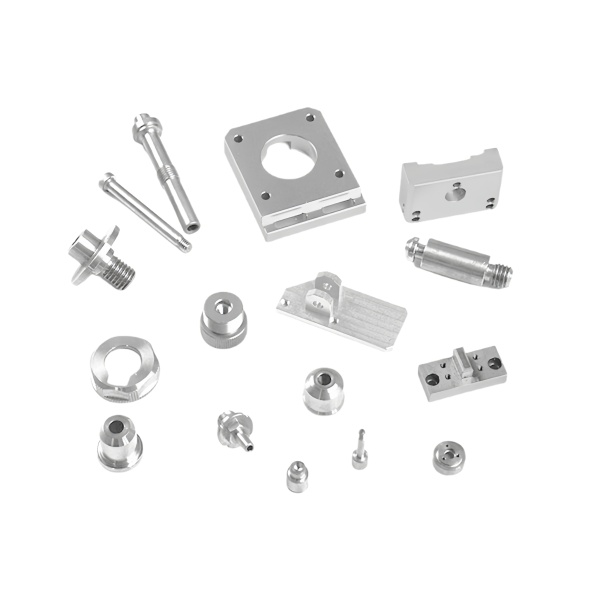
Parts like this one sit under the CNC Machining Parts range, whose overview page gathers the tooling logic, finishing options and tolerance notes shared across the family.
Where this part is used
Stainless steel parts arrive here for reasons that usually have nothing to do with corrosion. When a customer specifies 304 or 316 for a machined component, it is often because the part sees a corrosive environment, but the difficulties that show up on the shop floor come from the material’s behaviour under a cutting edge – work hardening, galling, heat, and an abrasive cutting environment that does not look abrasive.
The parts themselves are ordinary – fittings, adapters, spacers, housings, shafts – and it is the grade choice that changes the route. A free-machining stainless steel variant exists precisely because standard austenitic grades cut poorly, and choosing one is often a better answer than fighting the material with parameters, which is what a lot of drawings currently ask for.
What we need to quote it
Send the drawing, the grade and any temper or surface requirement, and tell us where the part actually sees its environment – immersed, splashed, or simply in a humid enclosure. That decides whether 304 is sufficient or 316 is justified, and it is worth having the conversation before quoting because the two grades cut differently. Mark the surfaces that must not be marked or where a lay direction matters, and note whether the parts will be welded, since welding a machined stainless steel part changes the heat-affected zone the tolerance has to survive.
Specifications
| Item | Stainless steel Machining parts |
|---|---|
| Brand | AUNOV |
| Designing | Send drawings, or send a sample to be measured – a manufacturability review comes back with the quotation; the approved drawing is kept as the controlled master. |
| Tooling | Our toolroom covers die design, wire-cut EDM and maintenance, so no tooling step is outsourced, and the charge is refundable against agreed volumes. |
| Samples | Prototype and pre-production samples are provided against the drawing, so the approved first article becomes the gauge reference, and later batches are gauged back to the signed sample. |
| Materials | Carbon steel (SPCC / DC01), 304 / 316 stainless steel, aluminium and brass are held on site; mill certificates and heat numbers accompany the first article. |
| Surface finish | Duty decides the surface treatment, plating, coating or polishing; we quote alternatives with the quotation and approve samples in writing. |
| Processing | Turn-mill machining, critical diameters finished in one setup; every stage is logged against your part number. |
| Equipment | CNC turning centres with bar feeders and 3-/4-axis machining centres; secondary ops run on CNC turning centres, inspection on the CMM. |
| Tolerance | +/-0.005 mm achievable on ground faces where the print demands it; capability is checked on the first article before the run continues. |
| Delivery terms | FOB Ningbo or Shanghai, T/T or L/C, with D/P accepted on repeat business; price breaks tie to annual volume. |
Related Products


Request a Quote for This Part
Send a drawing or sketch — get material advice, tooling cost and a per-piece price within 24 hours (working days).