
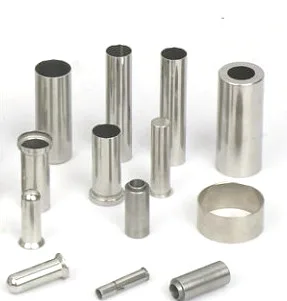
Sleeves for expansion valves: refrigerant service, and what it demands
An expansion valve meters refrigerant into an evaporator, and the sleeve or tube around its moving parts has a duty that general industrial tubes do not share: it lives in a closed refrigerant circuit, sees lubricant-laden refrigerant cycling through it, and must be clean enough, tight enough and compatible enough not to poison the system. Stainless steel expansion valve tube sleeves are therefore engineered around refrigerant service – and this page covers what that means in practice, from material selection to brazing interfaces and the cleanliness that keeps a compressor alive.
Why stainless steel for refrigeration duty
Copper tubing dominates refrigeration, but the drawn sleeve inside an expansion valve is often specified in stainless steel, and the reasons are consistent. Strength at thin walls: a stainless steel sleeve holds its bore roundness at 0.3-0.6 mm wall where copper would deform. Corrosion margin: refrigerant systems suffer from moisture ingress and acidic lubricant breakdown, and 304 or 316 stainless steel resists these where copper can pit. Machinability and sealing interfaces: stainless steel holds a machined or formed sealing face the way a copper sleeve cannot. And cleanliness: stainless steel is passivated and easily verified clean, which matters because the smallest particle in a refrigerant circuit becomes a compressor problem. The trade-off is draw difficulty – austenitic stainless steel work-hardens, so the sleeve’s radii and draw sequence are set with that in mind – and we quote that honestly rather than pretending a brass or copper process scales sideways.
The bore as the valve’s metering geometry
In many expansion valve architectures, the sleeve’s bore guides a pin or needle whose position sets the flow. That makes the bore a metering surface whose roundness and finish affect flow consistency, and it changes the tolerance conversation: an oval bore modulates flow with rotation, a scored bore affects it with wear. We hold these bores by sizing and ironing after the draw, verify roundness with a bore gauge on first articles, and specify finish by roughness band matched to the pin’s design, exactly as on our solenoid valve tubes. Where the valve’s pin is driven by a stepper motor or electronic actuator – the electronic expansion valve case – the bore’s straightness also matters, because pin misalignment with a small flow annulus changes the effective opening. Straightness is verified by a through-gauge check on samples.
Cleanliness for refrigerant circuits
Refrigeration is unforgiving of contamination: moisture forms acids, particles wear compressors, and residual machining or drawing residues can react with lubricant. Our sleeve finishing includes degreasing, passivation for the stainless steel grade, and a cleanliness verification – residue and particle checks – with capped ends and individual protection in packing. For HVAC and refrigeration customers the cleanliness record travels with the lot, and where a customer specifies a cleanliness standard (particle count per surface area, for instance), we test to it and report against it. This is one of the clearest cases where the supplier’s finishing and documentation discipline decides whether the part works, and it is why refrigerant sleeves are usually sourced from suppliers set up for fluid-service parts rather than general stampers.
Brazing and joining interfaces
A sleeve joins the valve body and the system’s tubing, usually by brazing or welding, and the joint is a leak-critical sealing interface. The sleeve’s ends must be dimensioned for the joining process: adequate thickness where the joint forms, a defined edge or land, and a fit to the mating tube that closes a capillary gap without being so tight that filler cannot penetrate. We ask for the joining specification at RFQ – torch brazing, furnace brazing or welding differ in how they treat the sleeve’s end – and where the customer has known their process, we design the end to match, verifying the geometry with a brazing trial on first articles. A sleeve that meets its dimensions and cracks at the braze has an end-design problem, and it is far cheaper to design around at tooling than to discover at a leak test.
Austenitic grades thin differently
The sleeve drawing with bore diameter, roundness and finish; wall thickness and end geometry; the joining process and the mating tube’s fit; the refrigerant and lubricant (for material and cleanliness); the cleanliness standard; and volume. We return a draw and finishing plan, a material recommendation, and a sample schedule – typically three to five weeks after die approval, with first articles carrying bore metrology, finish, the cleanliness record and a brazing trial if the joining process is specified.
Can you draw a stainless steel sleeve as thin as the copper one?
Can you draw a stainless steel sleeve as thin as the copper one it replaces?
Often yes, with the caveat that austenitic grades need generous radii and sometimes an anneal; the quote names the extra step. If the wall is thinner than we can hold reliably, we will say so rather than quote a marginal process.
Our refrigeration circuit keeps suffering compressor wear – could the sleeves contribute?
A sleeve that sheds particles or residue into the circuit will. Send a sample for cleanliness testing; our residue and particle results separate a sleeve problem from a system cleaning problem.
Do you supply sleeves with the bore finished for a specific pin?
Yes – finish is specified by roughness band to the pin’s design, and we verify with the customer’s pin in a sliding check where the application warrants it.
This part belongs to our Deep Drawn Tubes & Sleeves range. The deep drawn tubes & sleeves pages collect the process notes, common materials and inspection points behind every product in the family.
Where this part is used
The sleeve inside an expansion valve is one of the few drawn components in a refrigeration system that is expected to be both a precision part and a clean part. It guides the valve’s pin or needle, it forms the metering geometry the valve works against, and it sits in a sealed circuit where lubricant and moisture are both present. A particle of the wrong size in that circuit ends up at the compressor, and a sleeve that has lost its bore roundness changes how the valve meters.
You will find these sleeves in thermostatic expansion valves, in electronic expansion valves, in refrigerant distributors, and in the pilot assemblies that larger systems use to control superheat. The housing they are pressed or brazed into is usually copper or aluminium, which is why the sleeve is often the one stainless steel component in the assembly – it holds its roundness at thin wall where the copper around it deforms, and it survives the moisture that a refrigeration system eventually sees.
What we need to quote it
Send the sleeve’s outside diameter and the wall you need, the bore and its tolerance if a pin or needle runs in it, and the refrigerant with its lubricant and temperature range. The brazing or press-fit detail matters too, because the sleeve’s end geometry and the housing’s bore have to be designed as a pair rather than quoted separately. If the sleeve has to survive a cleanliness standard, name the standard – it changes the material and the finishing.
Specifications
| Item | Expansion Valve Tube Sleeves – Stainless Steel |
|---|---|
| Brand | AUNOV |
| Designing | Your drawing sets the part – samples are reverse-measured into a controlled drawing; changes are priced before they are made. |
| Tooling | Tooling is built and held under your part number, so no tooling step is outsourced, and first-article timing is measured from the tooling start date. |
| Samples | Sample parts are measured and reported before submission, so the part is proven before it is made in volume, and production starts only after your written sign-off. |
| Materials | Carbon steel (SPCC / DC01), 304 / 316 stainless steel, aluminium and brass are held on site; the final grade is fixed with the drawing review. |
| Surface finish | Natural, plated or coated – the print decides, and the agreed finish is logged; the finish is inspected with the dimensional report on the first article. |
| Processing | Drawn-tube process with in-line annealing and finish turning; batch records are filed so a repeat order starts from approved data. |
| Equipment | Drawn-tube benches, in-line annealing and CNC turning; secondary ops run on CNC turning centres, inspection on the CMM. |
| Tolerance | +/-0.03 mm on machined features, +/-0.1 mm on formed ones; finer bands confirmed from capability data before quoting. |
| Delivery terms | Delivery is quoted to your location: FOB, CIF or DDP, by sea or air as you prefer. |
Related Products


Request a Quote for This Part
Send a drawing or sketch — get material advice, tooling cost and a per-piece price within 24 hours (working days).