
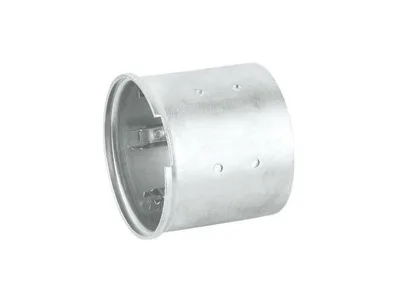
Long-body starters: drawing the deep can that houses a gear reduction
Gear-reduction starters changed the can’s proportions. By inserting a planetary set between the armature and the pinion, motor designers traded a huge, heavy direct-drive armature for a smaller, faster one – and the can grew longer to house the reduction. These starter cans – longer, often with a stepped or two-stage internal profile – are the deepest shells in the starter family, and they put the draw process back at the edge of its window. This page covers how we build them.
Depth strategy for a long can
When a starter can’s depth passes roughly 1.8 times its diameter, the single-stroke draw is no longer the rational choice, and pretending otherwise buys scrap. Our long-body programmes use a two-stroke sequence: a first draw to about 60% of the final depth, then a redraw that carries the wall the rest of the way. The split is set by simulation so that wall thinning stays flat across both operations rather than spiking at the first draw’s critical zone – a subtlety that shows up as a narrow neck midway down the can if it is missed. Tooling for the redraw adds a station and a longer stroke, but the finished can’s wall uniformity is measurably better, and wall uniformity on a starter can is a magnetic property as much as a structural one.
Internal features without machining
Inside a gear-reduction starter, the can usually needs one or two internal features: a shoulder or step that locates the planetary carrier, a ledge for a bearing, or a formed rib that positions the field assembly axially. All are drawable, but each carries its own ratio penalty. Our approach is to form them as part of the redraw where possible – a shoulder is created by the redraw die’s geometry rather than a separate operation – and to keep their radii generous. Where an internal feature demands tighter tolerance than forming can hold, we recommend coining at the shoulder or, for the most demanding cases, a machined insert pressed into the can. The honest trade is always shown in the quote: formed features are cheap but looser, machined ones precise but dearer, and most starter programmes land partway between them.
The can as the reduction’s structural envelope
Inside a gear-reduction starter, the can transmits the reduction stage’s reaction torque to the mounting flange – a load higher than a direct-drive starter’s because the reduction multiplies the armature torque into the pinion, and the reaction is proportional. This makes the can’s wall and its flange joint structurally significant rather than merely containing. We thicken the section that carries the reaction (again, by blank development rather than machining) and hold the flange faces flat so the reaction transfers into the engine block without distorting the can. Programmes that thin the can for weight without re-checking the reaction path discover it as a flange that fatigues after high mileage – a failure worth the extra few grams of steel to avoid.
Why long cans need extra shipping care
A long, thin-walled can is a spring between the press and the customer. Restrained incorrectly on a pallet, it will take a permanent set – a bend nobody notices until the armature binds. Our starter can packing uses full-length cradles that support the can along its body rather than clamping at one end, plus axial restraint that keeps parts from telescoping into each other. It costs a little more than a cardboard box and prevents the single most avoidable incoming-inspection rejection on long parts. Customers with their own returnable-container systems should send the design; we will fit the cradles to it.
Step position and diameter are reproducible
The can drawing with depth, diameter, wall and any internal steps; the location and tolerance of internal locating features; the reduction stage’s reaction torque (or the starter’s rated cranking torque); the under-hood corrosion spec; and volume. Expect the quote to state the stroke strategy explicitly and the internal-feature route (formed, coined or insert) per feature. First articles in four to five weeks after die approval.
Can you reproduce our long can’s internal step exactly?
Can you reproduce our current long can’s internal step exactly?
Yes – we reproduce the step’s position and diameter to your print, and if the print permits, we will recommend forming it in the redraw rather than as a separate station. For replacement programmes we match the incumbent geometry first and propose improvements only when invited.
Our long cans arrive slightly bowed – manufacturing or shipping?
Usually shipping, specifically end-clamped restraint. The cradle packing above is the fix, and we can quote it as a change to your existing programme.
Is a welded-tube starter can competitive?
At very low volumes, sometimes. At starter volumes, the drawn can’s roundness and uniformity win for the same reasons as on accessory parts, and the weld’s field-path anomaly is one more variable to control.
Automotive Motor Components is the parent range for parts like this one; the overview page gathers the tooling logic, finishing options and tolerance notes that apply across the family.
Specifications
| Item | Auto Starter Motor Can 2 |
|---|---|
| Brand | AUNOV |
| Designing | Your drawing sets the part – samples are reverse-measured into a controlled drawing; the agreed version governs every later batch. |
| Tooling | Progressive and drawing dies are designed and built in house, so no tooling step is outsourced, and the charge is refundable against agreed volumes. |
| Samples | Prototype and pre-production samples are provided against the drawing, so the approved first article becomes the gauge reference, and later batches are gauged back to the signed sample. |
| Materials | Stock list: carbon steel, 304 / 316 stainless steel, aluminium, brass; the final grade is fixed at the drawing review. |
| Surface finish | Zinc or nickel plating guards against corrosion; housings can take powder coating or electrophoresis, and laser etching is available on request. |
| Processing | Blanking, multi-stage deep drawing with interstage annealing, trimming and piercing, coining, then finishing. |
| Equipment | Mechanical capacity 5-250 T and hydraulic 250-500 T, with annealing ovens and CNC turning and machining centres alongside. |
| Tolerance | +/-0.1 mm on formed features and +/-0.2 mm on overall lengths; tighter bands confirmed against the die before quoting. |
| Delivery terms | FOB Ningbo or Shanghai, payment by T/T, L/C at sight or D/P; repeat orders reuse the approved first article. |
Related Products


Request a Quote for This Part
Send a drawing or sketch — get material advice, tooling cost and a per-piece price within 24 hours (working days).