
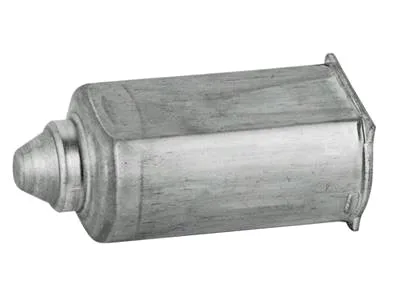
Aluminium cans: what changes when the shell stops being steel
Most motor cans are steel for one honest reason: the magnetic circuit. But some window regulator and auxiliary motor designs separate the flux path from the shell – yoke as a separate insert, or motor architectures that do not need the can to carry flux – and then aluminium’s weight, thermal conductivity and corrosion immunity become attractive. Drawing an aluminium can is the same physics with different constants, and the differences matter enough that a steel quote cannot simply be rescaled. This page is the aluminium-specific conversation.
Aluminium draws differently: the physics that changes
Three constants reset when the sheet becomes aluminium. Draw ratio: aluminium’s work-hardening and friction behaviour support roughly 1.6-1.8 single-stroke against steel’s 1.9-2.0 – deep aluminium cans go two-stroke more readily than steel ones, and quoting around it is dishonest. Springback: aluminium’s lower modulus means roughly three times steel’s elastic recovery, so open-end flares and flange lifts are bigger and need sizing operations steel designs might skip. Galling: aluminium sticks to tooling – draw dies for aluminium run polished, coated (PVD or hardened chrome) and lubricated with aluminium-specific oils; a steel die run against aluminium uncoated will gall within a shift. None of this is difficult; all of it is mandatory knowledge, and it separates suppliers who run aluminium routinely from those who rescale steel programmes.
Alloy selection: the real options
- 1050 / 1060 (pure series) – maximum formability, minimum strength. Draws beautifully, dents easily. Right for cans whose shell carries no structural load and whose magnetic function is handled elsewhere.
- 3003 / 3103 – the workhorse middle. Good draw behaviour with modest strength gain from manganese; the default for drawn motor cans and housings in aluminium.
- 5754 / 5182 (aluminium-magnesium) – strength with acceptable formability at room temperature, but watch two traps: magnesium alloys age-harden at room temperature after annealing (limiting redraws scheduled late), and they show stretcher-strain marks on shallow draws unless skin-passed. For structural cans and brackets they earn their place; for deep draws they need process care.
- 6xxx in drawn form – rarely. Heat-treatable alloys work-harden fast and crack in deep draws; they belong to extrusions and machined parts, not deep drawing. A drawing specifying 6082 as a drawn can is a conversation we start before quoting.
Finishing aluminium cans
Aluminium’s corrosion immunity is real but conditional – it pits in chloride environments and galvanically corrodes when bolted to steel, which describes most motor assemblies. The standard defences: chemical conversion coating (chromate-free trivalent passivates are now the norm) as the base, anodizing where wear or dielectric strength is wanted, and design-level galvanic management – isolating washers or compatible fasteners where the can bolts to steel bracketry. Inside a door cavity, conversion coating plus drainage awareness covers the duty cycle; exposed locations may want anodize. We match the finish to the assembly context rather than defaulting upward, because anodizing a hidden can is money with no function.
Where aluminium genuinely wins – and where it does not
The honest ledger: weight (30-40% lighter than the equivalent steel shell, real in window regulators where every gram counts against regulator fatigue), thermal conductivity (four times steel – the can doubles as a heatsink for hot-running designs), corrosion (no plating line, no red rust ever). Against it: material cost per unit stiffness (walls go thicker to recover strength), draw limitations on depth, and the magnet-compatibility constraint that keeps aluminium out of flux-path duty. For motor designs that already carry a separate yoke, the ledger usually favours aluminium in window regulators and favours steel everywhere the flux path matters. We will run the comparison on request; the answer is programme-specific and the calculation is short.
A redraw is what steel would not have needed
Can diameter, depth, wall, alloy (or the trade space you want us to explore), the magnetic architecture (does the can carry flux – yes/no), the assembly’s galvanic context, and volume. First articles in three to four weeks after die approval; aluminium tooling is built with its coatings specified from day one, because retrofitting a galled die is a false economy.
Can you match the steel can’s depth in aluminium?
Can you match the depth of our steel can in aluminium?
Usually, with a redraw that steel would not have needed – and the quote shows that station honestly. If the depth is marginal, we explore a design tweak before committing the die.
Our aluminium cans show white marks after storage – what is that?
Likely chloride pitting from handling or packaging rather than storage humidity alone; conversion coating and chloride-free packing paper close it. We can diagnose from photographs.
Is aluminium actually cheaper once plating is removed?
At stable volumes, often yes – the blank costs more and the finishing line disappears. The comparison only works with real plating prices in it, which is why we model the total cost rather than compare blanks.
This part belongs to our Automotive Motor Components range. The automotive motor components pages collect the process notes, common materials and inspection points behind every product in the family.
Specifications
| Item | Power Window Regulator Motor Aluminum Can |
|---|---|
| Brand | AUNOV |
| Designing | Made to your 2D/3D drawings (PDF, DWG, STEP, IGS) – a manufacturability review comes back with the quotation; the agreed version governs every later batch. |
| Tooling | Progressive and drawing dies are designed and built in house, so die cost stays transparent, and the die remains dedicated to your part. |
| Samples | First-article samples ship with a dimensional report and material certificate, so any deviation is corrected at sample stage, and mass production is gated on that approval. |
| Materials | Aluminium 1050, 3003 and 6061; anodising-grade or chromate-grade surface supplied to suit the finish chosen. |
| Surface finish | Corrosion protection comes from zinc or nickel plating, housings additionally take powder coating or electrophoresis, and laser etching can be added on request. |
| Processing | Blanking, multi-stage deep drawing with interstage annealing, trimming and piercing, coining, then finishing. |
| Equipment | 5-250 T mechanical and 250-500 T hydraulic presses, annealing ovens, and CNC turning and machining centres for secondary work. |
| Tolerance | +/-0.01 mm to +/-0.03 mm on controlled dimensions, with CMM reports and capability data for critical features. |
| Delivery terms | CIF or DDP, with FOB available, T/T with deposit and L/C for larger runs; price breaks tie to annual volume. |
Related Products

Request a Quote for This Part
Send a drawing or sketch — get material advice, tooling cost and a per-piece price within 24 hours (working days).