
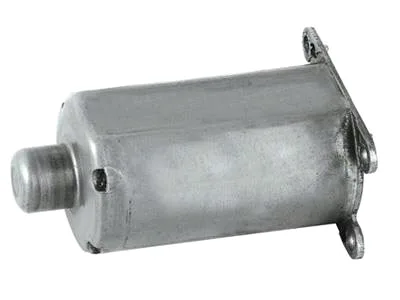
High torque, small can: the window regulator motor can
The power window regulator motor can carries a harder magnetic job than its size suggests. Window motors produce among the highest torque densities in small DC machinery – a 35 mm can pushing enough torque to lift a glass against seals, ice and fingers – and the can is half of the magnetic circuit doing it. This page covers the can-specific engineering: how the shell stays dimensionally honest under flux saturation, how magnets are retained at these load levels, and what a buyer should look for in a can supplier’s data.
The saturation ceiling in practice
Window motor designers trade magnet strength against can thickness, and the trade ends at saturation – roughly 1.5-1.6 T in low-carbon steel. A can wall sized carelessly saturates opposite the poles, and the motor’s torque curve flattens where the spec wanted a peak. The can supplier’s contribution is wall uniformity: a wall specified at 1.0 mm that actually runs 0.90-1.15 mm across its circumference varies the flux path by ±12%, which reads directly as torque spread between motors. We map wall thickness around the circumference on first articles and hold the map within a ±5% band in production – the tightest spec in the can family, because this is the family where it pays.
Magnet retention at reversal loads
Window motors reverse against pinches, and every reversal inertially loads the magnets bonded inside the can. Magnet retention is a shared design: the adhesive carries the shear, the can’s inner surface carries the adhesive. That inner surface is a drawn surface, and its finish decides the bond line – too smooth and adhesives starve; too rough and the bond thins on the peaks. Our can inner surface is specified and verified for bond readiness: a defined roughness band, cleaned of drawing lubricant (an aqueous wash stage between draw and bonding, because residual oil is the classic quiet killer of magnet bonds), and lot-sampled with a dyne test so the adhesive supplier’s surface-energy window is met consistently. Motor makers who fight “random magnet shift at endurance” usually trace it here.
One-stroke or two: the depth decision
Window motor cans are deep for their diameter – aspect ratios near 2:1 are common – which puts them at the draw-ratio boundary. Our standard is simulation-first: one stroke where thinning stays under 12%, redraw where it does not. The redraw’s piece-price premium is cents; the yield difference is points. Where the design allows, a slight taper or thicker section at the open end buys draw ratio honestly. What we refuse to do is quote a one-stroke can at ratio 2.1 and let the scrap rate appear later as a price increase – the depth decision is made on the simulation, stated in the quote, and stays made.
The can as thermal path
Window motors cook in bursts: stall currents heat the armature fast, and the heat’s only easy exit is through the can wall into the regulator’s bracketry. Wall thickness therefore plays a thermal role beyond its magnetic one – a can that doubles as heatsink wants thickness where the bracket contacts it and consistency everywhere else for flux uniformity. Local thickness variation is achievable through blank development rather than machining; our blanking strategy for thermal-graded cans places the thicker zone at the contact band, which the simulation confirms and the wall map verifies.
Torque variation between lots is usually wall uniformity
Can diameter, depth, wall, material; the magnet bonding spec (adhesive, cure, surface-energy window); the motor’s stall and reversal loads; volume. First articles in three to four weeks after die approval, with the wall map and bond-readiness certificates included as standard for this family.
Trim, flange and closure details at can scale
The can’s open end closes against the end-bell, and its geometry there decides assembly quality. Flange width must exceed the fastener land plus the seal width with margin for flare; trim height tolerance drives the gasket compression directly, so the trim tool is sized to the flared end and restrike-squared before trimming. Some window cans carry an inward curl or rolled rim for stiffness at minimum weight – formable in fine-grain steel, and a feature the die develops with the blank rather than improvises at tryout. None of these details is exotic; all of them are cheaper agreed at RFQ than reworked at PPAP.
Why do our cans vary in torque between production lots?
Why do our cans vary in torque between production lots?
Likely wall uniformity or inner-surface condition – both affect the magnetic circuit. Send cans from the good and bad lots; our wall maps usually separate them in an afternoon.
Can you bond the magnets for us?
On qualifying volumes, yes – bonding, cure-verification and pull-test sampling as a value-added step, with the adhesive specified by your motor group. The bonding jig is dedicated to your magnet geometry.
Is stainless steel possible for a window motor can?
Ferritic 1.4016, yes – and its slightly stiffer draw is manageable. Austenitic 300-series, no; the flux path dies. We flag the distinction in every quote review because the cost of catching it late is a motor redesign.
Automotive Motor Components is the parent range for parts like this one; the overview page gathers the tooling logic, finishing options and tolerance notes that apply across the family.
Specifications
| Item | Power window regulator motor can |
|---|---|
| Brand | AUNOV |
| Designing | Driven by your drawing or a physical sample – unusual walls, threads or tolerances are feasibility-checked first; the same drawing is used for every repeat order. |
| Tooling | Progressive and drawing dies are designed and built in house, so tooling lead time stays under our control, and the charge is refundable against agreed volumes. |
| Samples | Pre-production samples come with a full inspection report, so the approved first article becomes the gauge reference, and the signed sample is kept for future reorders. |
| Materials | Carbon steel, 304 / 316 stainless steel, aluminium and brass are held in stock; the drawing review fixes the final grade. |
| Surface finish | Adhesion comes from phosphating, followed by powder coating, e-coating or zinc plating; visible faces get chrome or nickel. |
| Processing | Blanking, multi-stage deep drawing with interstage annealing, trimming and piercing, coining, then finishing. |
| Equipment | Mechanical presses 5-250 T, hydraulic presses 250-500 T, an in-line annealing furnace, and CNC turning for secondary work. |
| Tolerance | +/-0.01 mm on machined faces and +/-0.05 mm on formed details; GD&T per drawing, PPAP-style reports on request. |
| Delivery terms | CIF or DDP, with FOB available, payment by T/T, L/C at sight or D/P; repeat orders reuse the approved first article. |
Related Products

Request a Quote for This Part
Send a drawing or sketch — get material advice, tooling cost and a per-piece price within 24 hours (working days).