
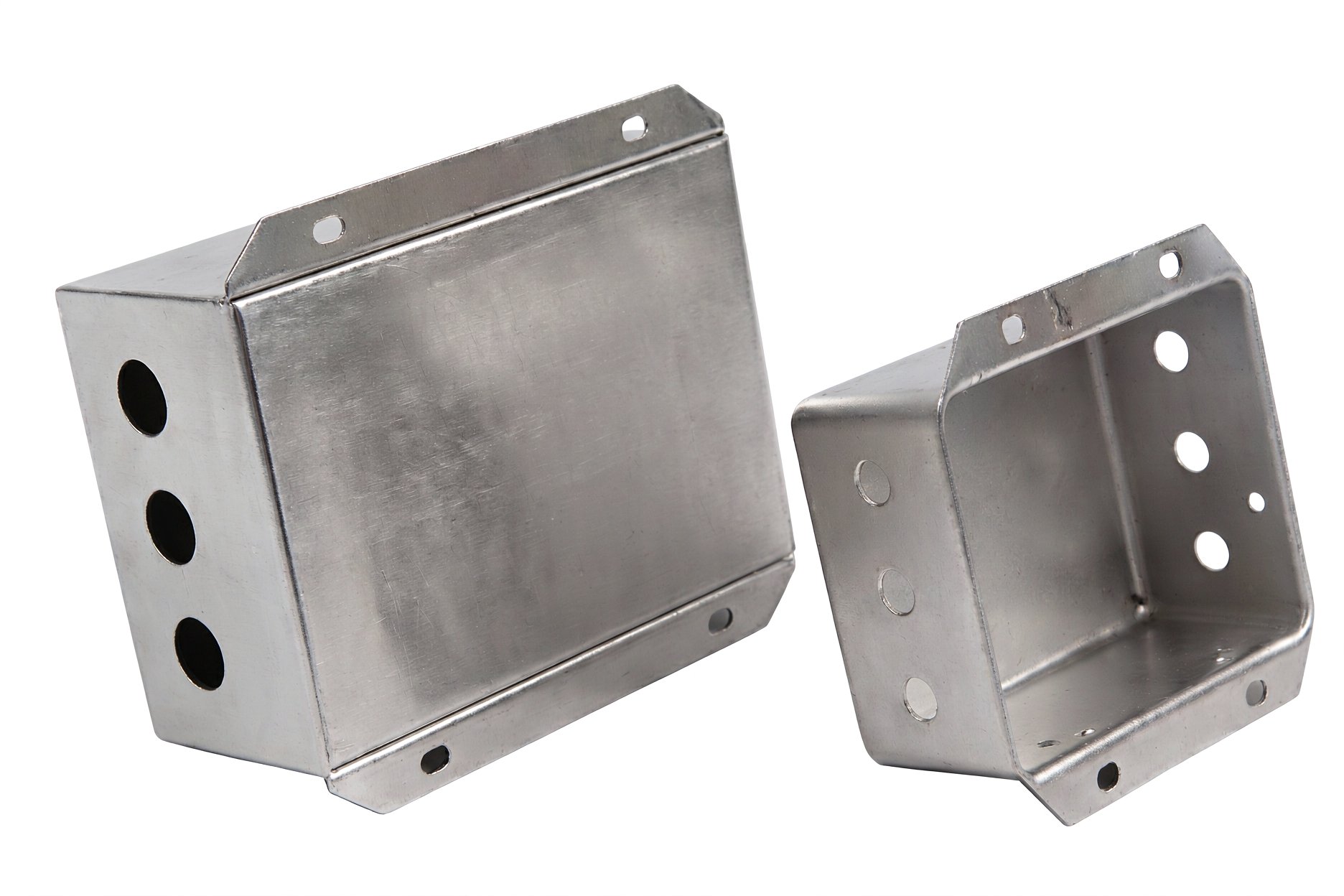
A square cover is four corners, and the corners are where every square cover fails
A deep drawn square cover in stainless steel is a shallow square dish with a flange, and it looks like the simplest thing in this family. It is also the geometry that behaves worst in forming, because a rectangle has four corners and the material in them has to travel furthest to get there. Every quality problem on a square drawn cover – the corner that cracks, the corner that lifts, the corner that is thinner than the rest – comes from the same place, and understanding that is the whole of the engineering on this part.
We draw these progressively through several stages, annealed between draws, then trim and pierce, and every stage is logged against your part number, on mechanical presses 5-250 T plus hydraulics 250-500 T with in-line annealing, secondary operations on CNC turning centres, and CMM inspection. Drawn diameters to +/-0.05 mm with tighter bands confirmed against the drawing, and finer bands confirmed from capability data before quoting. Stainless Steel 304 and 316L, pickled and annealed, at 0.5-3.0 mm nominal wall – one grade chosen for the corrosion duty and the formability of this cover. Zinc, nickel or chrome plating, anodising, passivation or e-coat are available, with masking and laser marking available where needed. This page is about the corners, and the four decisions that decide whether a square cover is flat or dished.
Why the corners are different from the walls
Think about a flat blank being drawn into a square cup. The material in the middle of each wall travels a short distance to form the wall. The material at the middle of the base barely moves. The material in the corners has to travel furthest of all – diagonally outward and then down – and it is the last material to arrive. Four consequences, and they compound each other:
- The corners are the most stretched region on the part, and therefore the thinnest. On a square cover the corner wall is measurably thinner than the wall in the middle of a face, and this is geometry rather than a defect. It should be specified, and it should be specified at the corner rather than at the face.
- The corners are where cracking starts. The material at a corner is at its forming limit, so it has no margin. A tight corner radius there takes it over the limit and a crack appears. The corner radius on a square cover is the single most important geometric dimension on the part, and it is almost always left to the toolmaker.
- The corners pull in four directions, and the four pulls are not perfectly symmetric. So a square cover is not merely dished – it is twisted, with opposite corners slightly higher than the other pair, and a twisted cover will rock on a surface. This is a worse condition than a uniform dish because it cannot be corrected by a simple shim.
- The corners are the last-formed region, so on a multi-stage draw they are formed from material that has already been worked, and they are where an interstage anneal matters most.
What the corner radius actually controls
The corner radius is worth understanding as three separate things, because it controls three separate problems:
- Forming. A generous radius lets the material flow around the corner. A tight radius makes the material stretch instead, and stretch at a corner is exactly what leads to cracking. One material thickness is the absolute minimum; two to three thicknesses gives a much better margin and a more stable corner.
- Stiffness. A tight corner is a good stiffener – it resists a change of shape locally. So the corner radius is trading formability against stiffness, and a cover that needs to resist denting wants a tighter corner than the forming process would ideally choose. Where both matter, the answer is a moderate radius plus a separate stiffening feature.
- Flatness. A large radius spreads the corner’s forming effect over a wider area of the base, which reduces the local distortion near the corner. A small radius concentrates the distortion. So a larger corner radius also helps the cover stay flat – which is a trade against the stiffness benefit.
Since all three pull in different directions, the corner radius on a square cover is a genuine design decision rather than a default, and the right value depends on which of the three the cover cares about most.
Flatness, which on a square cover is harder than on a round one
A round drawn cover has symmetric residual stress and stays flat. A square one does not, and this is the part’s defining quality problem. Four things that improve it, in order of effectiveness:
- A larger corner radius, as above – it spreads the distortion and reduces the twist.
- A coining operation on the final station, which presses the base to a controlled flatness and is the reliable fix. On a cover whose flatness is functional – where it seats or seals – this is usually the right answer.
- A stiffening feature in the base, and here there is a cleanability trade-off. A rib raises the base’s stiffness dramatically for very little material, and a rib on a cover that will be washed creates a pocket that holds residue. A rib that runs to a drain hole, or one whose profile has no closed geometry, resolves it.
- A thicker base than wall. This works and it is the expensive answer in material. A uniform-thickness square cover is a dishable square cover.
Flange and rim, and the fit to the base
Flange and rim dimensions to +/-0.05 mm with the wall controlled by the draw. On a square cover, the flange has two additional problems that a round cover does not have:
- The flange is not naturally flat, because the four walls were formed around it and left it in tension. A square cover’s flange tends to bow along the middle of each side and lift at the corners, and this is a shape the drawing’s flatness callout has to allow for.
- Corner radius on the flange, in the corners of the square, has the same forming and stiffness trade-off as the base’s corners, and a very tight flange corner on a square cover is a common source of a corner crack on the trim line.
So where the flange seals or seats, its flatness has to be specified against a named surface, the corner lift has to be anticipated in the tolerance, and the flange’s corner radius needs the same consideration as the base’s.
Pickled and annealed, and what that says about the surface
Stainless Steel 304 and 316L, pickled and annealed, at 0.5-3.0 mm nominal wall. That material description is doing real work, and two parts of it are requirements rather than information:
- Pickled means the anneal’s oxide skin has been removed by acid treatment. On a drawn part the anneal leaves an oxide, and on a visible cover that oxide is a surface defect; on a cover that will be handled, the oxide is a roughness. Pickling is therefore a surface requirement and it should be stated as a process step with a verification method – not as a material description.
- Annealed means the material is in a soft, ductile, stress-relieved condition. On a square cover, where the corners are near the forming limit, the annealed condition is what makes the geometry achievable – and it is also why the part’s final shape is sensitive to the material’s condition and why the material’s specification is part of the tolerance scheme.
The practical consequence for a square cover: because the corners are working so hard in the draw, the corner’s condition after the anneal is what determines whether it cracks. A tighter material specification, or a material selected for its formability rather than for its strength, is often the fix for a corner-cracking problem that the geometry alone has been blamed for.
Coverage is worst in the corners of a square cover
Zinc, nickel or chrome plating, anodising, passivation or e-coat, with masking and laser marking available where needed. Four points on a square cover:
- Coverage is worst in the corners, because a corner is a concave region that a spray reaches least. On a square cover the four corners are the last places to be coated, and on a cover in a severe environment that is exactly where corrosion will start.
- A coating follows the flange’s existing shape, so it does not correct a dished flange – it may even exaggerate the local build at the lifted corners.
- Masking the sealing face, if the cover seals, and masking any locating feature, since these are the surfaces whose precision matters.
- Passivation on stainless steel changes no dimension and gives full corrosion resistance, which makes it the natural choice on a cover whose flange has a tight fit and whose appearance requirement is modest. A visible cover wanting colour and gloss is where plating or anodising earns its place.
Square means four corners that all pull
Eight things, and the first three are what a square cover needs that a round one does not:
- Corner radius, stated as a dimension, on both the base and the flange – and the corner is the part’s most important geometric feature.
- Wall thickness at the corner, and at the middle of a face, stated separately. A square cover’s wall varies, and a single nominal does not describe it.
- Flatness or twist, stated with the surface and the support condition, and with the tolerance realistic about the corner lift. On a square cover this is the requirement that most needs writing down and least often is.
- Wall thickness held to print, with the minimum location identified – the corner.
- Any stiffening feature in the base, with its geometry and its drainage direction if the cover is cleaned.
- Flange flatness and corner lift, as separate requirements from the flange’s size, if the cover seats or seals.
- Pickling and passivation stated as process steps, with a verification method, since the material description’s “pickled and annealed” is not a surface specification.
- Material grade – 304 or 316L – tied to the environment, and which surfaces are masked.
Does this cover have to be square?
Does this cover have to be square? It sounds like a strange question for a part that is described as a square cover, but the reasons for a square are usually one of three: it has to fit a square opening, it has to match a square mating part, or it looks better square. In the first two cases the square is required and this page’s corner requirements are the price of it. In the third case, a round cover is dramatically easier to form, flatter, cheaper to tool, and stronger for the same weight – and a round cover will fit a square opening with a round-to-square adapter if the constraint is really about appearance. It is worth asking which of the three reasons applies, because the answer tells you whether the corner geometry is a solved problem or an ongoing one.
Sizing the draw for a part like this — reduction per station, ironing allowance, flange width — is covered step by step in our deep drawn covers guide.
Specifications
| Item | Stainless steel deep drawn square cover |
|---|---|
| Brand | AUNOV |
| Designing | Send drawings, or send a sample to be measured – a manufacturability review comes back with the quotation; the approved drawing is kept as the controlled master. |
| Tooling | Progressive and drawing dies are designed and built in house, so no tooling step is outsourced, and maintenance is tracked against the part number. |
| Samples | Prototype and pre-production samples are provided against the drawing, so any deviation is corrected at sample stage, and later batches are gauged back to the signed sample. |
| Materials | Stainless Steel 304 and 316L, pickled and annealed, 0.5-3.0 mm nominal wall – one grade chosen for corrosion duty and formability of this cover. |
| Surface finish | Zinc, nickel or chrome plating, anodising, passivation or e-coat; masking and laser marking available where needed. |
| Processing | Progressive drawing through several stages, annealed between draws, then trim and pierce; every stage is logged against your part number. |
| Equipment | Mechanical presses 5-250 T plus 250-500 T hydraulics, with in-line annealing; secondary ops run on CNC turning centres, inspection on the CMM. |
| Tolerance | +/-0.05 mm on drawn diameters, tighter bands confirmed against the drawing; finer bands confirmed from capability data before quoting. |
| Delivery terms | FOB Ningbo or Shanghai, T/T or L/C, with D/P accepted on repeat business; each volume tier carries its own quoted price. |
Frequently Asked Questions
Can a square cover be deep drawn, or must it be welded?
A square or rectangular cover can be deep drawn in one piece when the corners are radiused enough for the metal to flow, avoiding the welds and fixtures a fabricated alternative needs. The corners are the engineering – too sharp and the wall splits or thins, so the radius is part of the specification, not an afterthought.
What flatness does a deep drawn square cover hold?
The mounting face is the critical surface and is held by the draw and the trim, typically to a few hundredths of a millimetre, then checked on the CMM. Flatness is what the seal depends on, so it is named explicitly on the drawing rather than left to the trim allowance.
Which stainless steel is used for a deep drawn square cover?
304 is the default, with 316 specified for chloride or marine exposure. The grade is chosen for the environment, and mill certificates with heat numbers travel with the first article so the shipped covers trace to the coil.
How is a square cover sealed at the rim?
The seal runs on a uniform drawn rim or a formed land, and the cover is drawn so that edge is consistent all the way round. A wavy or thinned corner is where a square cover leaks, so the rim is held to its own tolerance band independent of the flat faces.
Related Products

Request a Quote for This Part
Send a drawing or sketch — get material advice, tooling cost and a per-piece price within 24 hours (working days).