
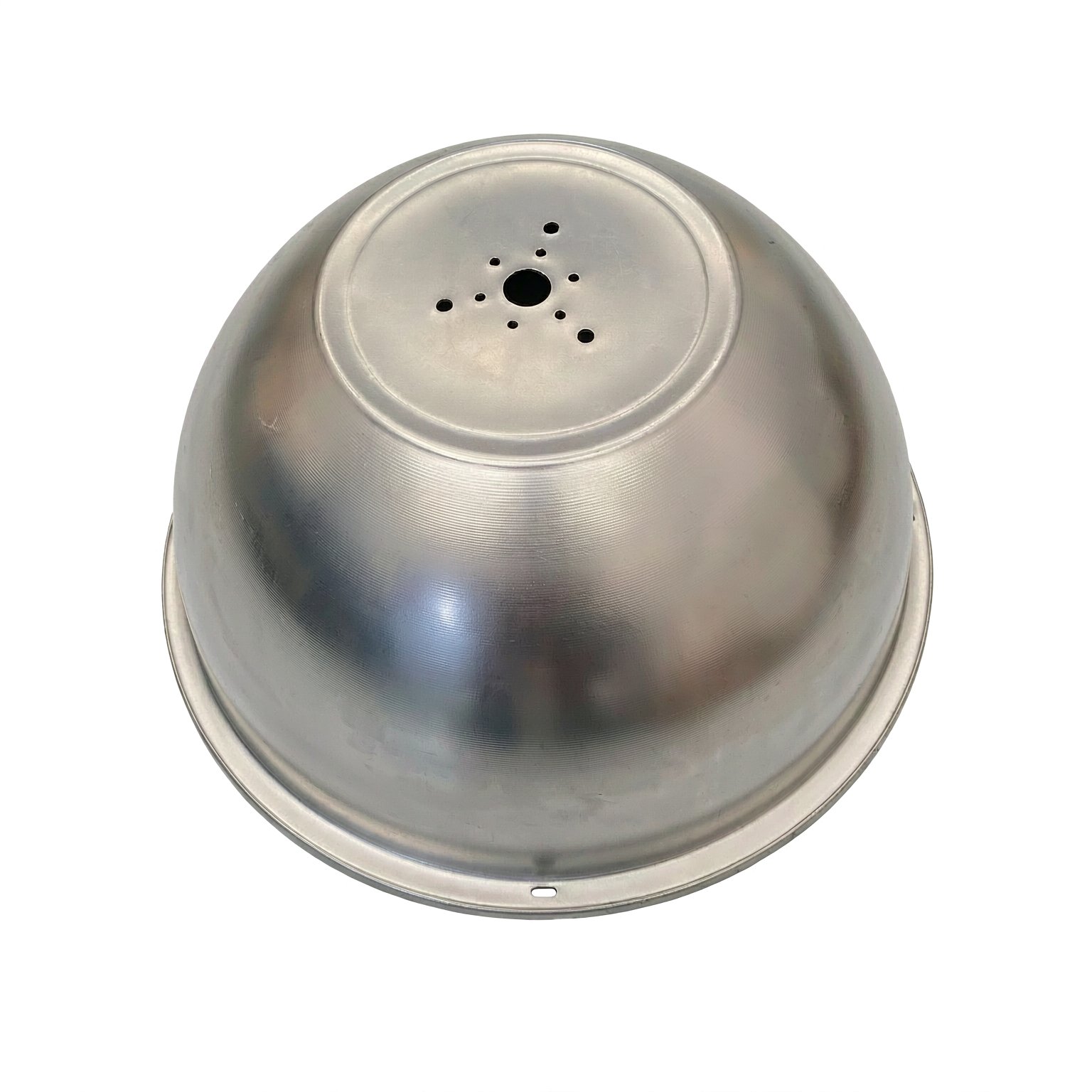
A light cover is a cover, and the “light” is a load case
A deep drawn stainless steel light cover is a cover, and the word “light” in its name is doing two different jobs. It describes what the part covers – a lamp, an indicator, a display – and it describes a physical property of the part itself, because a light cover is expected to be light. Both readings are real, and the second one is where the engineering is. A cover that is specified as a light cover but designed as a heavy one looks identical and weighs twice as much, and nobody finds out until the assembly is in someone’s hand.
We deep draw from coil or blank with in-process annealing so walls thin evenly, and every stage is logged against your part number, on 5-250 T mechanical presses and 250-500 T hydraulic presses and annealing furnaces in line, with in-house toolmaking keeping dies and fixtures maintained. Flange and rim dimensions to +/-0.05 mm with the wall controlled by the draw, and critical dimensions carry CMM data with the shipment. Materials held include carbon steel, 304 and 316 stainless steel, aluminium and brass, with material substitutes proposed only with your written approval. Finish is selected from the drawing – plating, coating, anodising or passivation – with the agreed finish travelling with the part number. This page is about the three ways “light” becomes a requirement, and about what each one costs to satisfy.
Three different meanings of light, three different requirements
- Low mass. Where the cover is on a portable or handheld product, or on anything that is carried, mass is a real requirement and it drives three things at once: the material, the wall, and the geometry. This is the interpretation that has actual engineering content.
- Light transmission or light-tightness. Where the cover is a lens, a diffuser, or a light seal, its optical behaviour is the requirement – and here the material, the finish, and the wall’s uniformity all matter, sometimes more than its mass.
- Simply a cover for a light fitting. The most common reading, where “light” simply qualifies what the cover fits over and the part has no mass requirement at all. This is the reading under which the part is a general drawn cover and this page’s other content is optional.
Establishing which of the three applies is worth one question at enquiry, because the answer changes the material, the wall, the tolerance scheme, and the price – and because the drawing under the third reading is a much simpler document than under the first.
If it means low mass: the three levers, and what each costs
On a part that has to be light, the mass is set by the material’s density and the volume of metal, and there are only three ways to reduce it:
| Change the material | The biggest lever by far. Aluminium is roughly a third the density of steel, so an aluminium cover of the same shape is about a third the mass. This is the single most effective move and it also changes everything else – the formability, the springback, the finishing options, and the stiffness. |
|---|---|
| Reduce the wall | Direct but limited, and it has a floor. The wall cannot go below what the forming process can handle without the part cracking or distorting, and on a drawn cover the minimum wall is set by the punch nose in the base and by the material’s forming limit. A thin wall also reduces stiffness, and a cover that flexes is a cover that rattles. |
| Reduce the volume of metal | By drawing features into the part – ribs, beads, or embossed stiffening. A rib that replaces material in a flat panel gives back most of the stiffness for a small fraction of the mass. This is the free move, and it is worth asking about because a cover designed with a rib is often lighter than the same cover designed with extra wall. |
The stiffness point is the one that catches people out. Stiffness in a shell scales with thickness cubed, so halving the wall reduces the stiffness to about an eighth. A light cover that has been made too thin will flex, and a flexing cover on a lamp or a display will rattle, will not seat properly, and will look thin. So the wall on a light cover is a stiffness requirement as much as a mass one, and the minimum is usually set by stiffness rather than by forming.
If it means optical: the material and the finish decide it
Where the cover is a lens or a diffuser, the optical requirement changes what the part can be:
- Light transmission favours a clear polymer or a very thin transparent material. A drawn stainless steel cover is opaque, so a “light cover” that transmits is not a stainless steel part – it is a different product, and the material line on the drawing should resolve which is meant.
- Light-tightness, for a lamp reflector or a display bezel that must not leak light, is a surface and a geometry requirement: a continuous shell, no pinholes, and a low-reflectance interior where stray light matters. This is the same family of requirement as a light-tight instrument housing.
- Diffusion favours a surface texture or a frosted finish, and on a stainless steel cover that means a mechanical finish rather than a coating. It is a real and separate specification from colour or corrosion.
Stainless Steel, and what it does to the mass question
Materials held include carbon steel, 304 and 316 stainless steel, aluminium and brass, with material substitutes proposed only with your written approval. On a light cover:
- Stainless Steel is dense. At roughly 8 g/cc against aluminium’s 2.7, a stainless steel cover of a given geometry is about three times the mass of an aluminium one. So on a genuine low-mass requirement, stainless steel is usually the wrong answer – and the drawing should be checked for whether stainless steel was specified for corrosion resistance, for appearance, or by default.
- Stainless Steel is stiff, for its mass, which offsets part of the penalty. A stainless steel cover of half the thickness can be as stiff as an aluminium one, and a thinner stainless steel cover can be lighter than a thick aluminium one. So the real comparison is stiffness at a given mass, not material density alone – and where mass is critical enough to matter, that calculation is worth doing rather than assuming.
- Aluminium is the usual answer on mass and it takes a coated or anodised finish for appearance and corrosion. Its stiffness penalty is real, so a rib is nearly always needed on an aluminium cover that has to be light and rigid.
A dished flange on a thin cover needs a flatness figure of its own
Flange and rim dimensions to +/-0.05 mm with the wall controlled by the draw, and critical dimensions carrying CMM data. On a cover:
- The flange’s flatness, if the cover seats against a frame or a bezel. A dished flange on a thin cover is common, because a thin cover is more prone to dishing, and a dished flange will not seat flat. Where the cover seats, this is a functional tolerance and it may need a coining operation or a machined face.
- The rim’s position, relative to the cover’s features, where the cover mounts or clips.
- Any locating feature, where the cover has to register – a tab, a spigot, a screw boss – and these are usually tight because they are what makes the cover fit in the right place.
- The wall, controlled by the draw. This is a material specification rather than a press one, and on a light cover where the wall is the mass – the wall’s tolerance is a mass tolerance and should be stated as one.
Finishing, and the two effects on a light cover
Finish is selected from the drawing – plating, coating, anodising or passivation – with the agreed finish travelling with the part number. On this part two effects compete directly against the part’s purpose:
- A coating adds mass, and on a genuinely light cover that is not a trivial amount. A powder coat at 80 microns on both surfaces of a cover is a measurable fraction of the part’s mass, and on a very thin cover it can be several percent. Where mass is specified as a requirement, the coating’s contribution has to be counted.
- A coating changes the flange’s dimension, by roughly twice its thickness, which on a flange at +/-0.05 mm is a real fraction of the band. So whether the flange is dimensioned before or after coating is a fit question.
On a light cover, passivation or a thin metallic plating is often the better choice than a powder coat, because it protects the surface without adding significant mass – and where the appearance requirement allows, that is the specification worth discussing at review.
Weight and stiffness rarely point the same way
Eight things, and the first is the one that resolves what “light” means:
- What “light” means on this part – low mass, optical behaviour, or simply a cover for a light. Everything else follows.
- If mass is a requirement, the mass limit as a number, so the material and the wall can be chosen against it rather than assumed.
- Material grade, and the density the design is working against – and if stainless steel, the reasoning for accepting its density.
- Wall thickness held to print, with the minimum location, and the stiffness requirement that sets it.
- Any stiffening feature – a rib or a bead – with its geometry, because on a light cover the rib is usually what makes the thin wall viable.
- Flange and rim flatness, as a separate callout from size, and whether the cover seats.
- Critical dimensions with CMM data, and what capability data exists for them.
- Finishing, including masked areas, and the coating’s mass contribution if mass is a stated requirement.
How much does this cover weigh, and how much must it?
How much does this cover actually weigh, and how much does it need to? A surprising number of “light covers” were specified as lightweight years ago when the enclosure was the heaviest part in the assembly, and the assembly has since been redesigned around them – so the mass requirement may no longer be binding, while the corrosion and appearance requirements that justified stainless steel still are. Asking for the actual mass and the actual reason for it takes one sentence and can remove the most expensive constraint on the part. Where the mass requirement is real, the second question is whether a ribbed aluminium cover would be lighter than a plain stainless steel one, because on most covers it is.
Drawing a cover like this is a chain of decisions — draw ratio, wall thinning, radii and trim. Our deep drawn covers design guide works through each of them with worked numbers.
Specifications
| Item | Deep Drawn Stainless Steel Parts Light Cover Metal Spinning Fabrication |
|---|---|
| Brand | AUNOV |
| Designing | Design intent is read from the print, and any conflict in the drawing is raised before quoting. |
| Tooling | Dies, fixtures and gauges are made in our own toolroom, so no tooling step is outsourced, and maintenance is tracked against the part number. |
| Samples | Sample parts are measured and reported before submission, so the sample is retained as the master, and production starts only after your written sign-off. |
| Materials | Materials held include carbon steel, 304 / 316 stainless steel, aluminium and brass; material substitutes are proposed only with your written approval. |
| Surface finish | Finish selected from the drawing: plating, coating, anodising or passivation; the agreed finish travels with the part number. |
| Processing | Deep drawing from coil or blank, with in-process annealing so walls thin evenly; every stage is logged against your part number. |
| Equipment | 5-250 T mechanical presses, 250-500 T hydraulic presses and annealing furnaces in line, with in-house toolmaking to keep dies and fixtures maintained. |
| Tolerance | +/-0.05 mm on flange and rim dimensions, wall controlled by the draw; critical dimensions carry CMM data with the shipment. |
| Delivery terms | FOB, CIF or DDP per Incoterms 2020, T/T or L/C, with D/P accepted on repeat business; repeat orders reuse the approved first article. |
Frequently Asked Questions
Is this light cover deep drawn or spun, and which wins?
For a shallow, symmetrical cover the part may be spun, but where the wall is taller or the rim has to be precise the shell is deep drawn and then finished. The choice is set by the aspect ratio and the tolerance on the mounting face, and spinning is favoured when a simpler form gets the part into hand faster.
How is a thin light cover kept flat at the mounting flange?
The flange is held by the draw and the trim, typically to a few hundredths of a millimetre and checked on the CMM, because a cover that rocks on its seal leaks light or ingress. Flatness is named on the drawing rather than left to the trim allowance.
Which stainless steel is used for a light cover?
304 is the default for general use, with 316 for chloride or marine exposure. Where the cover also has to stay light, the grade is balanced against the wall, and mill certificates with heat numbers travel with the first article.
What does the optical requirement do to the finish of a light cover?
If the cover sits in an optical path, the inside finish and any coating are specified so they do not scatter or tint the light, and that finish is applied without changing the geometry the seal depends on. The optical and sealing requirements are planned together, not one after the other.
Related Products


Request a Quote for This Part
Send a drawing or sketch — get material advice, tooling cost and a per-piece price within 24 hours (working days).