
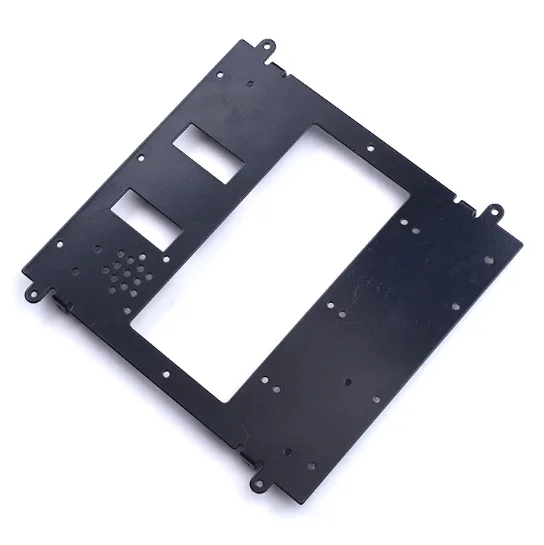
This aluminium cover is hydroformed, and it is the clearest case in the family of a part where the process is chosen for one reason – the shape – and where every difficulty afterwards comes from what that process does not do well. Hydroforming makes a smooth compound contour. It does not make anything non-axisymmetric, it does not pierce a hole, and it does not leave a uniform surface. An electrical cover needs all three.
The shape is the reason, and it costs a secondary operation each
Because the process cannot pierce, every hole, slot and cut-out on this cover is a secondary operation on a part that has no flat to locate from. Because it cannot make a non-axisymmetric feature, the mounting feet and the cable entries are formed or added afterwards. Each of those operations needs a fixture that grips a curved shell without distorting it, and that fixture is a real part of the cost rather than an afterthought.
The surface is not uniform, and this cover is powder-coated
Expanding metal into a die leaves a surface that varies with how far each area has stretched, and the cover is then finished in black powder coat. A coating hides colour variation but it does not hide texture, and on a large smooth panel the differences read as uneven gloss. Surface preparation before coating is therefore specified as part of the route, not left to the coater, and we approve the finish on a sample before the run.
Aluminium grade follows the forming depth
The grade is chosen from the depth the contour has to reach and from what the cover has to do afterwards. The softer commercial-purity and manganese-bearing alloys form deepest and are used where the shape is demanding and the strength requirement is modest; where the cover is structural or has to be machined after forming, a heat-treatable alloy in the right temper is the answer, formed in the soft condition and treated afterwards. The temper and the route are decided together, because forming a part in the wrong temper cracks it.
Trimming a curved shell is its own problem
The trim line on a compound-curvature part is a three-dimensional cut, and holding it to the flange and rim the assembly needs is what makes the cover fit its enclosure. It is cut on the CNC cells rather than in a die, and it is verified on the first article against the mating part rather than against a nominal dimension.
How the cover is checked before it ships
Flange and rim dimensions are measured to the assembly requirement, the pierced features are checked for position on the curved surface, and the finish is approved against the agreed sample.
First articles and the approved finish sample are kept for the programme, so a reorder is formed, trimmed and coated the same way. On a part whose difficulty is all downstream of the forming, that is what keeps the second batch fitting its enclosure.
This part belongs to our Deep Drawn Parts range, where the process notes and tolerance practice behind the whole family are collected.
Where this part is used
Powder-coated hydroformed covers sit where a curved surface is both the structure and the visible face: electronic enclosures and instrument frames, EV charging equipment and industrial control cabinets, and any product where a flat stamped cover would either look wrong or leave a gap. Aluminium keeps the weight down on large covers, and the powder coat does the corrosion work that bare aluminium would need help with.
This cover is the clearest case in the family of a part where the process is chosen for one reason — the shape — and where every difficulty afterwards comes from what hydroforming does not do well. The surface is not uniform, so the coating has to be specified against the whole part rather than a flat panel.
What we need to quote it
Send the powder coat specification with colour, texture and film thickness, plus the areas that must be masked and the areas that must stay uncoated for grounding or connector contact. State the curvature and the forming depth, which set the aluminium temper, and tell us whether the cover carries connectors, displays or fasteners, since those decide the trimming and piercing sequence.
Specifications
| Item | Black Powder-Coated Electronic Frame Cover |
|---|---|
| Brand | AUNOV |
| Designing | Driven by your drawing or a physical sample – a manufacturability review comes back with the quotation; changes are priced before they are made. |
| Tooling | Our toolroom covers die design, wire-cut EDM and maintenance, so the die charge appears as its own quotation line, and first-article timing is measured from the tooling start date. |
| Samples | Prototype and pre-production samples are provided against the drawing, so any deviation is corrected at sample stage, and later batches are gauged back to the signed sample. |
| Materials | 1050 / 3003 / 5052 / 6061 aluminium, 0.5-3.0 mm stock – temper matched to the forming depth or machining route of this cover. |
| Surface finish | Plating, coating or polishing to suit the drawing; alternatives quoted with the quotation, samples approved in writing. |
| Processing | Tube or sheet preform, hydroforming into the finished contour, trimming, then annealing and finishing. |
| Equipment | 5-250 T mechanical presses, 250-500 T hydraulic presses and annealing furnaces in line, with CNC turning centres for secondary operations and CMM inspection. |
| Tolerance | +/-0.05 mm on flange and rim dimensions, wall controlled by the draw; dimensional reports accompany the first article. |
| Delivery terms | Freight, Incoterm and payment term are confirmed on the order: FOB, CIF or DDP, T/T or L/C. |
Frequently Asked Questions
Why does the shape end up costing more than the material?
Because every departure costs an operation. This cover is formed for its contour, and each subsequent feature that cannot come out of that one forming step becomes handling, a fixture and a setting. Shape – not gauge or grade – is what moves the number, and it is decided before anything else can help.
Why is coating this cover harder than coating a flat panel?
A curved, uneven surface does not coat evenly. Recessed areas attract less powder than exposed edges during application, so film thickness varies with position rather than being a property of the process. Specifying where minimum coverage has to be met matters more than specifying a nominal thickness.
Why should the aluminium grade follow the forming depth?
Forming asks for ductility before anything else, whereas most grade selection starts from strength. Deep or complex forming therefore needs a composition chosen for how far it will go, and selecting on strength alone tends to produce either splits in the tool or a weaker part than intended.
Why is trimming a curved shell its own problem?
The trim line is no longer on one plane. Cutting a three-dimensional edge means the line follows a curve in space, so it has to be defined against features rather than against a simple dimension. Poorly specified trim puts the visible edge in a different place every piece.
Related Products


Request a Quote for This Part
Send a drawing or sketch — get material advice, tooling cost and a per-piece price within 24 hours (working days).