
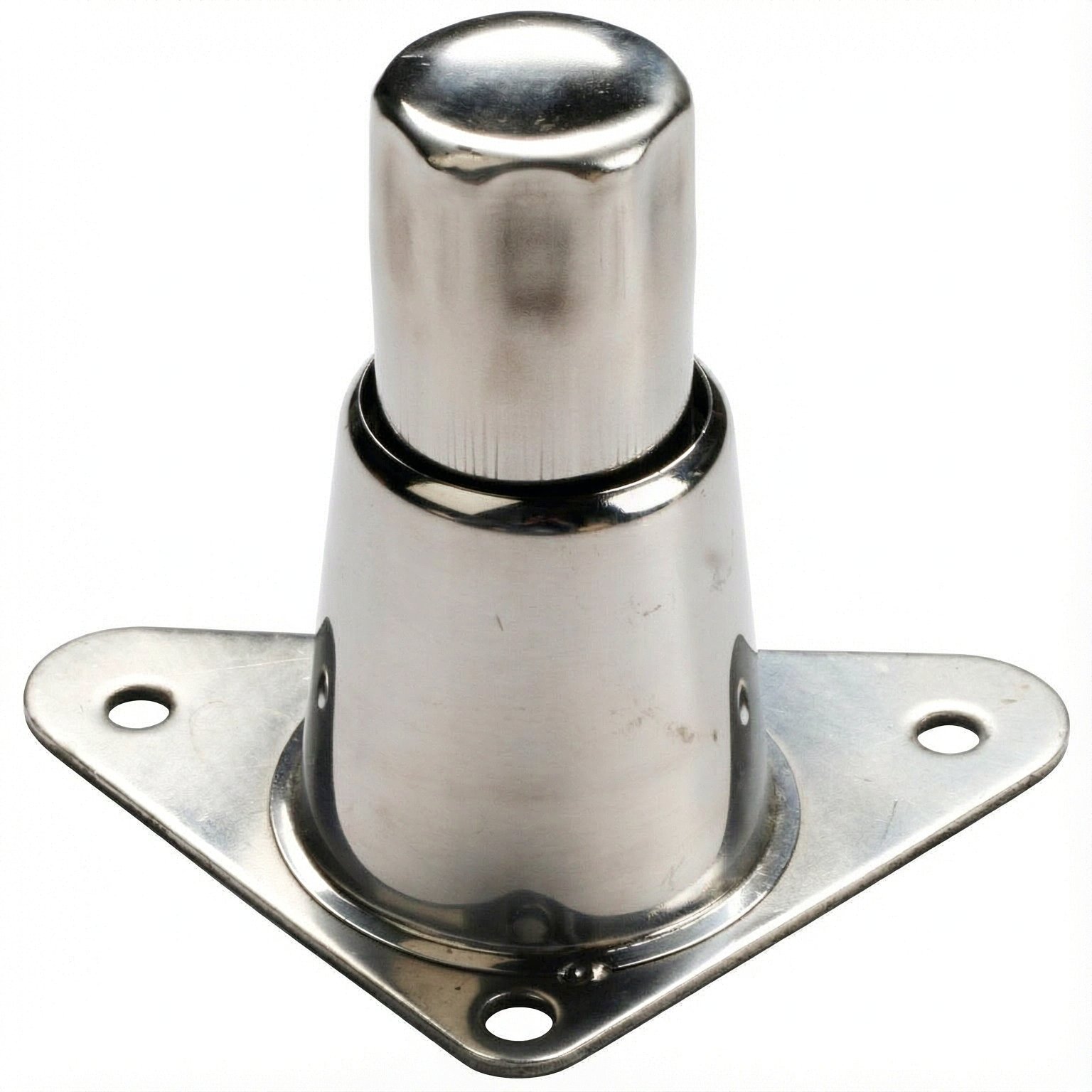
A medical battery housing has two independent requirements, and one of them is regulatory
A drawn medical battery housing with a base flange does two things that have nothing to do with each other. Mechanically, it is a drawn case with a flange that locates and seals it, and it has to hold a cell correctly and survive handling. Administratively, it is a component in a medical device, which means it has to be traceable, it has to be made under a controlled process, and it has to be documented to a standard that a general drawn case never has to meet. Neither requirement is optional and the second one is the one that catches people out.
We deep draw on maintained presses with blank size and lubrication logged per run, and batch records filed so a repeat order starts from approved data, on 5-250 T mechanical presses and 250-500 T hydraulic presses with annealing furnaces on site, CNC turning centres for secondary operations, and CMM inspection. Formed features to +/-0.05 mm with capability data on critical dimensions, and capability is checked on the first article before the run continues. Carbon steel, 304 and 316 stainless steel, aluminium and brass are all held in stock, with grade and temper confirmed in writing before tooling. Zinc, nickel or chrome plating, anodising, passivation or e-coat are available, with masking and laser marking available where needed. This page is about the two requirement sets and about why the medical one changes how the part is quoted, not just how it is drawn.
The mechanical requirement: a cell, a flange, and a lifetime
The mechanical side is broadly familiar from any battery housing, with three features specific to this part:
- The cell fit, over the cell’s life. A lithium cell changes – pouches and prismatic cells swell with age. The housing’s fit has to hold the cell at assembly and not crush it at end of life, which is a two-sided tolerance rather than a single interference. The cell’s part number and its maximum swollen dimension belong on the drawing.
- The base flange. A flange on a medical device’s battery housing is usually the part’s interface to the device – it locates the housing, it may carry the electrical contacts, and it may be the sealing face. So the flange has three jobs at once: position, sealing, and possibly current-carrying, and each has its own tolerance requirement. Its flatness and its position relative to the housing’s axis are functional and belong in the tight band.
- The vent path. A cell that goes into thermal runaway vents gas. In a medical device – where a patient and a clinician are both present – a venting cell in an unvented housing is a specific hazard. A vent in the housing, or a defined vent path elsewhere in the assembly, is a design requirement and it should be stated rather than assumed. This is also a case where a design review should confirm where the gas goes, because a vent that vents into a sealed enclosure has not solved anything.
The medical requirement: what actually changes
This is the part of the specification that a general drawn case does not carry, and it affects the quotation as much as the drawing:
- Material traceability, formally. Grade and temper confirmed in writing before tooling, and the material certificate with the heat number accompanies the batch. In a medical device this is not administrative tidiness – it is what makes a recall or an investigation possible, and it is frequently a requirement of the device’s quality system.
- Batch records, and what they have to contain. Batch records are filed so a repeat order starts from approved data. In a medical context, the records usually have to be retained for the device’s lifetime and have to be retrievable. That means the process data – press, tool, material lot, operator, date – is a deliverable with a storage requirement, not a shop-floor convenience.
- Process validation, where the device is validated. If the customer is running a validated process, the part’s production may need to be qualified or validated – which can mean first-article dimensional data, capability studies, and in some cases a documented process qualification. This is a real cost and lead-time item and it needs to be identified at quotation.
- Lot segregation and identification. A medical device’s parts usually need lot traceability so a finished device can be traced back. That means a marking requirement – laser marking is available and on a small medical part it is usually the answer. Laser marking is worth specifying early, because it is a per-part operation with its own cycle time and it needs a flat enough surface and enough contrast to read after.
- Change notification. Medical device supply chains usually require notification of any change to material, process, or supplier. That means the specification has to be frozen deliberately, and it is worth asking who authorises a change and how it is communicated.
Materials, and the medical question
Carbon steel, 304 and 316 stainless steel, aluminium and brass are all held in stock, with grade and temper confirmed in writing before tooling. For a medical device, the choice is more constrained than for a general part:
- 304 stainless steel is the most common choice for a medical battery housing, and for good reasons: it is cleanable, corrosion-resistant, non-shedding, and it is a well-characterised material in medical device contexts.
- 316 stainless steel where the environment is aggressive, or where the device is cleaned with aggressive chemistries, or where saline is present.
- Aluminium where mass matters, and it is used in some portable devices. It needs a controlled surface and, on a device that will be cleaned in an autoclave or in a wash cycle, its oxide behaviour has to be understood.
- Carbon steel with plating is used for a device where the enclosure is not a cleaned surface and cost matters. It is a legitimate choice and it is not a hygiene choice.
- Brass is rare on a medical battery housing and would be specified for a specific reason.
Finishing, and what a medical device needs from it
Zinc, nickel or chrome plating, anodising, passivation or e-coat, with masking and laser marking available where needed. Three requirements on a medical device:
- Passivation on stainless steel is a requirement, not a preference. Free iron from machining will spot and eventually rust, and on a device that is cleaned repeatedly the surface is repeatedly wetted. Passivation removes the free iron and restores full corrosion resistance, and it should be a stated process step.
- A coating that will not shed. A thick or brittle coating on a part that is handled repeatedly, or that is in a device which is dropped, can flake. This is a general medical-device concern and it is a reason to prefer a thin, adherent, well-bonded finish over a thick decorative one.
- Masking, and where it is required. The sealing face on the base flange, any electrical contact, any threaded feature, and any surface that bonds. Masking is a real operation and on a small medical part it is a meaningful part of the cost – and it is a decision that should be made at quotation rather than on the finishing line.
Eight items, and the last three would not appear on a general case drawing
Eight things, and this is a part where the last three would not appear on a general case drawing:
- The cell it holds, by part number and revision, including its maximum swollen dimension.
- Fit at assembly and at end of life, stated as a range.
- The base flange’s flatness, position, and concentricity, at the tight band, plus whether it seals, locates, or carries contacts.
- The vent path, defined, or explicitly stated as not required – and if required, where the gas goes.
- Material grade and temper confirmed in writing, with the certificate and heat number requirement stated.
- Batch record requirements – what has to be recorded, and how long it is retained.
- Marking, by laser or otherwise, and what the marking has to say – usually lot or date code.
- Passivation stated, and which surfaces are masked from any coating.
Does this part need to be a bare metal case at all
Is this part, as a bare metal case, actually required – or is the housing part of a moulded or machined assembly? A medical battery housing is very often a moulded polymer part, because polymer gives clean walls, integrated snap features, integrated contacts, and a much lower cost, and because a plastic case is easier to sterilise and to inspect. A drawn metal case is justified where the device needs EMI shielding, where a metal flange is required for a connector or a ground, where the environment is harsh, or where the customer’s design has specified a metal case. It is worth establishing which of those applies, because the answer changes the part, the price, the lead time, and the regulatory documentation burden – and it is a far better question to ask at enquiry than to discover during a validation review.
Cleanability, which a medical device adds on top
A medical device is cleaned between uses, often by an automatic washer-disinfector with defined chemistries and temperatures. On a drawn housing that produces three requirements:
- No closed pockets. A drawn housing with a formed dimple, a deep emboss, or a tight internal corner will hold residue. On a device that is washed repeatedly, that residue becomes a bioburden problem, and on a housing with a vent path a residue-filled vent will not vent.
- No crevices at the flange. A base flange and a housing wall meet at a corner, and that corner is a crevice. A generous internal radius there is a cleanability requirement rather than a manufacturing one, and it is worth stating as a minimum radius specifically for that corner.
- Surface condition. A drawn surface carries draw marks, and draw marks hold soil. Where the housing is in a zone that gets wet and is hard to dry, a drawn surface is a liability and a polished or coated surface is justified. Where the housing is dry and enclosed, it is not.
Beyond the drawing: what the quotation cannot tell us
Beyond the drawing itself, three pieces of information change the quotation materially and are worth establishing at enquiry rather than during a review:
- Which medical standard or quality system the device operates under, and whether the part itself is considered a device or an accessory. This determines whether the part needs a certificate of conformance, a lot number, or nothing beyond a material certificate.
- Whether the customer’s process is validated, and if so whether this part is in scope. A validated process may require first-article capability data rather than a first-article inspection report, and the difference between the two is a real amount of engineering and documentation time.
- The expected production life and the field life of the device. It sets the documentation retention requirement, and it may set a sterility or corrosion requirement that changes the material and the finish.
None of these three is unusual, all three are much cheaper to answer at enquiry than to answer six weeks later, and answering them is the difference between a quotation and a quote-followed-by-a-qualification-conversation.
Drawing, machining and welding each win on different geometries; the guide to deep drawn covers works through those boundaries, and the full Precision Deep Drawn Parts range is reachable from the overview page.
Specifications
| Item | Deep Drawn Medical Battery Housing |
|---|---|
| Brand | AUNOV |
| Designing | Quotation follows the print, not a catalogue – DFM notes are returned before any tooling is cut; the approved drawing is kept as the controlled master. |
| Tooling | Tooling is built and held under your part number, so die cost stays transparent, and ownership is confirmed on the quotation. |
| Samples | Pre-production samples come with a full inspection report, so the part is proven before it is made in volume, and the signed sample is kept for future reorders. |
| Materials | Carbon steel, 304 / 316 stainless steel, aluminium and brass are all held in stock; grade and temper are confirmed in writing before tooling. |
| Surface finish | Zinc, nickel or chrome plating, anodising, passivation or e-coat; masking and laser marking available where needed. |
| Processing | Deep drawing on maintained presses, blank size and lubrication logged per run; batch records are filed so a repeat order starts from approved data. |
| Equipment | 5-250 T mechanical presses, 250-500 T hydraulic presses and annealing furnaces in line; secondary ops run on CNC turning centres, inspection on the CMM. |
| Tolerance | +/-0.05 mm on formed features, with capability data on critical dimensions; capability is checked on the first article before the run continues. |
| Delivery terms | FOB, CIF or DDP per Incoterms 2020, payment by T/T or L/C, quoted in USD or EUR; price breaks tie to annual volume. |
Frequently Asked Questions
What makes a medical battery housing different from a standard one?
A medical housing is built to a cleanliness and traceability bar a standard part is not – the material, the finish, and every stage are documented so the part can be tied back to its coil and its run. That matters because the housing sits inside a device that has to pass audit, not just function.
How is a medical battery housing cleaned and validated?
The drawn shell is deburred and passivated, then cleaned to the device’s specification and verified rather than assumed. First articles are measured on the CMM and the cleaning step is recorded, because the validation is part of the product, not a separate job.
Which material is used for a deep drawn medical battery housing?
304 or 316 stainless steel is typical, chosen for biocompatibility and cleanability, with the grade matched to the body contact and sterilization duty. Mill certificates and heat numbers accompany the first article so the shipped housings trace to the coil.
What traceability does a medical battery housing need?
Every stage is logged against your part number, from the coil through the draw to the clean and pack, so a housing shipped months later traces to the same setup and material. That chain is what a medical audit asks for, and it is built into the route rather than added afterwards.
Related Products


Request a Quote for This Part
Send a drawing or sketch — get material advice, tooling cost and a per-piece price within 24 hours (working days).