
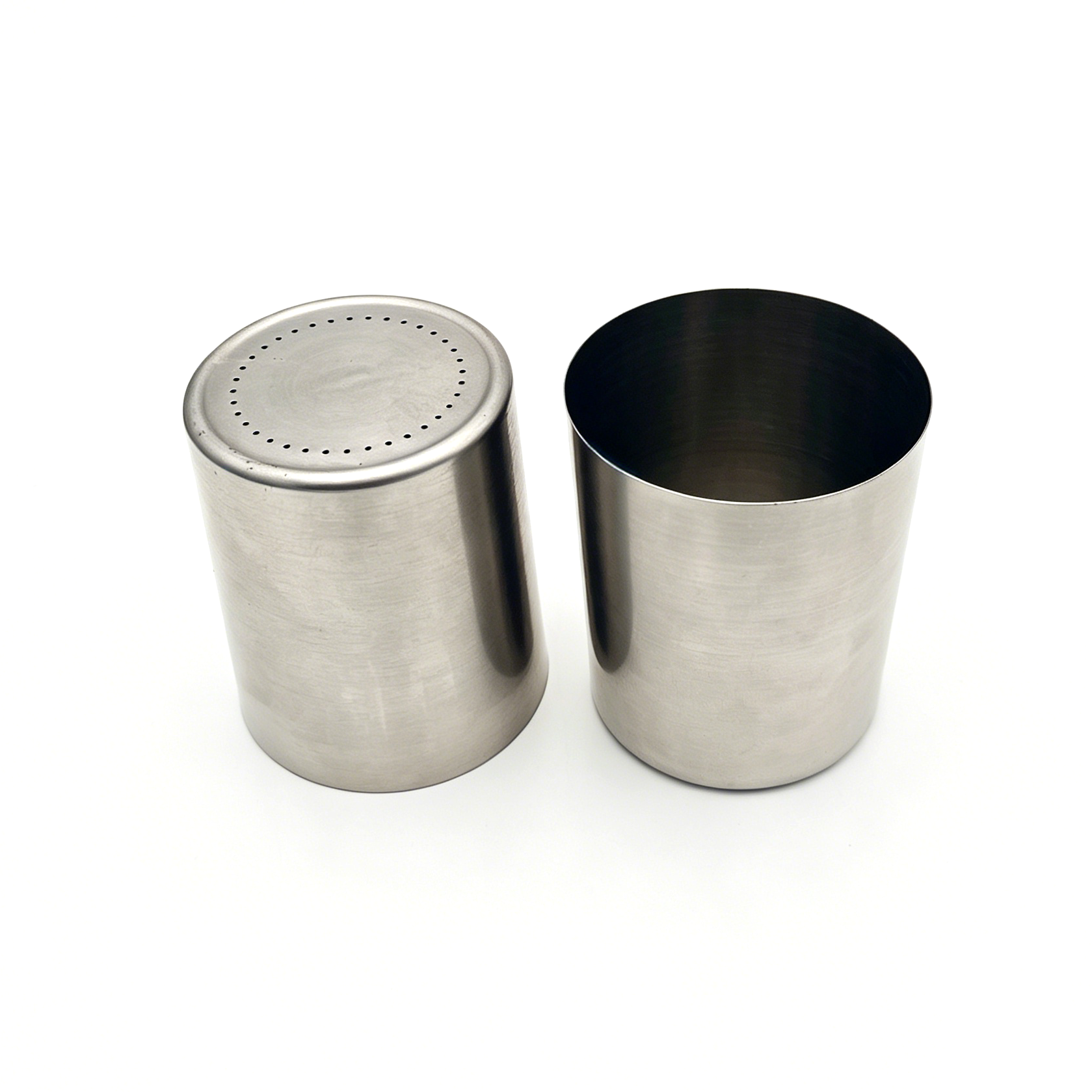
The stainless steel deep drawn cup with a perforated lid looks like two simple parts, but the engineering lives in the relationship between the cup mouth and the lid that snaps or welds over it. Get the perforation wrong and the lid buckles; get the cup mouth wrong and the lid will not seat. We draw both from the same material heat so the fit is predictable, and we treat the perforation as a structural decision, not a decoration.
Sizing the perforation pattern for flow without weakening the lid
A perforated lid has to pass air, liquid or light while still carrying handling and pressure loads, so the open area is a balance. We start from the flow the customer needs – say 30 to 40 percent open area for a vented food or filter cup – then distribute that area as many small holes rather than a few large ones, because small holes keep the lid’s bending stiffness far higher for the same throughput. Hole diameter typically runs 1 to 2.5 mm on a 0.5 to 0.8 mm lid, and we model the lid as a perforated plate, not a solid one, so the quoted deflection under a 5 kPa differential is real and not optimistic.
Pitch is held to +/-0.1 mm by a progressive pierce die, and we keep holes at least two diameters from the lid edge so the trim does not tear the pattern. If the lid must be washable or food-contact, we deburr both faces and specify a round, rolled entry rather than a sheared one, because a sheared hole in stainless steel has a sharp lip that cuts a cleaning brush and harbours bacteria. We also confirm the open-area percentage by weighing a sample lid against a solid blank of the same size, which is more honest than trusting the die drawing.
- We model the lid as a perforated plate, not a solid one, so the quoted deflection under a 5 kPa differential is real and not optimistic.
- Hole pitch is held to +/-0.1 mm by a progressive pierce die, and we keep holes at least two diameters from the lid edge so the trim does not tear the pattern.
- If the lid must be washable or food-contact, we deburr both faces and specify a round, rolled entry rather than a sheared one.
- We confirm open area by weighing a perforated lid against a solid blank, because the die drawing is not the as-made part.
Drawing 304 versus 316 for a corrosion-exposed cup
The choice between 304 and 316 is rarely about strength – both draw almost identically – and almost always about the service chemistry. For indoor or mild-duty cups we quote 304 because it is cheaper and draws cleanly; for marine, salt-spray or process-fluid duty we move to 316L so the weld seam and the drawn corners do not pit. The difference shows up first at the draw corner, where stretching thins the passive layer and any chloride in the environment finds the weak spot.
We confirm the grade from the mill certificate per heat and stamp the heat number into the job card so a corrosion claim can be traced, because a cup that pits in the field and cannot be tied to a heat is a closed investigation. 316L is our default when the lid is laser or resistance welded, because the lower carbon avoids sensitising the heat-affected zone during the weld. Where the customer is unsure, we quote both grades side by side so the lifetime cost, not just the unit price, drives the decision – a 316 upgrade on a small cup is often a few cents that buys years of service.
- We confirm the grade from the mill certificate per heat and stamp the heat number into the job card so a corrosion claim can be traced.
- 316L is our default when the lid is laser or resistance welded, because the lower carbon avoids sensitising the heat-affected zone during the weld.
- Where the customer is unsure, we quote both grades side by side so the lifetime cost, not just the unit price, drives the decision.
- We warn when 304 is being pushed into chloride service, because that is the single most common field failure we see on stainless steel cups.
Keeping the lid weld-free on a press-formed seam
Many cups spec a lid that is crimped or curled onto the mouth rather than welded, and that is usually the right call: a welded seam on thin stainless steel is a leak and a corrosion risk, while a mechanical seam is repeatable on the press. We form the cup mouth with a slight outward curl and the lid with a matching lip, then a final curling station rolls them together in one hit. The seam is always outside the perforation zone, so the lid’s structural ring stays intact around the holes.
Seam tightness is checked by a water or air-decay test on the first article, and we sample it per batch because curl pressure drifts as tooling warms and a warm die rolls a looser seam than a cold one. If a true hermetic seal is needed we fall back to resistance seam welding and then passivate, but we say so up front because it changes the tooling line and the price. We never quietly substitute a weld for a curl, because the customer chose the curl for a reason – usually cleanability or cost.
- Seam tightness is checked by a water or air-decay test on the first article, and we sample it per batch because curl pressure drifts as tooling warms.
- If a true hermetic seal is needed we fall back to resistance seam welding and then passivate, but we say so up front because it changes the tooling line.
- The seam is always outside the perforation zone, so the lid’s structural ring stays intact around the holes.
- We log the curl station pressure and die temperature window so a re-order repeats the same seam.
Holding open-cup diameter when wall-thinning fights you
As a cup is drawn deeper, the wall thins and the mouth wants to spring back oval, especially in stainless steel which has more springback than carbon steel. We hold the mouth diameter to +/-0.1 mm by drawing slightly under and then restriking the top few millimetres in a sizing ring, rather than hoping the first draw lands on size. The restrike also squares the mouth so the lid seats without a gap, which is the property the customer actually cares about even if the drawing only calls out diameter.
We measure mouth ovality with a two-point air gauge on the line, because a caliper misses the high spot that later blocks the lid, and that high spot is exactly what makes a lid bind on one side. Draw speed on the mechanical press is slowed for stainless steel so the wall flows instead of stretching and thinning unevenly, and the blank is lubricated with a stainless steel-specific soap film that is later cleaned off, because residual lubricant traps under the lid seam and smells or corrodes. A clean cup is not cosmetic here; it is what keeps the seam honest.
- We measure mouth ovality with a two-point air gauge on the line, because a caliper misses the high spot that later blocks the lid.
- Draw speed on the mechanical press is slowed for stainless steel so the wall flows instead of stretching and thinning unevenly.
- The blank is lubricated with a stainless steel-specific soap film that is later cleaned off, because residual lubricant traps under the lid seam and smells or corrodes.
- We restrike the mouth even when the draw looks close, because springback on stainless steel is not predictable enough to skip it.
Why we anneal between draws on thin stainless steel
Stainless Steel work-hardens fast – faster than carbon steel – so a cup drawn in one aggressive pass will split at the corner. We budget a bright anneal after roughly 40 percent of the total reduction, then draw again. The anneal is done in a protective atmosphere so the surface stays bright and needs no pickling before the next stage, which matters because pickling removes the very passive layer that makes stainless steel stainless steel.
We log the anneal temperature and soak time against the part number, because an under-annealed cup draws differently on the next shift and the lid fit drifts in a way nobody can see until assembly. For very deep cups we may use two anneals, and we warn the customer that each anneal adds a handling step and a small flatness risk at the mouth. After the final anneal we passivate the whole cup so the drawn corners carry the same corrosion resistance as the flat stock, because a drawn corner without passivation is the first place a cup rusts, oddly enough, even in 316.
- We log the anneal temperature and soak time against the part number, because an under-annealed cup draws differently on the next shift and the lid fit drifts.
- For very deep cups we may use two anneals, and we warn the customer that each anneal adds a handling step and a small flatness risk at the mouth.
- After the final anneal we passivate the whole cup so the drawn corners carry the same corrosion resistance as the flat stock.
- We reject the idea of a single aggressive draw to save a step, because the split corner it causes shows up only after plating.
How we verify perforated-lid cups at first article
The first-article report for a stainless steel cup with perforated lid covers the things that actually fail in the field: lid fit, hole pattern and corrosion readiness. Production sampling repeats the critical ones, and we keep the qualified sample so a reorder starts from a known-good reference rather than a fresh interpretation of the drawing.
- Lid seating and seam tightness proven by air-decay or water test on the first article.
- Perforation count, pitch and open-area measured against the flow requirement.
- Mouth diameter and ovality checked with the air gauge, not just a caliper.
- Material grade confirmed from the mill certificate and heat number logged.
- Passivation verified by the copper-sulphate spot test where 316 was specified.
- Surface deburr confirmed on both lid faces for food or handling contact.
Our deep drawn covers guide puts numbers to the design decisions behind a part like this — draw ratio, wall thinning, radii and trim; the Precision Deep Drawn Parts pages collect the rest of the family.
Specifications
| Item | Stainless Steel Deep Drawn Cups with Perforated Lid |
|---|---|
| Brand | AUNOV |
| Designing | A drawing file or a physical sample starts the review, our engineers reply with a manufacturability assessment and pricing. |
| Tooling | Dies designed and built in our own toolroom, each die held against your part number. |
| Samples | First articles go out with a dimensional report and material certification. |
| Materials | 304 / 316 stainless steel leads the stock list for this part, alongside carbon steel (SPCC / DC01), aluminium, brass and copper, per the drawing. |
| Surface finish | Surface treatment per the drawing: plating, e-coat, powder coating, anodising, passivation, per your print. |
| Processing | Progressive deep draw stages with in-line annealing as the draw ratio demands, pierced and finish-machined on the same floor. |
| Equipment | 5-250 T mechanical presses plus 250-500 T hydraulic presses, CNC turning centres and a climate-controlled CMM room. |
| Tolerance | Drawn tolerances held to +/-0.1 mm, machined features held to +/-0.03 mm. |
| Delivery terms | FOB as standard, DDP available for EU and US destinations, T/T or L/C, D/P on repeat business, call-off scheduling supported. |
Frequently Asked Questions
Why use many small holes instead of a few large ones on a lid?
Many small holes keep the lid’s bending stiffness far higher for the same open area than a few large holes would, because each hole removes less material from the load path. The open area is distributed as many small holes so the lid still carries handling and pressure loads while passing air, liquid or light.
How is the open area of a perforated lid controlled?
We start from the flow the application needs, then hold the pitch to a few tenths of a millimetre with a progressive pierce die and keep holes clear of the lid edge so the trim does not tear the pattern. The open-area percentage is confirmed by weighing a sample lid against a solid blank of the same size, which is more honest than trusting the die drawing.
Which stainless steel for a perforated-lid cup?
304 is the default, with 316 where chloride or corrosion exposure calls for it, and the grade is matched to the duty. If the lid must be washable or food-contact, both faces are deburred and the holes get a round, rolled entry rather than a sheared one, because a sheared lip in stainless steel harbours bacteria and cuts a cleaning brush.
How is a perforated stainless steel lid cup verified?
First articles are checked on the CMM and the open area is confirmed by the weigh-against-solid method, with annealing between draws on thin stainless steel so the walls thin evenly. The dimensional report travels with the shipment so the flow and the strength are both proved.
Related Products


Request a Quote for This Part
Send a drawing or sketch — get material advice, tooling cost and a per-piece price within 24 hours (working days).