
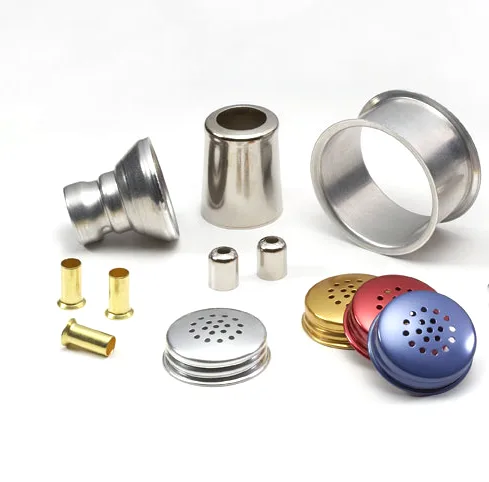
A small drawn cap is a family, and a family is a quoting problem before it is a manufacturing one
A small precision deep drawn caps and rings assortment is not a product in the ordinary sense. It is a catalogue entry standing in for a set of parts, and the real question behind it – whether a customer wants twenty sizes of the same cap or twenty different products – determines almost everything about how the order is quoted, tooled, scheduled and inspected. This page is written about that, because the manufacturing detail is straightforward by comparison.
We deep draw on maintained presses with blank size and lubrication logged per run, and batch records filed so a repeat order starts from approved data, on mechanical presses 5 to 250 T and hydraulics 250-500 T with in-line annealing furnaces, and first articles and batch samples checked on the CMM. Turned secondary features to +/-0.03 mm and as-drawn walls to +/-0.1 mm, with critical dimensions carrying CMM data with the shipment. Stock runs to carbon steel in SPCC and DC01 grades, 304 and 316 stainless steel, aluminium and brass, with special grades sourced to the drawing when volumes justify. Finish is selected from the drawing – plating, coating, anodising or passivation – with the agreed finish travelling with the part number. This page covers the four questions that turn an assortment enquiry into a workable order.
Question 1: is it the same part in twenty sizes, or twenty parts?
These two look identical on a website and are completely different to manufacture.
- One part in twenty sizes means twenty variants of a single design. In practice it usually means one part number with twenty diameters or twenty lengths, where the smallest and largest are the only ones that need their own tooling and the intermediate sizes can often be made from the same tooling with a change. This is a very economical arrangement if the design allows it, because one die covers most of the range.
- Twenty different products means twenty tools, twenty first articles, twenty drawings and twenty sets of sample approvals. The cost is dominated by tooling and by the approval effort, and it scales linearly with the number of items.
The single most valuable question to ask, and it is often answered by asking whether the customer can consolidate. A family of twenty sizes where the volumes differ sharply is often best served by a small number of tools covering bands of sizes, rather than a tool per size. That decision affects everything downstream, and it is worth an explicit conversation rather than a silent assumption.
Question 2: what is the size floor, and what happens at it
Small drawn parts run into hard physical limits, and knowing where they are before quoting saves an expensive trial. Four walls on the draw ratio: above roughly 0.7 to 0.8 for a single draw, the wall thins so much at the punch nose that the part either fails or needs intermediate annealing. And the material thickness available commercially in the required alloy and diameter – a 0.3 mm wall requires a strip of a thickness that has to exist in that alloy.
For a caps and rings assortment, the binding limit is usually one of three:
- The smallest diameter where the tool, the handling, and the inspection all get difficult. Below a certain size, a part cannot be reliably fed, pierced, deburred, or measured, and the piece cost per part becomes dominated by handling rather than by material.
- The thinnest wall where the part becomes fragile in handling and in transit. A very thin drawn cap can be handled correctly by a person and destroyed by a vibratory finishing line, which is worth checking before the finishing route is fixed.
- The tightest tolerance where the process’s repeatability is no longer smaller than the requirement. This is where capability data rather than a general tolerance band is the right answer, and where the review should push back if a tolerance is aspirational rather than achievable.
Question 3: how many of each, and does that change the process?
A family order has a distribution of volumes rather than one volume, and the distribution decides the economics:
- A slow-moving large size that carries the tooling amortisation while a fast-moving small size carries the piece cost. This is the normal and healthy shape of a family order, and it works.
- Twenty low-volume sizes is the expensive shape, because the tooling cost is spread over few pieces. It is not always uneconomic – there is a genuine business value in a broad catalogue – but the quotation should reflect it rather than pretending the costs average out.
- One very high-volume size changes the process answer. Where a size’s volume justifies it, that size may warrant its own tool run in a much higher-volume mode, and the process review should say so.
Price breaks tied to annual volume apply per size, not across the family – a point worth making clear in the quotation, because a customer who expects the family’s total volume to set every size’s price will be disappointed at invoice time.
Question 4: does every size need the same finish and material?
On a family order, the temptation is to assume everything is the same and simplify. That assumption is where problems come from, and two questions resolve most of it:
- Does every size need passivation, or only the stainless steel ones? On a mixed-material family, the finish requirement differs by material – passivation for stainless steel, anodising for aluminium, nothing or plating for carbon steel and brass. A blanket finish note on a mixed family is either wrong for some sizes or needs exceptions listed.
- Does the size affect the finish? A very small part can be difficult to mask, and masking is often the operation that decides whether a size can be made to specification. A family where only the small sizes are problematic is a family where the smallest sizes cost disproportionately more, and that should be visible in the quotation.
What a family order needs that a single-part order does not
Seven things, and they are all about control rather than about metal:
- A master drawing that defines the family – the parameter that varies, its range, and what is held constant across the range. Without it, twenty drawings will drift apart and eventually describe twenty different products.
- A size list with volumes against each, so tooling decisions can be made per size rather than per family.
- A stated tolerance strategy: which dimensions vary with size, which are held constant, and where a tighter band is required for any size. A family where a critical dimension is held constant across a wide size range is usually impossible to make, and this should be resolved at review.
- A finish specification per material, not one note for the family.
- An inspection plan that scales. Full CMM reporting on twenty sizes is expensive; a sensible plan is full reporting on the critical sizes and capability-based sampling on the rest, and the sampling rule should be agreed rather than assumed.
- Approval discipline. Sample approval per size, with the approved sample retained as the reference for that size. On a family order, a single signed sample cannot govern twenty sizes.
- Batch records per size and per part number so a repeat order for one size can start from approved data without waiting for the rest of the family.
Manufacturing detail, for the sizes that need it
For a part that does need real precision rather than a family relationship, three things dominate:
- Turned secondary features at +/-0.03 mm where a machined feature is a fitting dimension. On a small cap, that is usually the sealing face, the bore, or a locating step.
- As-drawn walls at +/-0.1 mm, with the understanding that the wall’s variation is inherited from the incoming material rather than produced by the press. A wall tolerance on a small drawn part is effectively a material specification.
- Critical dimensions carrying CMM data, which on a family order should be a defined short list rather than everything – because a CMM report on every dimension of twenty sizes produces a document nobody reads and no information anyone acts on.
Materials and finishes across the family
Stock runs to carbon steel in SPCC and DC01 grades, 304 and 316 stainless steel, aluminium and brass, with special grades sourced to the drawing when volumes justify. Across a family this has a specific implication: the same part number in four materials is four different products. A drawn aluminium cap and a drawn stainless steel cap of the same geometry form differently, spring back differently, have different wall thicknesses’ relationships to the material’s strength, and take different finishes. Where a family spans materials, the master drawing has to state whether the geometry is truly common or whether each material’s version differs slightly – and the honest answer is usually the latter.
Finish is selected from the drawing, plating, coating, anodising or passivation, with the agreed finish travelling with the part number. On a family the finish’s dimensional effect has to be considered per material, because a plating thickness is a significant fraction of a small aluminium cap’s wall and negligible on a large steel one.
Drawing it right, for a family
Five things beyond the normal per-part requirements, and they are what separate a workable family order from an unworkable one:
- State what varies and what is constant. Explicitly.
- Give the size range and confirm every size in it is feasible before committing to the range.
- State which tolerances are size-dependent, because a tolerance held constant across a range that includes very small sizes is usually not achievable.
- State the per-size volumes, so tooling and process decisions can be made per size.
- Name the smallest size explicitly and confirm it is above the process’s practical floor – that one question prevents most of the problems a family order runs into.
And the piece of advice that saves the most on these orders: ask whether the customer needs every size. A family of twenty where four sizes cover the overwhelming majority of demand is a much better order for both sides than twenty sizes with the other sixteen sitting in a warehouse. It costs one question to ask and it changes the quotation’s logic entirely.
Draw ratio, wall thinning, radii and trim — the design decisions behind a part like this are worked through with numbers in our deep drawn covers guide, and the Precision Deep Drawn Parts pages collect the rest of the family.
Specifications
| Item | Small Drawn Caps and Rings Family Assortment |
|---|---|
| Brand | AUNOV |
| Designing | Made to your 2D/3D drawings (PDF, DWG, STEP, IGS) – samples are reverse-measured into a controlled drawing; the same drawing is used for every repeat order. |
| Tooling | Die design and toolmaking stay in house, so a die can be re-cut against the approved drawing, and maintenance is tracked against the part number. |
| Samples | Sample parts are measured and reported before submission, so the part is proven before it is made in volume, and the signed sample is kept for future reorders. |
| Materials | Stock runs to carbon steel, 304 / 316 stainless steel, aluminium and brass; special grades are sourced to the drawing when volumes justify. |
| Surface finish | Finish selected from the drawing: plating, coating, anodising or passivation; the agreed finish travels with the part number. |
| Processing | Deep drawing on maintained presses, blank size and lubrication logged per run; batch records are filed so a repeat order starts from approved data. |
| Equipment | Mechanical presses from 5 to 250 T and hydraulic presses 250-500 T, with in-line annealing furnaces; first articles and batch samples are checked on the CMM. |
| Tolerance | +/-0.03 mm on turned secondary features, +/-0.1 mm on as-drawn walls; critical dimensions carry CMM data with the shipment. |
| Delivery terms | CIF or DDP, with FOB available, payment by T/T or L/C, quoted in USD or EUR; sea or air freight is quoted to your door. |
Frequently Asked Questions
Is an assortment one part in many sizes or many parts?
That question drives everything. Twenty sizes of the same cap versus twenty different products changes quoting, tooling, scheduling and inspection, so it must be answered before the order is set up rather than discovered in production.
What is the size floor for small drawn caps and rings?
Each geometry has a minimum drawable size set by the draw ratio and wall; below it the part needs a different route, and we flag that on the enquiry so the process is chosen deliberately.
Do all sizes in a family need the same material and finish?
Not necessarily. Material and finish can vary per size, and the agreed finish travels with each part number in the batch record so a repeat order starts from approved data.
How are family orders quoted and controlled?
Drawn walls are held to +/-0.1 mm and turned features to +/-0.03 mm, with CMM first articles and batch samples. The typical minimum order is 1,000 pieces with a 24-hour quotation.
Related Products

Request a Quote for This Part
Send a drawing or sketch — get material advice, tooling cost and a per-piece price within 24 hours (working days).