
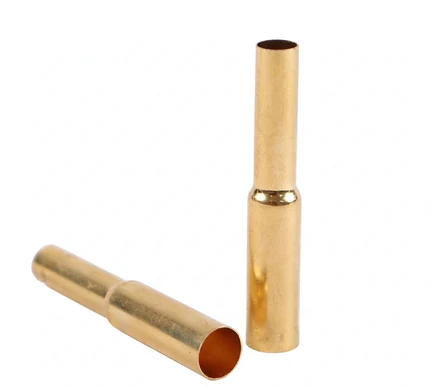
A deep-drawn copper sleeve is one of the few parts on this site where the temper – not the alloy – is the primary specification. The same copper in a soft temper and a hard temper are two different products: one that forms beautifully and is weak, and one that holds its shape and will not form at all. Getting that wrong is the single most common way a copper sleeve fails to be made.
T2 and T3 copper and H62 brass at 0.8 to 4.0 mm, soft tempers for deep forming and hard tempers where stiffness matters. That sentence on the material line is the design. The tolerance scheme at +/-0.03 mm on machined features and +/-0.1 mm on formed ones follows from it.
Copper and brass, and they are not substitutes
- T2 and T3 are copper, nominally 99.9 per cent and 99.95 per cent, with T2 being the softer. Copper is chosen for conductivity, for formability, for corrosion resistance in specific environments, and for appearance – it is the metal of a premium cosmetic part.
- H62 is brass, roughly 60 per cent copper and 40 per cent zinc, harder and stronger than copper. Brass is chosen where the sleeve needs stiffness, where it will be machined, and where it will be plated – brass takes a plating better than copper because the zinc in the brass etches and gives the plating something to key into.
- So they are chosen by function, and the substitution between them is not cosmetic. A copper sleeve that is stamped rather than deeply drawn is not achievable in pure copper at a small diameter; a brass sleeve that has to be drawn deeply wants a different grade again.
- And copper’s own limitation is worth naming: copper is soft, it galls readily against steel and against itself, and it has a fatigue behaviour that makes it unsuitable for a cyclically loaded sleeve. So a copper sleeve is chosen for conductivity, formability, appearance or corrosion behaviour – and not for strength.
Temper, which is the whole specification
- Soft temper is for deep forming. It takes large reductions, it flows into tight radii, and it survives being drawn. It has low yield and it will deform under load.
- Hard temper is for stiffness. It holds its shape in service, it resists deformation, and it will not take a deep draw – a sleeve with a tight corner and a hard temper either cracks in forming or requires an intermediate anneal.
- And the practical consequence: on a drawn sleeve the temper has to be chosen for the forming, and where the part also has to be stiff in service the design has to allow for the anneal – either by a less demanding geometry, or by annealing mid-draw, or by designing a part that is soft where it forms and hard where it matters through work hardening rather than through the starting temper.
- Which is a real design decision, not a material note. On a sleeve with a tight corner and a stiffness requirement, the answer is usually to form it soft and let the forming work-harden the sections that need it, which is what a cold-worked copper’s forming naturally does in the corners.
What the sleeve is for, because it decides copper versus brass
- An electrical sleeve – a busbar, a contact holder, a shield – is copper, and here conductivity is the requirement and the surface’s finish matters because it carries current. On this application the interior and exterior surface’s finish are functional, and a plated copper surface is a contact surface with its own requirements.
- A decorative sleeve on a visible product is copper for appearance, and here the surface is the product and the requirement is colour and gloss consistency – which is a plating or a polish specification with an approved sample.
- A sleeve that must resist deformation in assembly is brass, and here stiffness is the requirement and copper’s galling would be the failure mode.
- And a sleeve that carries fluid is usually brass, because copper in a water system is a dezincification-adjacent concern and because brass machines and threads better.
Surface finish, and on copper it is not optional
Plating, coating or polishing to suit the drawing, with masking and laser marking available. On copper the finish is closer to mandatory than on steel, for a specific chemical reason.
- Bare copper reacts. It tarnishes, it darkens, and in a moist environment it develops a film that will not match the adjacent part. So on a visible copper part a finish is a product requirement.
- Plating adhesion is improved by a pre-treatment that etches the surface slightly, and on copper that etch removes a layer. So a plated copper part’s dimensions have to be specified post-plate or the plating has to be masked on the functional features.
- Where the part is electrical, the plating is a contact plating and its thickness is a conductivity requirement as well as a durability one – and a thick plating on a sleeve reduces its conductivity measurably.
- And on a wear surface, copper’s galling means the plating is what prevents the sleeve from seizing – so a plated sleeve and a bare copper sleeve behave completely differently in assembly.
Formed features, and the band that reflects them
At +/-0.1 mm on formed features the loose band is on the drawn geometry, and on a copper sleeve the springback is the reason.
- Copper and brass both spring back more than steel, and a copper part’s formed angles will differ from the die’s. So a general band on formed features is not slackness – it is the material.
- And a flange on a copper sleeve will not hold its angle as well as one on steel, so where a flange is functional – a locating lip, a stop – the design has to account for it or the part needs a second operation to bring the angle into tolerance.
- The corner’s condition is where copper fails. On a tight radius in copper the outer fibre is at its strain limit, and it is where a crack initiates. So the corner’s radius is a durability parameter on this part, not only a forming one.
Machined features, and why they need masking
At +/-0.03 mm the tight band is on the machined features, and on this part those features are where the plating must not go.
- A bore that receives a shaft, a seal, or a conductor is plated unless it is masked, and a plated bore changes both the size and the surface the mating part will see. Where the bore is a precision fit, it should be masked and the size stated on the masked surface.
- A seal groove in copper is a plating problem for the same reason, and a plated groove changes the seal’s compression.
- And on a threaded feature the plating is a fit change and a flaking problem, and on copper the flaking is particularly bad because the plating’s keying layer is a chemical etch of the base and any damage exposes the base directly.
Formed features sit at the loose band because they are drawn, not machined
+/-0.03 mm on machined features and +/-0.1 mm on formed ones, with GD&T per drawing and PPAP-style reports on request. Four items.
- Machined features: size, roundness, concentricity, at the tight band, and where any of them is a fit it should be stated as a fit.
- Formed features: angles, lengths, radii, at the loose band, with the band reflecting the temper’s springback rather than pretending the material does not exist.
- Wall thickness, at a band that reflects the draw’s thinning, and with a minimum where the formed corner is the critical section.
- And the requirements that are not dimensions: the temper and its condition after forming, the plating and its mask list, and – on an electrical sleeve – the plating’s thickness as a conductivity requirement. Those three are the specification on this part and the tolerances only cover the metal.
A masked feature has to be confirmed bare rather than assumed
Tube drawing with precision turning on critical diameters, first articles verifying the whole flow, GD&T per drawing and PPAP-style reports on request. Three items.
- Machined features at the tight band, and the masked features verified as bare rather than plated.
- Formed features verified against a master, and where the temper’s springback is the concern, verified across material lots rather than on a single first article.
- Plating thickness and adhesion on the first article, with the mask list verified – and on a copper part, adhesion is worth an explicit test because the plating system depends on the etch.
- Surface appearance against a retained sample, where the finish is a product requirement – and on copper that sample is the specification because copper’s colour drifts with its own ageing.
Is the sleeve structural, or is it electrical, decorative or fluid-carrying?
Direct answer: The question is worth asking because copper versus brass and soft versus hard are decided by the function, and a sleeve that is both structural and electrical is the genuinely interesting case: it wants brass’s stiffness and copper’s conductivity, and the usual answer is a bimetallic construction or a copper sleeve with a plated or reinforced section rather than a single material trying to be both. And there is a second question that is nearly always asked too late on this part: is the sleeve going to be plated, and has anyone decided which surfaces must stay bare? Because on a deep-drawn copper part the plating interacts with the forming – the etch that keys the plating removes material – and a masked area on a drawn feature is a design feature rather than a finishing instruction. Deciding the mask list after the part is drawn, rather than before, means a plating process that has to accommodate features that were never considered, and on copper that accommodation is not always free.
Copper or brass on a drawn sleeve – what does the choice hang on?
Direct answer: The sleeve’s function. An electrical sleeve – a busbar, a contact holder, a shield – is copper, because conductivity is the requirement and the surface finish matters because it carries current. A structural sleeve is brass, which is harder and stronger. A sleeve that has to be both structural and electrical is the interesting case: it wants brass’s stiffness and copper’s conductivity, and the answer is usually a plated brass rather than a soft copper.
Why is a finish closer to mandatory on copper than on steel?
Direct answer: Because bare copper reacts. It tarnishes, it darkens, and in a moist environment it develops a film that will not match the adjacent part, so on a visible copper part a finish is a product requirement. Plating adhesion is also important because copper’s surface oxide is not a good base for plating unless it is cleaned properly.
Deep Drawn Tubes & Sleeves is the parent range for parts like this one; the overview page gathers the tooling logic, finishing options and tolerance notes that apply across the family.
Specifications
| Item | Custom Deep Drawn Part Copper Sleeve |
|---|---|
| Brand | AUNOV |
| Designing | Your drawing sets the part – a manufacturability review comes back with the quotation; the approved drawing is kept as the controlled master. |
| Tooling | Tooling is built and held under your part number, so tooling lead time stays under our control, and first-article timing is measured from the tooling start date. |
| Samples | Prototype and pre-production samples are provided against the drawing, so the approved first article becomes the gauge reference, and mass production is gated on that approval. |
| Materials | T2 / T3 copper and H62 brass, 0.8-4.0 mm; soft tempers for deep forming, hard tempers where stiffness matters. |
| Surface finish | Plating, coating or polishing to suit the drawing; masking and laser marking available where needed. |
| Processing | Tube drawing with precision turning on critical diameters; first articles verify the whole flow before the run is released. |
| Equipment | Drawn-tube benches, in-line annealing and CNC turning, with CNC turning centres for secondary operations and CMM inspection. |
| Tolerance | +/-0.03 mm on machined features, +/-0.1 mm on formed ones; GD&T per drawing, PPAP-style reports on request. |
| Delivery terms | Order ships FOB unless you prefer DDP; payment by T/T or L/C, freight quoted to destination. |
Related Products
Request a Quote for This Part
Send a drawing or sketch — get material advice, tooling cost and a per-piece price within 24 hours (working days).