
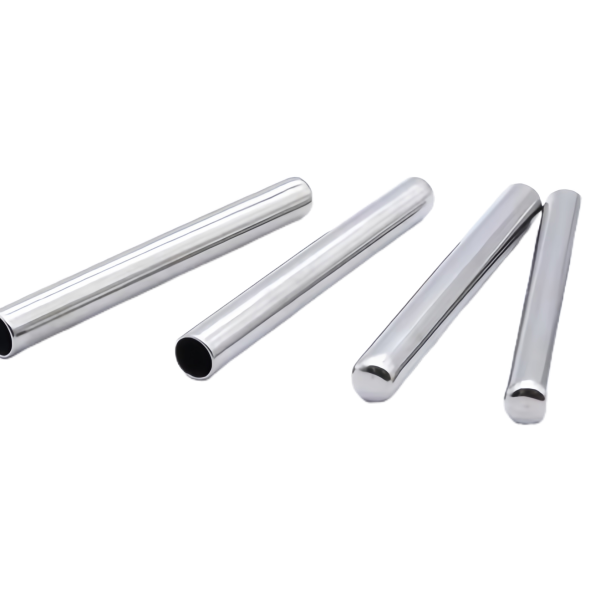
Stainless closed-end sensor housing tubes in multiple sizes – one closed-end family across several diameters, all from matched tooling. Multi-size families are how probe builders standardize: one design, many fits.
Function and Design
A closed-end sensor housing looks like the simplest item in a catalogue and is often the most demanding to make consistently. That is why the closed-end sensor housing is inspected between operations, not only at the end.
What Makes It Work
- The closed end is formed, not welded – a smooth radius with no heat-affected zone to corrode or crack.
- No plating to scratch: the stainless closed-end sensor housing handles washdown, humidity and process media directly.
- Volume pricing benefits from in-house dies and continuous press capacity.
- Material: stainless steel (304 / 316) for the closed-end sensor housing, with material certs issued together with the dimensional report.
- Process: the closed-end sensor housing combines deep drawing with light machining so seats stay concentric.
- Finish: Surface treatment for the closed-end sensor housing is picked for its working environment, not from a catalogue.
- Size: Final dimensions of the closed-end sensor housing to your drawing; this page shows the family, your version is quoted from the print.
- Custom: OEM/ODM to print: the closed-end sensor housing quotation includes material advice and tooling cost.
Applications
Typical applications include household appliance thermometers, industrial process instrumentation, NTC and PT100 probe assemblies.
Why Source It From Aunov
Sealing faces are machined and checked, because a housing that leaks fails the whole instrument. First articles are dimension-checked and pressure-tested, and production is sampled against the approved part.
Request a quote for firm numbers on the closed-end sensor housing: material, tolerances and tooling.