

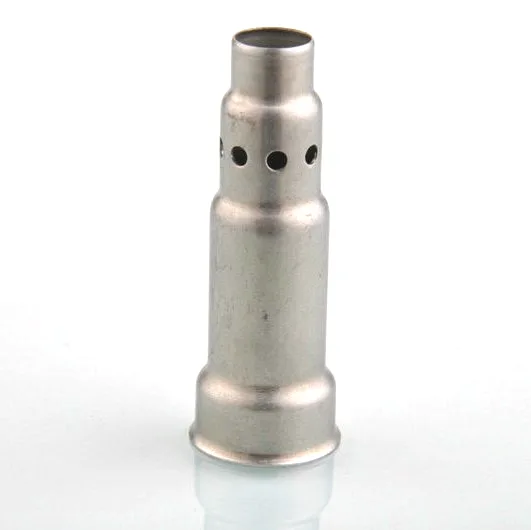
A stainless steel closed cylinder sensor shell is a deep-drawn cup – a cylindrical body closed at one end that houses a temperature or pressure sensor element. The closed end is the sensing face that meets the process, while the open end is where the lead, cable or fitting exits. What matters on this part is the roundness of the drawn wall, the flatness of the sealed end, and the consistency of the bore the element drops into.
So the requirements on a capillary are not pressure requirements and they are not dimensional requirements. They are requirements about stiffness, about bend radius, and about what happens when the part is installed badly – which it will be.
The tube’s diameter is a stiffness decision, not a flow decision
Blanking, drawing and piercing in sequence, then machining of sealing faces. On a capillary the drawn tube’s wall thickness and diameter decide three things at once, and they conflict.
- Pressure containment. If the capillary has to hold the process’s pressure – which it does if it is the thermowell’s fill line – then its wall is a pressure calculation and the diameter affects it directly.
- Bend stiffness. A thin tube’s resistance to kinking and to collapsing when bent is a function of the diameter to the fourth power. So doubling the diameter makes it roughly sixteen times stiffer in bending, which is the difference between a capillary that can be routed through equipment and one that kinks at the first bend.
- And the number of conductors inside, if it is a leads capillary rather than a fill capillary. That fixes the internal diameter.
So on a capillary the diameter is chosen against routing, not against the fluid, and it is worth asking what route the capillary has to take and how tight the bends in that route are. A capillary specified by its diameter alone will be delivered and then discovered not to fit.
Bend radius, which is the number that decides whether it survives
This is the requirement that is almost never on a drawing and that governs every field failure on this part.
- A drawn thin-wall tube has a minimum bend radius, and below it the tube kinks. The kink is a permanent ovality, and once the section is oval the internal conductors – if any – are squeezed, the flow area is reduced, and the capillary has permanently changed its behaviour. It cannot be straightened back.
- The minimum radius is a function of the diameter and the wall. A thin wall needs a proportionally larger radius, and a wall that is thin enough to be flexible is also thin enough to kink. So the specification is the ratio, and the ratio should be on the drawing as a stated minimum bend radius rather than left as an expectation.
- And the bend radius in the design is not the bend radius at installation. A capillary that is designed with a generous radius and then clamped at a tighter radius by a cable tie will fail at the clamp. So the installation has to be controlled, which usually means stating the clamping requirement.
What the capillary carries, and why that changes the part
There are three quite different things a capillary can carry, and each makes a different part.
- A thermowell’s fill. A liquid or gas column that transmits the process’s pressure and temperature to a remote sensor. Requirements: pressure containment, no leakage, and no trapped air that will separate. The fill’s own thermal expansion and its freezing point are constraints on the whole assembly.
- A sensor’s leads. Two or three or four fine conductors, usually insulated, inside the tube. Requirements: the tube is a mechanical protection and a moisture barrier; the leads must be able to flex; and the leads’ own insulation must survive the temperature.
- Nothing – it is a protective conduit for an element or a probe that is mounted at the far end. This is the simplest case and it is the one where the capillary is purely mechanical.
And the distinction matters commercially as well as technically, because a fill capillary and a leads capillary have different walls, different materials, different price, and different failure modes – and a drawing that says “stainless steel capillary” is compatible with all three.
Fixing, routing, and vibration
A capillary is fixed at one or more points, and every fixed point is a place where it can fatigue or where a clamp can damage it.
- A support clip’s radius has to exceed the capillary’s minimum bend radius, and the clip has to be lined or the capillary has to be sleeved at the clip. This is a one-line drawing note that prevents the most common installation damage.
- Where the capillary moves – near a rotating machine, near a vibrating pipe – a small radius bend is a fatigue loop. It will flex repeatedly and it will eventually crack. So a moving capillary needs a service loop and the service loop’s geometry is a design requirement.
- And differential thermal movement is a real load. A capillary clamped at both ends between a hot vessel and a cool instrument box will try to move, and because it is thin it will move at its ends and buckle in between unless there is slack or a service loop. The design has to accommodate the vessel’s thermal movement, and the vessel’s travel is sometimes large.
On a capillary the alloy is chosen by temperature and by containment
Standard stock: carbon steel, 304 and 316 stainless steel, aluminium, brass, with special grades sourced when volumes justify. On a capillary the material is chosen by the temperature and by what it has to contain, and there is one requirement that is specific to thin-wall parts.
- 304 or 316L for a process-side capillary, on the usual corrosion logic, and 316L for anything chloride-bearing.
- And a thin-wall tube is more susceptible to intergranular attack than a thick one, because at a given grain size the surface-to-volume ratio is higher and there is less material to resist it. So on a thin-wall stainless steel capillary the grade’s weldability and its service history matter more than on a thick one, and a part that has been welded and then drawn is a part that needs a post-weld solution treatment if the service is corrosive.
- Brass where the temperature is moderate and the flexibility matters, because brass is more ductile than stainless steel and will take a tighter bend. That is a real advantage on a capillary that has to be routed through tight equipment, and the price is dezincification in a warm aqueous service.
- Aluminium on a non-process part where weight and cost matter, with the consequence that it is very easy to bend and very easy to damage, which makes the installation’s care the dominant factor.
What is in the capillary decides how its interior has to be finished
Surface treatment matched to the duty, with the finish inspected with the dimensional report on the first article. On a capillary the finish is almost entirely about one thing.
- Where the capillary carries a fill and the fill is a liquid, the interior surface has to be clean and smooth and free of any residue or lubricant, because any of them will contaminate the fill or trap gas. So on a fill capillary the interior requirement is a cleanliness requirement rather than a finish requirement, and it is worth stating separately.
- Where it carries leads, the exterior’s finish is conventional corrosion protection and it should not be a coating that cracks when the tube is bent.
- Where the capillary is visible or is a probe’s exposed stem, the exterior’s finish is an appearance specification.
On a capillary the tight band sits on the ends, not the tube
+/-0.01 mm on sealing faces and +/-0.05 mm on drawn profiles. On a capillary that tolerance scheme is right, and it points at the fact that the tight band is on the ends and not on the tube – because on a capillary the tube’s requirements are about form and material rather than about size.
- Sealing faces at the tight band: the face that seals to the vessel or to the instrument, its flatness and perpendicularity.
- The drawn profile at the loose band: the diameter and the wall, because those are the material’s own variation.
- And the requirements that are not dimensions: the minimum bend radius, the ovality after bending, the leak rate along the whole length, and – if it carries leads – the conductors’ number and gauge.
On the leak requirement in particular: a capillary’s length is its weakness, and a joint-free length has to be tested end to end rather than at its ends. Where the capillary is a pressure line, an end test proves nothing.
What route does this capillary take, and what moves at its ends?
What route does this capillary have to take, and what has to move at its ends? Two questions, and they decide the diameter, the wall, the minimum bend radius and whether the part is even the right shape. The first one decides the bending requirement: a capillary that has to get through a 60 mm gap between two pieces of equipment has a very different minimum radius from one that has a straight run, and specifying the diameter without specifying the route means the radius will be discovered in the field. The second one decides whether it needs a service loop, and if it does then the loop’s geometry is part of the part rather than part of the installation – and on a capillary between a hot vessel and a cool instrument, the vessel’s thermal travel is sometimes enough to close a tight bend and buckle the tube. There is also a third question worth asking because it decides what the part actually is: does this capillary carry a fill, or does it carry leads? Because a fill capillary has to be clean inside and pressure-tight along its whole length, and a leads capillary has to carry a specified number of conductors of a specified gauge and has to be flexible enough to be routed. Same outside, different part, and the drawing should say which it is.
Parts like this one sit under the Sensor Housings range, whose overview page gathers the tooling logic, finishing options and tolerance notes shared across the family.
Specifications
| Item | Stainless Steel Closed Cylinder Sensor Shell |
|---|---|
| Brand | AUNOV |
| Designing | Made to your 2D/3D drawings (PDF, DWG, STEP, IGS) – unusual walls, threads or tolerances are feasibility-checked first; revisions are re-quoted once rather than silently absorbed. |
| Tooling | Tooling is built and held under your part number, so the die charge appears as its own quotation line, and ownership is confirmed on the quotation. |
| Samples | Prototype and pre-production samples are provided against the drawing, so the sample is retained as the master, and mass production is gated on that approval. |
| Materials | Standard stock: carbon steel (SPCC / DC01), 304 / 316 stainless steel, aluminium, brass; special grades are sourced to the drawing when volumes justify. |
| Surface finish | Surface treatment matched to the duty: plating, coating or polishing; the finish is inspected with the dimensional report on the first article. |
| Processing | Blanking, drawing and piercing in sequence, then machining of sealing faces; every stage is logged against your part number. |
| Equipment | Press line for drawing, CNC cells for finishing, with CNC turning centres for secondary operations and CMM inspection. |
| Tolerance | +/-0.01 mm on sealing faces, +/-0.05 mm on drawn profiles; finer bands confirmed from capability data before quoting. |
| Delivery terms | Delivery quoted per Incoterms 2020 – FOB, CIF or DDP – by sea or air, to your address. |
Related Products


Frequently Asked Questions
Why is a capillary’s diameter a routing decision rather than a flow one?
A stainless steel capillary is a very thin tube, and everything follows from how easily it bends and how easily it breaks. It carries a thermowell’s fill or a sensor’s leads out of a vessel to an instrument, and must survive being routed, clamped and handled. The diameter is chosen against the route it must take, not the fluid it carries.
What sets the minimum bend radius a capillary can survive?
The drawn tube’s wall thickness and diameter decide stiffness, minimum bend radius and pressure duty at once, and they conflict. A capillary that must pass through a 60 mm gap between two machines has a very different minimum radius from one with a straight run. Specifying the diameter without specifying the route means the radius gets discovered in the field, after the part no longer fits.
Why does a drawing that says stainless steel capillary stay ambiguous?
Because a fill capillary and a leads capillary have different walls, different materials, different prices and different failure modes, and one phrase is compatible with all three. The distinction matters commercially as well as technically. On a capillary the tight band sits on the ends, at +/-0.01 mm on sealing faces and +/-0.05 mm on drawn profiles, not on the tube, because the tube’s requirements are about form and material rather than size.
What route does this capillary take, and what moves at its ends?
Those two questions decide the diameter, the wall, the minimum bend radius and whether the part is even the right shape. Fixing, routing and vibration at the ends are where a capillary is most likely to fail. Standard stock includes carbon steel, 304 and 316 stainless steel, aluminium and brass.
Request a Quote for This Part
Send a drawing or sketch — get material advice, tooling cost and a per-piece price within 24 hours (working days).