
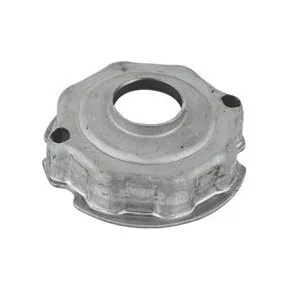
From casting to stamped steel: the sheet-metal end shield shift
For decades, motor end shields were castings – aluminium or iron, thick-walled, heavy, and slow to tool. Then volume motor makers started asking a simple question: if the shield’s job is to locate a bearing and close the motor, why cast a block when a formed sheet will do it? Sheet metal forming electric motor end shields are now standard across huge swathes of small and medium motors, and the migration is instructive because it shows exactly which functions a formed shield can carry and which it cannot. This page covers the shift and the engineering behind a formed shield’s acceptance.
The specific stiffness argument
A cast aluminium shield carries load with mass distributed through its section. A formed steel shield carries it with thin material placed where geometry makes it stiff – a flange, a boss, a rib. Steel’s modulus is roughly three times aluminium’s, so a formed steel shield of a fraction of the casting’s thickness can match its stiffness, and the resulting part is lighter for equal performance in most motor sizes. That specific stiffness advantage is why the shift happened, and it is why formed shields are often not just cheaper but better – less mass on the motor, less mass on the vehicle, and no casting porosity to leak or crack. The trade is that a formed shield’s shape is limited: it cannot make thick conformal bosses or intricate internal passages, so the migration only succeeds when the design is optimized for forming rather than shrinking a casting.
Redesigning rather than shrinking
The commonest failure in a casting-to-stamping migration is trying to reproduce a casting’s geometry in sheet. A cast boss with a thick shoulder becomes, in sheet, either a deep drawn boss with limited depth or a formed feature with generous radii; the mounting pattern may shift; the ventilation openings become formed louvers rather than cast apertures. The successful programmes redesign the shield for the process – moving the bearing seat’s support into a formed boss with radiating ribs, locating the mounting interface on a stiff flange, and shaping the ventilation for the airflow rather than for the casting’s convenience. The result is a part that looks different, weighs less and performs the same, which is the point; a part that looks the same has usually compromised on accuracy or stiffness to mimic a casting.
Holding the bearing seat on a formed shield
The bearing seat is where a migrated design earns or loses its reputation. Casting established the seat in a thick section; forming must produce it as a boss whose bore is then finished – coined, sized or ironed – to the bearing’s fit band, with squareness and position to the mounting datum verified on first articles. The extra operation is real and the quote names it. What the formed design gains is consistency: where a cast seat varies with die wear and porosity, a coined bore varies with tool wear alone, and tool wear is measurable and controllable. Customers who have lived with casting-to-casting seat variation often find the formed version’s consistency more valuable than its cost saving.
Ventilation, terminals and the parts forming cannot absorb
Formed shields handle ventilation well – louvers, apertures and deflecting lips are natural formed features – and they handle mounting and simple terminals. They do not absorb a terminal box, complex connector geometry or a deep internal cavity, and those stay as an attached part or move to the motor’s other end. Documenting that boundary at design stage is what keeps a migration honest: the shield carries what forming does well, and the residual functions are specified explicitly rather than expected to emerge from the sheet. Programmes that skip the boundary discussion find themselves adding brackets and boxes later, which erodes the migration’s savings.
What we need to quote a migration
The existing casting’s drawing or a sample, the bearing seat’s requirements, the mounting interface, the shaft loads, the ventilation requirements, the finish and the volume. We return a formed-shield proposal showing the redesigned geometry, the load-path analysis, the finishing operation for the seat, the weight and cost comparison against the casting, and a sample schedule – typically three to five weeks after die approval. Where the casting’s geometry genuinely cannot be formed, we will say so and leave it where it belongs.
A formed shield’s modal set, and why it differs
Will a formed shield be as quiet as a casting? Usually yes, but the shield’s modal set changes, so a programme with a strict noise spec should run a tap test on first articles as we do on our other motor parts. If a mode moves into an audible band, a rib or a damping treatment addresses it.
Can you form the shield in stainless steel for a corrosive environment? Yes, in ferritic grades where magnetism matters or austenitic where it does not – the same material logic as our housings, with the draw sequence adjusted for the grade.
How much weight can a migration save? Typically 25-40% against a cast iron shield and 10-20% against cast aluminium at equal stiffness, but the honest answer is programme-specific – we model the actual loads before claiming a number.
If you are weighing drawing against machining or welding for this geometry, the guide to deep drawn covers sets out where each route wins; the full Precision Deep Drawn Parts range is linked from the overview page.
Specifications
| Item | Sheet metal forming electric motor end shields |
|---|---|
| Brand | AUNOV |
| Designing | Your drawing sets the part – DFM notes are returned before any tooling is cut; the same drawing is used for every repeat order. |
| Tooling | Our toolroom covers die design, wire-cut EDM and maintenance, so no tooling step is outsourced, and maintenance is tracked against the part number. |
| Samples | First-article samples ship with a dimensional report and material certificate, so the part is proven before it is made in volume, and production starts only after your written sign-off. |
| Materials | Carbon steel, 304 / 316 stainless steel, aluminium and brass are all held in stock; mill certificates and heat numbers accompany the first article. |
| Surface finish | Plating, powder coating, anodising or polishing, per the print; the agreed finish travels with the part number. |
| Processing | Progressive drawing through several stages, annealed between draws, then trim and pierce; in-process checks sit between stages, not only at the end. |
| Equipment | Mechanical presses 5-250 T plus 250-500 T hydraulics, with in-line annealing; secondary ops run on CNC turning centres, inspection on the CMM. |
| Tolerance | +/-0.03 mm on turned secondary features, +/-0.1 mm on as-drawn walls; finer bands confirmed from capability data before quoting. |
| Delivery terms | FOB, CIF or DDP per Incoterms – payment by T/T or L/C, with shipping quoted door-to-door. |
Frequently Asked Questions
Why move an end shield from a casting to stamped steel at all?
Mainly because castings carry time and machining with them. A casting is heavy, slow to produce, prone to porosity, and usually needs substantial machining to reach the bearing seat. Formed steel removes most of that work, which is why the move is normally driven by throughput and unit cost rather than by the material alone.
Why is a migration a redesign rather than a substitution?
Because the two processes get stiffness from different places. A casting gets its stiffness largely from section thickness, which it can vary freely. Sheet gets it from geometry – profile, beads, flanges – and those have to be designed in. Copying the casting’s outline without adding back what its thickness was doing reliably produces a part that measures correctly and flexes.
What is the specific stiffness argument here?
Stiffness per unit mass. Properly shaped sheet can match a casting at a fraction of the weight, because material placed away from the neutral axis does more work than material in the middle of a thick section. That is the entire basis for a successful migration, and it is why the geometry has to be reconsidered rather than simply reduced.
Which features does forming not absorb, so they stay as separate parts?
Threads deep enough to carry load, anything requiring close-tolerance bores through a thick section, terminals and brush gear that need their own fixing, and details whose position cannot be reached from the press direction. These stay as inserts, weldments or machined operations, and identifying them early is most of what a migration quotation needs.
Related Products

Request a Quote for This Part
Send a drawing or sketch — get material advice, tooling cost and a per-piece price within 24 hours (working days).