
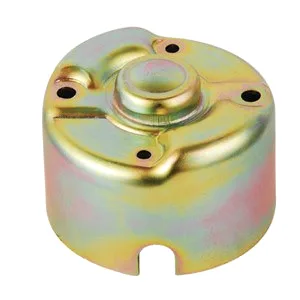
The Cold Drawn Motor Cover is a precision housing formed from flat stock in a controlled drawing sequence. Cold drawing does something to the material that casting and machining cannot: it work-hardens the shell and aligns the grain along its contour. This page explains what that means in practice for a motor end cover that must locate a bearing and stay quiet over its life.
What cold drawing changes in the material
Three consequences of the process matter for a motor cover:
- Grain flow follows the shell. The metal fibres wrap around the drawn contour instead of being cut across it. Along the load path of the cover wall, that means higher fatigue resistance than a machined-from-bar equivalent of the same alloy.
- Work hardening stiffens the wall. The drawn shell is measurably harder than the blank it came from. For a cover that carries bearing load and transmits vibration, the stiffer wall damps differently – usually to the good, provided thinning is controlled.
- Wall thickness is a designed variable, not an accident. As-drawn walls hold ±0.1 mm; the thinning is predictable (10-20% at the corner radius on a well-designed die). Where a face must be flat or a bore precise, those zones are machined afterwards to ±0.03 mm.
The precision features that define the housing
“Precision” on a motor housing is not a general claim – it names specific features:
- Bearing bore. The seat that carries the bearing. Drawn near-net, then bored or turned to ±0.03 mm with a surface finish the bearing manufacturer will accept.
- Spigot / rabbet fit. The register that concentrically locates the cover on the motor housing. Runout here is what shows up as shaft vibration two assemblies later.
- Sealing faces. Flat, machined lands where the O-ring or gasket sits. Drawn flanges are checked for flatness; the mating land is machined where the seal class demands it.
- Threaded features. Single-pointed or rolled in one setup with the bore where possible, so thread-to-bore concentricity is not a stack-up of separate operations.
Drawn-and-machined vs machined-from-solid
For covers above roughly 40 mm diameter and modest depth, drawing the shell then machining the functional seats is materially cheaper than machining the whole part from bar – the drawing buys the envelope at press-cycle speed, and the machining buys only the precision. Below that, or for one-off prototypes, machining from solid wins because tooling is zero. The crossover is a quotation question, and we answer it both ways when a print is near the boundary.
Process record and repeatability
The manufacturing record – draw stages, anneal points, machining offsets – is archived with the drawing revision that produced it. Every cold drawn cover reorder is gauged back to the signed first article: bearing-bore size and spigot runout are measured at first article and gauged on production runs. Nothing changes silently between shipments, and any grade or finish change is agreed in writing first.
Inspection summary
ISO 9001 certified production; mill certificates per incoming heat; CMM first-article report with dimensional data; sampling plan per production batch; torque, leak or pressure tests arranged where the service demands them, report packed with the shipment.
Sizing the draw for a part like this — reduction per station, ironing allowance, flange width — is covered step by step in our deep drawn covers guide.
Why cold drawing, not stamping, for a round precision housing
A round motor housing that must hold a bearing and a seal is often better cold drawn than stamped, because cold drawing delivers roundness and a clean surface in the forming step instead of needing them machined in later. The draw work-hardens the wall so a thin section stays rigid, and it leaves a surface the seal can ride without a heavy finish operation. We reach for cold drawing when the part is round, when concentricity to the axis matters more than a complex outline, and when the volumes justify the draw tooling. The trade is less freedom of shape than stamping, which is why the decision is made against the function, not the toolroom habit.
Datum strategy on a drawn shell
A drawn shell has no flat face to sit on, so we establish datums from the bore and the drawn shoulder and machine every feature back to them. The bearing seat, the seal bore, and any external register are all located from the axis the draw created, which keeps the stack tight without fighting the part’s natural geometry. We mark the primary datum on the print and hold it on the fixture so every op references the same axis, because referencing a drawn shell to its outer skin is how roundness errors creep into a housing that looked fine on the gauge.
Repeatability across the run
Cold drawing holds the wall and the bore within a band the whole run, so the machined features stay consistent part to part; we confirm that band with periodic section checks rather than trusting the first article alone.
Specifications
| Item | Cold Drawn Motor Cover – Precision Housing |
|---|---|
| Brand | AUNOV |
| Designing | Send drawings, or send a sample to be measured – a manufacturability review comes back with the quotation; the agreed version governs every later batch. |
| Tooling | Our toolroom covers die design, wire-cut EDM and maintenance, so tooling lead time stays under our control, and ownership is confirmed on the quotation. |
| Samples | First-article samples ship with a dimensional report and material certificate, so the approved first article becomes the gauge reference, and production starts only after your written sign-off. |
| Materials | Materials held include carbon steel, 304 / 316 stainless steel, aluminium and brass; special grades are sourced to the drawing when volumes justify. |
| Surface finish | Plating, coating or polishing to suit the drawing; the agreed finish travels with the part number. |
| Processing | Coil blanking and progressive drawing, coining on the final station where the print calls for it; every stage is logged against your part number. |
| Equipment | 5-250 T mechanical presses, 250-500 T hydraulic presses and annealing furnaces in line, with CNC turning centres for secondary operations and CMM inspection. |
| Tolerance | +/-0.05 mm to +/-0.1 mm across the part, wall thickness held to print; GD&T per drawing, PPAP-style reports on request. |
| Delivery terms | CIF or DDP, with FOB available, T/T or L/C, with D/P accepted on repeat business; sea or air freight is quoted to your door. |
Related Products
Frequently Asked Questions
What does the word precision actually name on this housing?
Specific named features, not a general claim. Usually a bearing or pilot fit, a face that has to run true, and the relationship between them. Everything else on the part can sit comfortably inside general tolerances. Naming which two or three surfaces carry the function is what turns a precision requirement from a slogan into something that can be measured and priced.
Why cold drawing rather than stamping for a round precision housing?
Because the material is worked uniformly around the circumference. Drawing keeps wall distribution even and controls roundness in a way a stamped and rolled form does not, since nothing has been bent back on itself and nothing depends on closing a seam. Where roundness and concentricity control the assembly, the extra process control buys more than it costs.
Drawn-and-machined, or machined from solid – what decides it?
Volume, and whether the geometry can be produced at all another way. Machining from solid suits prototypes and very low quantities, with no tooling to amortise and no forming limits to work around. Once quantities justify the die, drawing the shell and finishing selected surfaces recovers most of the material that machining would remove, and the piece price follows the material saving.
Why does the process record matter for an order placed a year later?
Because repeatability comes from controlling inputs, not from re-discovering them. Blank batch, anneal cycle, die identity including how many times it has been re-cut, lubrication and first-article data are what let a second order match the first. Without them the shop starts again from the drawing, which is how “identical” repeat orders come out slightly different.


Request a Quote for This Part
Send a drawing or sketch — get material advice, tooling cost and a per-piece price within 24 hours (working days).