
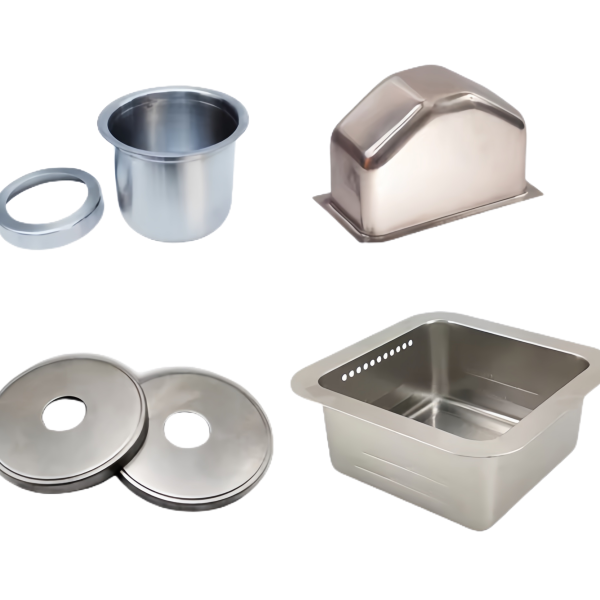
Cup, cover, disc and tray belong on one page because they leave on one order, not because they are one problem. A cup is judged by how deep it draws before the wall thins; a cover by whether its rim stays flat; a disc by the condition of its edge; a tray by whether its floor is flat. Each of them is quoted against its own drawing and its own first article, because the tolerance that matters and the way the part fails are different for all four.
A cup is a depth problem before it is anything else
The controlling question on a cup is the draw ratio: how deep it can be drawn relative to its diameter before the material tears or the wall thins past specification. Below the limit it draws in one hit and the part is cheap; above it, the route becomes first draw, redraw and finish draw, with an intermediate anneal to restore ductility. Every extra stage adds tooling and handling, so the useful design conversation is usually about lowering the required ratio rather than about shaving depth off a part that already needs three stages.
A cover is a rim problem, and the rim is what warps
A shallow cover draws easily, which is why its difficulty is usually downstream. The rim is the feature that has to stay flat enough to seal or to sit flush, and it is also where residual stress releases after trimming. Where the flatness is tight we restrike or stress-relieve and then measure the rim directly, because a cover whose rim has warped is rejected for a reason that has nothing to do with its cavity.
A disc is an edge problem, and the edge is rarely specified
A disc has almost no depth and no rim, so its only real feature is the edge, and drawings frequently leave the edge unspecified. A sheared edge carries a burr and a roll-over, and on a disc that spins or seals that edge is a working part of the component rather than a cosmetic one. We control burr direction and radius or deburr to a stated value, and we report the edge as a named measurement instead of leaving it as cut.
A tray is a flatness problem, and its floor is the datum
A tray exists to present a flat floor, so the floor is held as the reference and measured directly. A tray that rocks in its fixture or lets its load sit unevenly has failed at the only thing it was bought for, regardless of whether its outline is correct. Where flatness is tight we relieve stress or restrike, and that operation is planned into the route rather than added when parts come out curved.
Four shapes, four sampling plans
Because the failure modes differ, the inspection does too: a cup is sampled for wall, a cover for rim flatness, a disc for edge condition and a tray for floor flatness. Each is checked through the run rather than at the end, which is what lets a mixed order be released shape by shape instead of as one box.
Each shape keeps its own die and its own recorded settings under its own part number, so a later order for just the tray, or just the cup, is a reorder rather than a new development. That is the practical reason to quote the family the way we do.
This part belongs to our Deep Drawn Parts range, where the process notes and tolerance practice behind the whole family are collected.
Where this part is used
Cups, covers, discs and trays travel together because they leave on one order, not because they are one problem. We see the combination in instrument and small-pump builds, in sensor assemblies where a cup houses the element and a cover closes it, and in OEM programmes that standardise on one supplier for the whole drawn family.
Each shape fails differently, and the sampling plan has to follow the failure rather than the order. A cup is judged by how deep it draws before the wall thins; a cover by whether its rim stays flat; a disc by the condition of its edge; a tray by whether its floor stays flat enough to be a datum.
What we need to quote it
Send the four drawings with the critical dimension marked on each — depth and wall for the cup, rim flatness for the cover, edge condition for the disc, and the flatness datum for the tray. Tell us the quantity split across the four shapes, because that decides whether they share a die family or need separate tools.
Specifications
| Item | Assorted Deep Drawn Cup Cover Disc and Tray |
|---|---|
| Brand | AUNOV |
| Designing | Share your print, or send a part to be measured, DFM feedback is returned with the quote. |
| Tooling | Tooling designed and cut in house, with your part number on the tool record. |
| Samples | First-off samples of the disc are sent with a full dimensional report and mill certificate. |
| Materials | Materials held: carbon steel (SPCC / DC01), 304 / 316 stainless steel, aluminium, brass, copper, per the drawing. |
| Surface finish | Plating, e-coat, powder coating, anodising or passivation as the drawing calls out, fixed at the drawing review. |
| Processing | Multi-stage drawing, annealed in line where wall thinning calls for it, pierced and finish-machined on the same floor. |
| Equipment | Press capacity from 5 to 500 T across mechanical and hydraulic lines, CNC cells plus a temperature-controlled CMM room. |
| Tolerance | Drawn tolerances held to +/-0.1 mm, +/-0.03 mm on machined surfaces. |
| Delivery terms | FOB as standard, DDP available for EU and US destinations, T/T or L/C, with D/P for repeat business, call-off schedules and blanket orders supported. |
Frequently Asked Questions
Why do these four shapes share a page but not a specification?
They leave on one order, not because they are one problem. A cup is judged by how deep it draws, a cover by whether its rim stays true, a disc by its edge, and a tray by flatness. Sharing logistics while sharing a tolerance scheme loses precisely what each member needs controlled.
What is each shape actually judged on?
Cup: depth against the wall it can still hold. Cover: rim stability, because that is what warps. Disc: the edge, which is the feature most often omitted from drawings entirely. Tray: flatness, since its floor is what the assembly registers everything else from.
Why can one drawing not carry four shapes sensibly?
A general tolerance block spreads evenly and therefore thinly, leaving each member’s controlling characteristic less covered than it needs to be. The workable arrangement is a shared general block plus a specific call-out for whatever actually decides each shape, which costs a few lines and saves several arguments.
Why should the four have four sampling plans?
Because they fail in different distributions. A plan that catches a slow wall trend on cups may entirely miss a rim warp that appears intermittently on covers. Sampling built around one member’s behaviour tends to pass the others for the wrong reasons.
Related Products



Request a Quote for This Part
Send a drawing or sketch — get material advice, tooling cost and a per-piece price within 24 hours (working days).