
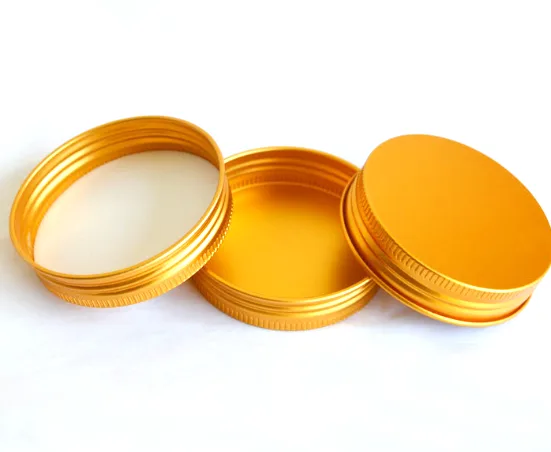
A screw-top jar is a pressure vessel, an aesthetic object, and a food-contact surface
An anodized aluminium deep drawn screw-top jar looks like packaging. It is actually three products in one: a pressure-bearing closure, a food-contact surface with a regulatory file attached, and a visible cosmetic surface whose whole purpose is to be looked at. The three requirements barely interact in a way that makes them easy to combine, which is why this part has a longer specification than anything else of its size in this family.
We draw these progressively through several stages, annealed between draws, then trim and pierce, with every stage logged against your part number, on mechanical presses 5 to 250 T and hydraulic presses 250-500 T with in-line annealing furnaces, CNC turning centres for secondary operations and CMM inspection. Formed features to +/-0.05 mm with capability data on critical dimensions, and GD&T per drawing with PPAP-style reports on request. Carbon steel in SPCC and DC01 grades, 304 and 316 stainless steel, aluminium and brass are held on site, with special grades sourced to the drawing when volumes justify. Plating, powder coating, anodising or polishing per the print, with the agreed finish travelling with the part number. This page is about the thread, the seal, and the fact that anodising changes both of them.
The thread is a pressure seal, and that changes everything
A jar closure thread is not a general-purpose thread. It has to meet three requirements that are usually in tension:
- It has to be accurate enough to start. A jar thread that is slightly off does not jam safely – it either will not engage or it engages and then leaks. A cosmetic jar on a shelf is a failure of a different kind.
- It has to seal. Typically by compressing a lining against the jar’s rim as the closure is tightened. That means the thread’s flank angle, its pitch and its lead-in all have to be consistent, because the sealing force depends on how square the thread sits.
- It has to resist loosening. A closure on a liquid product that opens in transit is a commercial failure. This is what the thread’s design length, its engagement and its flank geometry provide.
The consequence for manufacture: the thread is a formed feature whose geometry depends on the material’s springback, and a formed thread’s accuracy is fundamentally worse than a cut one. Where the closure carries a fill that must not leak, the thread is normally machined or broached rather than formed – and that is why this part’s route includes trimming and piercing plus secondary operations, and why a cosmetic jar and a functional closure have different costs that have little to do with their size.
The liner, which is where the real design is
Almost every cosmetic jar closure seals through a liner rather than through bare metal on metal, and the liner does most of the actual sealing work. That changes the tolerance picture:
- The liner sets the leak path, and the metal’s job is only to compress it consistently. This means the metal’s flatness and its rim geometry matter far more than its thread accuracy for the seal itself.
- The liner must be compressible and resilient, and it must not take a permanent set over the product’s shelf life. Where the product is alcohol-based or solvent-based, the liner’s compatibility with it is a requirement.
- The liner can hide a metal defect, – and conversely, a liner that is compressed slightly differently on every closure produces a seal that varies, which for a product that has to stay fresh is a real problem.
- The liner and the thread interact. A liner sitting proud raises the closure’s effective height, which changes the thread’s engagement and the torque needed to seal. This is why the liner’s height is a specified dimension and not a trimming detail.
Anodising: the finish that solves the cosmetics and complicates the thread
Anodising is the standard cosmetic finish on an aluminium jar closure, and it is the right answer for good reasons – it gives a hard, clean, corrosion-resistant, colourable surface that will not chip like a painted one. Four consequences that belong on the drawing:
- The layer grows outward, so the thread grows. An anodised thread is slightly larger in every direction and the effect is cumulative over a thread’s engagement length. This is entirely manageable, and it means the thread must be specified as post-anodise – or the pre-anodise dimension given with the growth accounted for. This is the single most important thing to state on this drawing.
- Anodising reduces the effective thread size and can affect mating. A closure anodised to spec will mate with a jar neck that is not anodised only if both were specified against the same post-anodise dimensions. Where the jar and the closure are made separately, this has to be agreed explicitly between the two drawings – it is a pair requirement, like a connector.
- Colour has a tolerance problem. Anodised colour is produced by dye in the porous oxide layer, and its consistency depends on the dye bath’s age and temperature. A cosmetic part’s colour should therefore be controlled against a retained physical reference, not by a colour code alone – and on a visible jar, the reference sample is the specification.
- Masking is needed and it is a real operation. The thread may be masked if it must stay at machined size; the rim is masked if it is a sealing surface. On a small closure the masking operation is a plug or a tape operation and it belongs in the cost and the schedule.
Forming: shallow draw, three requirements
A jar closure is a shallow draw from a blank, and it is one of the easier shapes in this family – but three features still need managing:
- The rim’s flatness. The rim is the sealing surface. A dished rim compresses the liner unevenly, and a curved rim is the classic cause of a cosmetic jar that leaks. This is why the route can include coining on the final station, and why rim flatness is a stated requirement.
- The sidewall’s wall thickness and its uniformity. For a cosmetic part the sidewall’s appearance is part of the product – a wall that shows draw lines or a thickness taper is visible on a shiny anodised surface.
- The thread’s forming. Formed in the draw or as a later operation, and its geometry depends on the material’s temper and thickness. Since anodising will then change it, the thread’s tolerance and the finish’s effect on it have to be considered together.
Materials, and the food-contact question
Carbon steel in SPCC and DC01 grades, 304 and 316 stainless steel, aluminium and brass are held on site, with special grades sourced to the drawing when volumes justify. For a cosmetic jar:
- Aluminium is the default because it draws well into a thin cosmetic wall, it is light, it takes a beautiful anodised finish in any colour, and its oxide gives a good corrosion resistance without further treatment. Almost every cosmetic jar closure is aluminium for exactly these reasons.
- Anodising on aluminium is intrinsically food-contact safe – the oxide layer is part of the metal and is inert. This is a real advantage over a coating, which is a separate layer that could in principle delaminate or be abraded through.
- Stainless Steel where a premium or durable look is wanted, and where a metal jar is being made rather than a plastic one. Anodising does not apply – passivation is the equivalent.
- Steel is rarely right for a cosmetic closure: it cannot be anodised, it is heavier, and it must be plated for appearance.
The regulatory point worth raising at quotation, rather than after: where the closure contacts a cosmetic product, the material and any additive or coating is subject to the market’s cosmetic and food-contact rules, and a declaration is normally required. Aluminium with an anodised finish is straightforward; a plated or coated closure requires that the coating be suitable for contact and that its documentation exists. Saying what the product is at the enquiry stage makes this a straightforward document request rather than a delay.
Metal or moulded polymer – which is the right closure?
Eight things, and they are longer than the list for a typical part because this one has three jobs:
- Thread form, class and pitch, and whether it is formed or machined.
- Thread dimensions stated as post-anodise, or the pre-anodise dimension with the growth accounted for. This is the most important line on the drawing.
- Rim flatness, against a named surface, because the rim is the seal.
- The liner, if there is one – its material, its height, and whether the closure’s height is measured with or without it.
- Colour, against a retained reference sample, and the texture or gloss if the finish has one.
- Which surfaces are masked, particularly the rim and the thread.
- Food-contact or cosmetic-contact compliance, stated as a requirement so the documentation can be arranged.
- Overall height and diameter tolerances, and whether they apply before or after anodising.
Is a metal jar closure the right answer at all?
Is a metal jar closure the right answer at all, or would a moulded plastic closure with a metal-look coating do the job more cheaply and with more design freedom? A metal closure genuinely earns its place where the brand position demands it, where the product is in an environment plastic will not survive, where the closure has to conduct heat or resist a solvent, or where a cosmetic jar’s shelf presence is worth the cost. But for many cosmetic applications a coated plastic closure performs equally well and costs a fraction. It is worth having that conversation at the design stage, because changing the closure material later is a much bigger project than choosing it correctly at the outset.
Not sure whether to draw, machine or weld this geometry? The guide to deep drawn covers compares the three routes and shows where each one wins; the full Precision Deep Drawn Parts range is linked from the overview page.
Specifications
| Item | Anodized Aluminum Deep Drawn Screw-Top Jars |
|---|---|
| Brand | AUNOV |
| Designing | Driven by your drawing or a physical sample – unusual walls, threads or tolerances are feasibility-checked first; changes are priced before they are made. |
| Tooling | Progressive and drawing dies are designed and built in house, so the die charge appears as its own quotation line, and ownership is confirmed on the quotation. |
| Samples | First-article samples ship with a dimensional report and material certificate, so any deviation is corrected at sample stage, and mass production is gated on that approval. |
| Materials | Carbon steel (SPCC / DC01), 304 / 316 stainless steel, aluminium and brass are held on site; special grades are sourced to the drawing when volumes justify. |
| Surface finish | Plating, powder coating, anodising or polishing, per the print; the agreed finish travels with the part number. |
| Processing | Progressive drawing through several stages, annealed between draws, then trim and pierce; every stage is logged against your part number. |
| Equipment | Mechanical presses from 5 to 250 T and hydraulic presses 250-500 T, with in-line annealing furnaces, with CNC turning centres for secondary operations and CMM inspection. |
| Tolerance | +/-0.05 mm on formed features, with capability data on critical dimensions; GD&T per drawing, PPAP-style reports on request. |
| Delivery terms | FOB Ningbo or Shanghai, T/T with deposit and L/C for larger runs; each volume tier carries its own quoted price. |
Frequently Asked Questions
Why is a screw-top jar three products in one?
It is a pressure-bearing closure, a food-contact surface with a regulatory file attached, and a visible cosmetic surface; the three requirements overlap awkwardly, which is why the specification is longer than its size suggests.
Why does the thread matter so much on a jar closure?
The thread is the pressure seal, so it is cut or rolled to a controlled form and then anodised; if the thread is only cosmetic the seal fails under pressure. The liner, not the metal, usually carries the actual sealing line.
How does anodising affect the thread and the seal?
Anodising grows the coating and can tighten or roughen the thread and change the sealing land, so both are sized for the finished state. The anodise is chosen for cosmetics but its effect on the thread is designed in from the start.
How is a screw-top jar verified?
Thread form, liner seat and food-contact finish are checked on the first article, and the typical minimum order is 1,000 pieces with a 24-hour quotation.
Related Products


Request a Quote for This Part
Send a drawing or sketch — get material advice, tooling cost and a per-piece price within 24 hours (working days).