
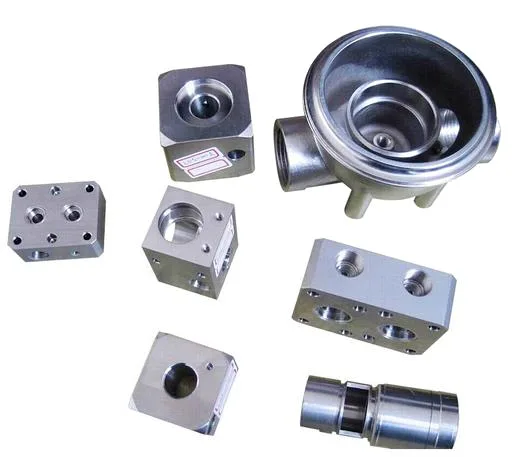
A pump or valve body machined from 304 or 316L is one of the few parts on this site where the grade choice is not a preference. It is a consequence of what the part will touch, and getting it wrong does not produce a part that looks wrong. It produces a part that passes every inspection and then pits.
So this page starts with the one question that has to be answered before anything else on the drawing, and then works outward to the machining, the bore, and the surfaces.
304 versus 316L, and why the difference is not subtle
Both are austenitic stainless steels with similar strength, similar formability and similar appearance. The difference is molybdenum content, and molybdenum is what resists chloride pitting and crevice corrosion. 304 has essentially none. 316L carries about 2 percent, and it is the L-grade variant specifically because the low-carbon version resists sensitisation – the intergranular corrosion that occurs when ordinary 316 is held in the 500 to 800 degree range, which is exactly the range a welding operation passes through.
Practical guidance, stated plainly:
- Fresh water, clean air, mild general service, no chloride sources: 304 is adequate and is usually the correct economic choice.
- Coastal, marine, de-icing salt, road salt, swimming pool environments, any chloride-bearing fluid: 316L. This is not a margin of improvement; it is a different order of resistance, and in stagnant crevices 304 will pit where 316L will not for years.
- Any chloride plus heat: 316L, and it is worth checking whether even that is enough. Chloride pitting resistance falls sharply above about 60 degrees Celsius, and in warm chloride service a duplex or a nickel alloy is sometimes the only sensible answer.
- Any welding in the fabrication, or any heat input during the build: 316L rather than 316, because the low carbon is what prevents sensitisation. On a machined body welding is sometimes needed for a seat or a boss, and this is the reason the grade is specified as L.
There is a second reason 316L appears on pump and valve bodies that has nothing to do with corrosion, and it is worth naming because it affects the machining: 304 and 316L have different machining behaviour. The austenitic stainless steel grades work-harden aggressively and gall readily, and the free-machining additions that make some stainless steel grades pleasant to cut are absent from both 304 and 316L. Anyone who has cut 303 free-machining stainless steel knows the difference, and 316L will behave more like 304 in that respect – tough, gummy, and prone to work-hardening if the tool dwells.
Pickled and annealed, and what that state does for the part
The specification here calls for material that is pickled and annealed, and this is a material state rather than a surface treatment. It matters for three reasons.
- Pickled means the surface has been chemically descaled – the heat-treatment oxide is removed rather than left to be polished off later. A properly pickled surface has no heat-affected scale, and it has a consistent passive layer rather than a locally oxidised one. This matters because a surface that still carries scale will contaminate the passivation layer that follows, and because scale under a machined face can lift and create a void.
- Annealed means the material is in a solution-treated condition: no work hardening from fabrication, no residual stress from forming or cutting, and a defined grain structure. For a pressure-containing body this is the important part, because residual stress in a machined part combines with service stress and it is the residual component that is usually not on anybody’s drawing.
- Annealed stock machines and machines badly in one specific way: it is soft, so it does not cut the way a cold-worked grade does, and it requires a definite approach to avoid smearing rather than cutting. Conversely, a part that is subsequently formed or machined heavily will work-harden at the surface, and the grade must tolerate that.
The practical specification items that follow: material grade stated with the ASTM or EN designation, the delivery condition stated as annealed and pickled, and the surface finish after machining stated separately. “Pickled and annealed” describes the stock. It does not describe the finished part, and the finished part’s passivation or plating is a separate decision.
The bore, because on a valve body the bore is the product
On a pump or valve body, the passage – the bore – is where the pressure boundary is, where the flow geometry lives, and where the seat and the seal sit. Everything else on the part is supporting structure. A valve body is bought for its bore.
Five properties define that bore, and each of them is separately specifiable:
- Nominal size. The nominal bore is the port size and it is the first thing on the drawing, but on its own it is the least informative of the five.
- Roundness and cylindricity, independently of size. A bore machined to size but with poor cylindricity gives a flow path that varies along its length, which on a valve means a seat that seals at one position and not at another, and on a pump means a varying flow rate and a varying pressure drop. Roundness on a bore is often more functionally important than its diameter.
- Surface finish, stated as a Ra value and a measurement convention. On a seat this is not cosmetic; on a flow path it affects friction and, on some fluids, affects whether deposits form. Ra alone is not a complete specification, because Ra is an average and says nothing about the peaks. Where a peak matters – a sliding seal, a seat – the specification should include an Rmax or an inclusion callout.
- Position and coaxiality, of the bore to the sealing face and to the mounting face. A valve body whose port is not concentric to its sealing face will have a seat that varies around its circumference.
- Depth, which on a port determines the volume of the internal cavity, and on a counterbore determines where a gasket sits.
A useful way to write this on a drawing is as a functional callout – the bore size, the finish required by the seal supplier, the roundness, and the position to the seat – rather than as a general diameter and a general roughness note. Seal suppliers publish their own bore finish and cylindricity requirements, and those are the numbers that matter.
Machining it, and the sequence problem specific to stainless steel
CNC turning with milling and drilling in as few setups as the geometry allows is the right route, and for a stainless steel valve body the constraint that drives the setup count is not the geometry. It is the fact that a stainless steel part should ideally be machined in one clamping wherever possible, because every re-clamp is an opportunity to work-harden the surface and then cut into it.
Three stainless steel-specific things belong in the routing:
- Rigid workholding. Thin stainless steel sections distort under clamping force, and a bore that was round when it was cut is not round when the clamp is released. Supporting the workpiece behind a finished bore during subsequent operations matters more on stainless steel than on aluminium.
- Continuous cutting, no dwelling. A tool that stops in a cut leaves a work-hardened spot that becomes the start of the next problem. This is why a stainless steel cycle should not be interrupted mid-feature – the machine should finish the pass.
- Positive, chip-breaking geometry with a sharp, positive rake. Stainless Steel does not like a negative rake and it does not like a worn tool. Work hardening from a dull tool feeds directly into the next pass.
Cooling matters on this part more than on aluminium, and specifically the delivery needs to reach the cutting point rather than merely exist. Consistent flood or through-tool coolant, and a settled part temperature before any measurement, because a stainless steel part that has been running thermally can be a few hundredths of a degree different from the inspection room and it will show up in the CMM data.
Tolerance, allocated to the pressure boundary
+/-0.01 mm on machined faces and +/-0.05 mm on formed details are achievable, and the sensible allocation on a body like this puts the tight bands where the pressure and the seal are.
- Bore and seat, at the tight end, with roundness and cylindricity called out separately and stated as their own requirement.
- Face-to-face and face-to-bore relationships, held tightly enough that the internal cavity geometry is predictable. On a valve body, the seat’s position relative to the body face controls the opening and closing behaviour, so this is a functional tolerance and not a manufacturing one.
- Port thread or connection, specified for fit and for sealing method, with the plating or passivation condition stated so that the effective size after finishing is unambiguous.
- Mounting face flatness and the position of any bolt holes to it, because on a flanged body the gasket seat has to be flat and the bolt circle has to be where the mating flange expects it.
- External envelopes and non-sealing features, at the general band. On a machined body there is usually plenty of room to recover tolerance cost here.
Surface, passivation and the question of plating
The specification allows plating, coating or polishing, matched to the duty, with the agreed finish travelling with the part number. The substantive point on a stainless steel body is that passivation is the default and anything else is a decision.
Passivation is not a coating. It is a chemical treatment that removes free iron from the surface and thickens the chromium oxide layer that makes stainless steel stainless steel. It leaves the part dimensionally unchanged, it restores full corrosion resistance after machining, welding or handling in carbon steel, and it is what almost every stainless steel part needs before it leaves the shop. It is also worth specifying explicitly rather than assuming, because a part that is machined and then handled on a shared bench will pick up free iron and will need passivation at the end regardless.
Where plating is considered instead, the trade is real. A plated part will not pit from chloride in the way bare stainless steel does, which can be the better answer in a salt-laden environment. But a plated stainless steel part no longer has a passive layer, it has a coating that can be scratched, and any damage to the coating exposes bare stainless steel in a worse condition than if it had never been plated at all. Plated stainless steel also complicates the bore, because the bore is exactly where you want the passive layer and exactly where plating will change the size.
On a valve body where the bore is the product, the argument for passivation rather than plating is usually stronger than it looks.
Concentricity held across operations is what a housing actually needs
Turning centres fed from bar, machining centres for the milled features, and first articles and batch samples checked on the CMM, with critical dimensions carrying data. The items worth specifying for this part family specifically:
- Bore size, roundness and cylindricity, reported as three numbers rather than one, with the measurement direction identified.
- Bore surface finish, measured and reported, not assumed.
- Coaxiality of bore to seat and of bore to mounting face, as its own characteristic.
- Flatness of every sealing or gasket face, against its stated datum.
- Material certification with the grade and heat number, and where the grade choice is the corrosion decision, a record that the right grade was used rather than a record that some stainless steel was used.
- Passivation recorded as an operation with a date, so the record survives the order.
What is in the fluid, and at what temperature
What is actually in the fluid, and at what temperature? This is the question that determines whether 304, 316L, or something else entirely is correct, and it costs nothing to answer before the material is ordered. It is remarkable how often the grade ends up chosen by default rather than by the chloride concentration and the operating temperature, because those are the only two variables that matter for the pitting question. Everything else about the body – the size, the pressure, the machining difficulty, the cost – is real engineering, but it is all secondary to whether the material survives its environment. Establishing that first also tends to simplify the rest, because a correctly chosen grade needs less defensive finishing, fewer compromises on the surface, and a much thinner justification file.
CNC Machining Parts is the parent range for parts like this one; the overview page gathers the tooling logic, finishing options and tolerance notes that apply across the family.
Specifications
| Item | Stainless Steel CNC Machined Pump and Valve Components |
|---|---|
| Brand | AUNOV |
| Designing | Send drawings, or send a sample to be measured – samples are reverse-measured into a controlled drawing; the approved drawing is kept as the controlled master. |
| Tooling | Die design and toolmaking stay in house, so no tooling step is outsourced, and the charge is refundable against agreed volumes. |
| Samples | Samples are issued for approval before the run, so the sample is retained as the master, and later batches are gauged back to the signed sample. |
| Materials | Stainless Steel 304 and 316L, pickled and annealed, 0.5-3.0 mm nominal wall – one grade chosen for corrosion duty and formability of this pump. |
| Surface finish | Surface treatment matched to the duty: plating, coating or polishing; the agreed finish travels with the part number. |
| Processing | CNC turning with milling and drilling in as few setups as the geometry allows; first articles verify the whole flow before the run is released. |
| Equipment | Turning centres fed from bar, with machining centres for milled features; first articles and batch samples are checked on the CMM. |
| Tolerance | +/-0.01 mm on machined faces, +/-0.05 mm on formed details; critical dimensions carry CMM data with the shipment. |
| Delivery terms | FOB, CIF or DDP per Incoterms 2020, T/T with deposit and L/C for larger runs; call-off schedules are supported. |
Related Products


Request a Quote for This Part
Send a drawing or sketch — get material advice, tooling cost and a per-piece price within 24 hours (working days).