
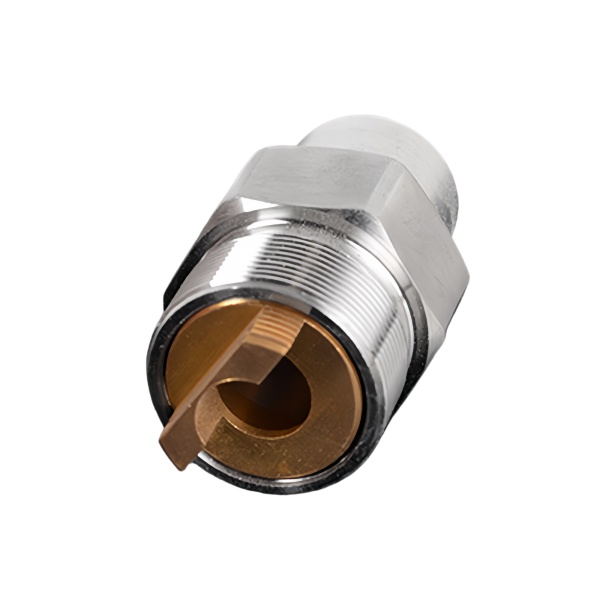
The brass insert in a stainless steel probe fitting exists for one reason: thermal conductivity to the sensing element
A temperature probe fitting typically combines a stainless steel body (for corrosion resistance and structural strength at the process interface) with a brass insert (for thermal performance around the sensor element). Brass conducts heat at roughly 120 W/m·K—about 15× better than 304 stainless steel (16 W/m·K). In a temperature probe, the sensing element must equilibrate with the process fluid temperature; the brass insert acts as a thermal short-circuit that pulls heat from the wetted stainless steel wall to the element, cutting response time by a factor of 3–5× compared to an all-stainless steel design.
The tradeoff is corrosion: brass cannot survive the same environments as stainless steel. In a probe fitting, this is managed by keeping the brass out of the process fluid entirely—the brass insert sits in the dry, back-end cavity behind the stainless steel sheath, where it touches only the sensor leads, potting compound, and ambient air. We review every probe fitting drawing to confirm the brass never crosses the wetted/dry boundary; a brass insert exposed to chlorinated process fluid would dezincify within months and fail the probe.
Interference fit between the brass insert and the stainless steel bore must survive thermal cycling without loosening
The brass insert is typically pressed into a stainless steel counterbore. Brass CTE (≈20 µm/m·K) roughly matches stainless steel (≈17 µm/m·K), so thermal cycling relaxes the interference only slowly—about 0.01 mm loss of interference for a 10 mm insert over a 50 °C swing, acceptable for most press fits.
The subtler failure is creep: brass creeps at room temperature under sustained compressive stress. A press fit designed at 60 MPa interfacial pressure (a typical design target) loses 20–30 % of its retention force over the first year as the brass creeps to conform to the bore. We design the initial interference for 80–100 MPa contact pressure where the insert must never move, accepting the creep loss and still retaining 60+ MPa after a year. Where the insert must be removable for service (element replacement), we reverse the logic—light interference (20–30 MPa) plus a radial set screw, so the insert can be drifted out without galling the bore.
Galvanic couple between brass and stainless steel is mild but must be managed at the interface
Brass and 304/316 stainless steel are relatively close in the galvanic series (stainless steel is slightly more noble). In a dry environment—the only place brass belongs in this design—the couple is inert. The risk arises if moisture wicks into the insert bore by capillary action along the insert’s lead wires.
We mitigate this with potting: the insert cavity is potted with epoxy (or a ceramic-filled compound for high-temperature probes) after the element and leads are installed, sealing the brass/stainless steel interface from moisture and mechanically locking the insert against rotation. The potting operation is done with the probe axis vertical and the potting compound de-aired under vacuum, so no voids remain along the interface—voids are where moisture collects and where corrosion begins.
Machining the stainless steel body and brass insert to matched tolerances makes the press fit predictable
A press fit is only as predictable as the two parts’ tolerance bands allow. The stainless steel bore is machined to H7 (+0.015/0 mm at 10 mm diameter); the brass insert OD is machined to p6 (+0.025/+0.015 mm), giving a theoretical interference of 0 to 0.025 mm depending on where each part falls. That spread is too wide for a controlled press fit.
We tighten the process: the stainless steel bore is held to the middle-to-upper half of H7 by tool offset feedback (bore measured every 10th part, offset adjusted), and the brass insert is turned to the upper half of p6. This narrows the actual interference to 0.015–0.025 mm consistently. Every insert is measured (micrometer, two angular positions) before assembly, and the actual value is matched against the measured bore of the body it will enter—matched-mating rather than random assembly, at zero added cost beyond the measurement discipline.
How we verify a probe fitting with brass insert before shipping
Validation protocol:
- Dimensional: Body threads (go/no-go per class), wetted-end seal face flatness (≤0.01 mm) and finish (Ra ≤ 0.8 µm), insert counterbore diameter and depth (micrometer/depth gauge).
- Insert retention: One assembly per batch (or 100 % for safety-critical probes) subjected to a 50 N axial pull and a 0.5 N·m torque on the insert. Acceptance: zero movement detectable (indicator resolution 0.01 mm).
- Thermal response (sample, if specified): One probe per batch immersed in a 60 °C water bath from 20 °C ambient; time to reach 63.2 % of the step (one time constant) recorded. Acceptance: per drawing (typically 3–8 s for a fast-response design, 15–30 s for a general industrial probe).
- Pressure test: The wetted side pressurized at 1.5× rated pressure for 10 minutes with the back end open. Acceptance: no leakage past the stainless steel sheath, no weeping at potting.
- Material certification: Mill certs for the stainless steel body (304/316 per ASTM A276) and the brass insert (C36000 or C3605 per ASTM B16). Certificates shipped with the CoC.
Our CNC Machining Parts range is where this part sits. The cnc machining parts pages carry the process notes, common materials and inspection points behind every product in the family.
Interference fit of the brass insert into stainless steel
A probe fitting with a brass insert pressed into stainless steel joins two metals by force, and the interference has to be tight enough to stay and light enough that the stainless steel does not split. We set the press fit from the materials and the temperature, because brass and stainless steel expand differently and a fit that is right cold can relax or bind when the service warms. The insert bore is held true to the stainless steel body so the probe seats concentric after pressing, and we verify the assembled runout rather than the two parts separately, because the joint, not the pieces, is what the probe sees.
Galvanic care at the insert interface
Brass in stainless steel is a galvanic pair, and in a wet service the interface can corrode even though each metal is fine alone. We isolate the joint where the environment demands it, with a coating or a dielectric film at the press interface, and we state the limitation on the drawing so the buyer knows the fitting is not universal. The care is cheap compared with a seized or corroded probe in the field, and it is the kind of note that prevents a returned fitting blamed on the wrong cause.
Specifications
| Item | Stainless Steel CNC Machined Probe Fitting Brass Insert |
|---|---|
| Brand | AUNOV |
| Designing | Send us your 2D drawing, or mail a sample for measurement, DFM feedback is returned with the quote. |
| Tooling | Every die designed and built in our toolroom, held under your part number. |
| Samples | Pre-production samples of the fitting ship with a dimensional report and material certificate. |
| Materials | 304 / 316 stainless steel is the primary stock for this part, alongside carbon steel (SPCC / DC01), aluminium, brass and copper, with grade selection confirmed at drawing review. |
| Surface finish | Select from zinc, nickel or chrome plating, e-coat, powder coat, anodising or passivation, matched to the drawing requirement. |
| Processing | Staged deep drawing, with in-line annealing where the draw ratio requires, then pierced and machined in house. |
| Equipment | Mechanical presses 5-250 T, hydraulic presses 250-500 T, CNC turning and milling cells, a climate-controlled CMM room. |
| Tolerance | Tolerances to +/-0.1 mm as drawn, +/-0.03 mm after machining. |
| Delivery terms | FOB as standard, DDP available for EU and US destinations, T/T or L/C, D/P on repeat business, call-off scheduling supported. |
Related Products



Request a Quote for This Part
Send a drawing or sketch — get material advice, tooling cost and a per-piece price within 24 hours (working days).