
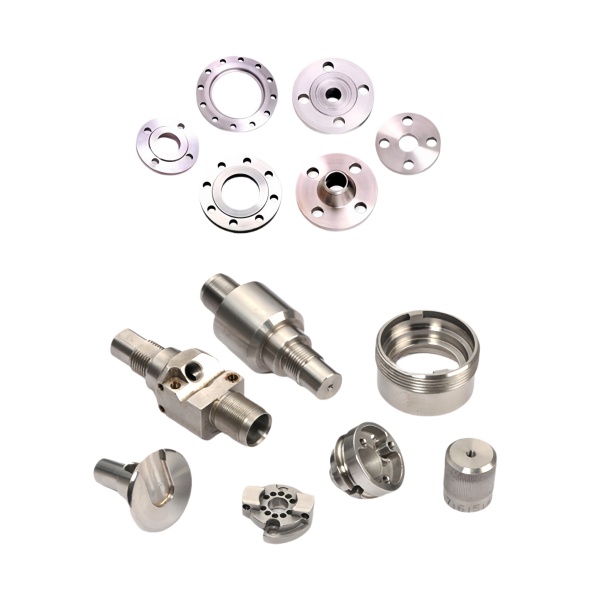
Aluminium versus steel on the same machine
An order that pairs aluminium flanges with steel machined fittings is usually a design decision rather than a purchasing convenience, and it is a good decision in the right circumstances. The aluminium flange is light and conducts heat; the steel fitting is stiff, hard and strong. Put them together and each does the job the other is bad at. But the pairing creates three specific engineering obligations that a single-material design does not have, and all three are the kind of thing that gets noticed a year into service rather than at the drawing review.
AUNOV turns aluminium flanges and machines steel fittings on the same CNC equipment to ±0.03 mm on machined features, with finishing per the drawing. This page is about the interface between the two materials rather than about either part on its own.
Obligation one: the galvanic couple
Aluminium sits well below steel in the galvanic series, and the moment the two are in electrical contact in the presence of an electrolyte, the aluminium becomes the anode and corrodes preferentially. The electrolyte does not have to be seawater; condensation, a wet workshop floor, a chloride-bearing wash-down, or simply humid air on a contaminated surface is enough.
What makes this dangerous rather than merely inconvenient is that the corrosion is concentrated. The attack appears at the joint, in the crevice between the flange face and the fitting, and in the threads, exactly where the assembly’s mechanical integrity lives. A flange that loses 0.5 mm of thickness uniformly would be an obvious problem; the same volume of material removed from a thread flank and a sealing face is a failure.
Three levers control the rate, and they act independently:
- Area ratio. The severity of galvanic attack on the anode increases as the cathode area grows relative to the anode area. A small aluminium fitting attached to a large steel structure is the worst case. A large aluminium flange bolted to a small steel fitting is much less severe, not because there is less corrosion but because the available anodic area is large and the attack is spread out. Where a design is forced into an adverse ratio, the aluminium part should be coated everywhere except where it must conduct.
- Electrolyte availability. Break the path and the couple stops. A gasket, an insulating washer, a coated interface or a sealant in the thread all interrupt the ionic path. This is the cheapest and most reliable countermeasure, and it is also the most frequently omitted.
- Barrier protection on the aluminium. Anodizing or coating the aluminium substantially reduces the exposed anodic area and raises the local resistance. It is important to recognise that anodizing helps exactly to the extent that it is unbroken; a coated part with a scratch at the joint corrodes intensely at the scratch.
A useful rule for the drawing: wherever an aluminium and a steel component are in contact, state whether the contact must be electrically conductive. If it must, use a conductive interface material and accept that the couple is present. If it must not, put an insulator in the joint and say so, because otherwise the shop will make the contact as clean and as tight as possible, which is precisely the wrong answer here.
Obligation two: differential expansion
Aluminium’s coefficient of thermal expansion is roughly twice steel’s. Over a 100 mm flange diameter with a 60 kelvin temperature rise, the aluminium grows about 0.14 mm more than the steel. That is more than a typical flange face flatness tolerance, and it is entirely normal for a warm machine or a hot fluid.
The consequences depend on the joint:
- Bolted flange with a gasket. The aluminium flange grows radially away from the bolts, which changes the compression on the seal track as the temperature changes. A joint that is leak tight cold can weep hot, or the reverse. The fix is a gasket with enough recovery to follow the movement, and a bolt pattern with enough bolts that the bay deflection stays small. Bolts themselves, if steel, expand less than the aluminium, so the clamp load rises when the joint is hot if the bolt is constrained; that is a real effect on a long bolt.
- Press or shrink fit. An aluminium component pressed onto a steel shaft will lose its interference when hot rather than gaining it, because the aluminium grows away from the steel. Conversely, cooling an aluminium hub onto a steel shaft produces an interference that relaxes as it warms. If the fit carries load, the fit has to be calculated at the temperature of operation, not at assembly.
- Threaded joint with a shoulder. A shoulder that seats metal-to-metal at room temperature may open when hot, because the aluminium thread pitch grows more than the steel’s. This is one more reason why a sealing design that relies on thread interference should be replaced by one that relies on a captured elastomer or a cone.
Obligation three: stiffness mismatch in the joint
The third obligation is less obvious. Aluminium’s modulus is roughly one third of steel’s, so if the two parts of a flange joint are loaded through their contact faces, the aluminium side will deflect about three times as much for the same stress. In a flange, this means the aluminium face cups more under bolt load, and contact pressure distribution is set by the aluminium. That is a design fact, not a defect: it means the aluminium side’s thickness and the bolt pattern, not the steel side’s, determine whether the joint seals.
The practical consequence is that a flange designed in steel cannot simply be reproduced in aluminium. A steel flange at 8 mm thick that seals reliably may need 12 mm in aluminium to give the same face deflection. The reverse direction is safe: an aluminium flange design reproduced in steel will be stiffer than needed.
| Joint requirement | Governing material | What that means for the drawing |
|---|---|---|
| Sealing face flatness under bolt load | Aluminium — it deflects more | Set flange thickness from the aluminium side’s deflection, not the steel side’s |
| Thread shear capacity | Whichever thread is softer, or whichever strips first | Engagement length and torque must be set by the weaker thread |
| Thermal excursion at the joint | The pair — differential expansion, not absolute | Gasket recovery must exceed the calculated differential movement |
| Galvanic corrosion rate | The pair — area ratio and electrolyte | State whether the interface must conduct, and whether it must be sealed |
| Overall stiffness of the assembly | Steel — it dominates once the parts are coupled | Do not size the steel fitting from the aluminium part’s load path |
Machining the two materials in one order
Machining aluminium and steel to the same ±0.03 mm tolerance on the same equipment is entirely routine, but the two materials do not behave identically and the process plan has to account for it.
- Thermal growth during machining. Aluminium conducts heat quickly and grows more per degree, so a heavy roughing cut on an aluminium flange raises its temperature and its dimensions. If a tight dimension is measured immediately after a roughing pass, it will read large, and it will shrink as it cools. Finishing cuts on tight features should follow a cool-down or be taken in a way that limits heat input, and final inspection should be done at a stable temperature. Steel is more forgiving, but a heavy cut on a thin steel fitting will also move it.
- Cutting forces and thin sections. A thin aluminium flange deflects more under cutting load than a steel one of the same geometry, which means the same fixturing is not equally suitable. Support and clamping pressure must be set for the softer, more flexible part.
- Contamination control. Aluminium swarf and steel swarf must not be mixed in a way that embeds steel particles in aluminium. Embedded steel in an aluminium surface creates a permanent galvanic couple that appears later as local pitting, and it survives cleaning. We keep the two material streams separate on the floor and clean machines between alloys where the part is corrosion-critical.
- Tool life. Steel wears tooling faster, so the cutting parameters differ; this is a shop matter, though it affects the relative cost of the two parts in one quotation and it is worth understanding when comparing quotes from different suppliers.
Finishing decisions when two materials share an assembly
Specifying finishes on a mixed-material order is a coordination problem. The finish on one part can compromise the other.
Anodizing the aluminium flange provides a barrier against galvanic attack, but it also insulates the flange electrically. If the assembly uses the flange as a ground path, the anodizing has to be masked at the ground contact, and the masking has to be specified at the drawing stage because adding it later means re-running the process.
Plating the steel fitting with zinc or nickel changes its position in the galvanic series, usually toward the aluminium’s, which reduces the driving voltage of the couple. That is a real benefit: a zinc-plated steel fitting coupled to an aluminium flange corrodes the zinc coating preferentially rather than the aluminium, and the coating is a sacrificial layer that can be inspected. The cost is that the plating changes the fitting’s dimensions, particularly on threads, so the pre-plate allowance must be specified.
Passivating the steel fitting is not a substitute for a barrier, and it must not be applied to a part that will be coupled to aluminium without consideration: a passive stainless steel surface is a strong cathode in a galvanic couple with aluminium, and a stainless steel fitting against an aluminium flange is one of the more severe pairings in common use. If the customer requires stainless steel fittings, the interface should carry an insulator and the assembly should be designed for it.
Assembly, torque and the weaker component
In a mixed joint the assembly torque has to be set by the weaker element, and in most of these assemblies that element is the aluminium. A torque that is right for a steel fitting threaded into a steel body will strip or deform an aluminium thread, and once the aluminium thread has yielded, the preload is gone permanently.
Four measures, all of which belong on the assembly drawing:
- A torque value with the material pairing stated, not a generic torque from a table.
- An assembly lubricant requirement, since friction on aluminium is variable and a lubricated thread develops more clamp load from the same torque.
- A hardened washer under the bolt head or nut, to spread the bearing load and stop the aluminium from cold-flowing under the fastener.
- Where the joint will be opened in service, either a thread insert in the aluminium or a dissimilar pairing to prevent galling, because an aluminium-on-steel thread that has been tightened for a year will often tear when it is opened.
Aluminium and steel can touch, provided the interface is accounted for
Is it acceptable to have aluminium and steel in permanent contact?
Yes, provided the design accounts for it. Either the interface is insulated, or the aluminium is coated and the geometry gives a favourable area ratio, or the joint is dry and protected from electrolyte. What is not acceptable is leaving it to chance, because the failure is localised and it appears at the joint’s load path.
Will anodizing an aluminium flange in contact with steel prevent corrosion?
It substantially reduces it as long as the coating remains intact. It does not eliminate it, and the coating must be continuous over the contact area, which means the interface must be masked intentionally if the design requires an insulator, not left as a coating layer that might be scraped during assembly.
Can the aluminium flange be made in steel instead?
Often yes, and it removes all three of the coupling problems at the cost of mass and of thermal conductivity. If the flange did not need to be light or to conduct heat, it is worth asking whether the material mix was ever necessary.
Do the two parts need the same surface finish?
No, and they normally should not have the same. The aluminium part is typically coated for corrosion and the steel part plated for corrosion or wear. What matters is that both finishes are specified with their thickness, so that the dimensional effect of the coating is accounted for on any fits and threads.
How do I know whether a steel fitting is compatible with my aluminium flange in service?
Give us the environment, the expected temperature range, whether the joint will be wet, and whether the contact must be electrically conductive. Those four answers determine whether an insulator is needed, whether the steel needs plating, and how the aluminium should be finished.
CNC Machining Parts is the range this part sits under; the overview page pulls together the tooling logic, finishing options and tolerance notes that apply across the family.
Specifications
| Item | Aluminum CNC Turned Flanges and Steel Machined Fittings |
|---|---|
| Brand | AUNOV |
| Designing | Send the drawing, or a sample we can measure, our engineers reply with a manufacturability assessment and pricing. |
| Tooling | Tooling designed and cut in house, with your part number on the tool record. |
| Samples | Approval samples of the fitting ship with dimensional data and material certs. |
| Materials | Aluminium leads the stock list for this part, alongside carbon steel (SPCC / DC01), 304 / 316 stainless steel, brass and copper, with the final grade confirmed at the drawing review. |
| Surface finish | Plating, e-coat, powder coating, anodising or passivation, per your print. |
| Processing | Deep drawing in stages, in-line annealing where needed, then pierced and CNC-machined in house. |
| Equipment | 5-250 T mechanical presses plus 250-500 T hydraulic presses, CNC cells plus a temperature-controlled CMM room. |
| Tolerance | +/-0.1 mm on as-drawn features, +/-0.03 mm on machined surfaces. |
| Delivery terms | FOB is standard; DDP offered for EU and US, T/T and L/C accepted, D/P for established customers, call-off schedules and blanket orders supported. |
Related Products


Request a Quote for This Part
Send a drawing or sketch — get material advice, tooling cost and a per-piece price within 24 hours (working days).