
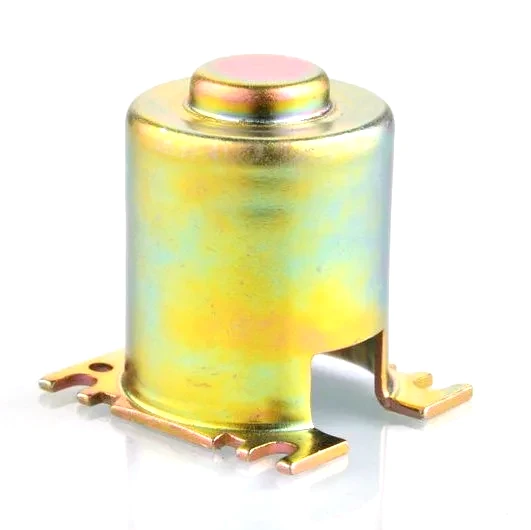
One supplier, one family: how a components platform works
A wiper motor is not assembled from random parts; it is assembled from a family – housing, can, end caps, bushings carriers, brackets – whose members share dimensions, materials, tolerances and a manufacturing logic. Sourcing that family piece-by-piece from specialist suppliers forfeits most of the value in that structure. Sourcing it as a wiper motor components platform from one stamped-parts supplier captures it. This page explains what a platform approach actually changes, technically and commercially.
Shared engineering: where platform value begins
When one supplier draws the housing, the can and the end caps, the interfaces stop being negotiations and become engineering data. The housing’s bore and the end cap’s boss share a datum scheme written once. The can’s flange and the cap’s pilot are dimensioned as a pair. Material selections align across the family – one steel grade strategy, one plating line, one salt-spray standard – instead of five suppliers each optimizing in isolation and arriving at five different coatings for parts that bolt together. The measurable consequence shows up at motor validation: platform-sourced families assemble with fewer shimming events, because the tolerance stacks were designed rather than discovered.
Manufacturing synergy inside the family
Family parts share more than drawings. The same coil grades run across members, so material is bought at family volume, not per-part volume – on a programme where the housing alone cannot hit a price break, the family’s combined tonnage can. Tooling shares components: standard die sets, guide pillars and sizing rings repeat across members, cutting both tooling cost and the spare-parts inventory the tool room carries. And quality infrastructure amortizes: one CMM programme family, one gauge set logic, one control-plan template applied across members with per-part specifics. None of this is visible on a piece-price quotation – all of it is visible in the total cost of the motor programme.
Change management across a family
Motors evolve, and family changes cascade: a depth increase on the can moves the cap’s pilot; a bracket relocation moves the housing’s ear pattern. In a platform relationship, the cascade is engineered by the supplier’s own die designers, who hold all the geometry – changes get assessed across the family in one review, and the drawings update coherently. In a fragmented supply chain, the same cascade becomes a conference call between suppliers, each protecting their scope, with the customer’s engineer as unpaid coordinator. Buyers rarely itemize this cost, but they feel it at every running change.
What the platform agreement should specify
Three clauses make a components platform work. Interface ownership: the supplier owns the family’s internal interfaces (the pairs of dimensions that mate family members to each other), while the customer owns the vehicle interfaces – a clean split that prevents both scope creep and orphaned dimensions. A change-process map: who assesses cascade, who approves, what the lead time is per change class. And an exit architecture: per-part drawings, gauges and process sheets maintained current, structured so any member could be re-sourced without unwinding the platform. We insist on the third clause in our own agreements – platform lock-in is a bad contract even when it is a good workflow.
What we need to quote a family
The full parts list with drawings, the motor’s architecture sketch (what assembles to what), volumes per member, and any existing supplier agreements that constrain timing. We return a platform proposal: the engineering assessment of shared tolerances, a tooling plan showing which members share infrastructure, and piece prices that show the family effect honestly rather than hiding it in rounding. Sampling follows per-member die timing, typically staggered over 4-8 weeks for a full family.
Platforming a family where some parts are plastic
Can you platform a family where some parts are plastic?
Partially – we take the metal members and coordinate the plastic interfaces from the same datum data, which still captures most of the tolerance-stack value even if the moulded parts stay with their specialist.
Does platform sourcing mean paying more per part for convenience?
Usually the opposite – the material and tooling synergies show up as piece prices at or below fragmented sourcing, and the savings the platform cannot deliver we show as clearly as the ones it can.
How do you avoid becoming a single point of failure?
The exit architecture plus a documented capacity plan: the agreement states which presses and which alternate routing back up each member, and we test the routing annually on a qualifying volume. Redundancy you have not rehearsed is a document, not a plan.
This part belongs to our Automotive Motor Components range. The automotive motor components pages collect the process notes, common materials and inspection points behind every product in the family.
One test plan across a mixed component family
A wiper-motor component family mixes metal stampings, turned shafts, and molded gears, and the temptation is to test each part type with its own plan. We instead write one family test plan that calls out the characteristics that matter per part and the sampling that applies across the lot, so a single incoming inspection covers the whole set. The plan names which dimension is critical on which piece and sets the audit frequency by failure consequence, not by part count. A buyer reviewing one plan understands the family’s quality at a glance, and a line receiving the family knows exactly what to check and at what rate.
Change control when one piece is revised
When a single component in the family is revised, the risk is that the change silently shifts the fit of its neighbors. We run every revision through the family drawing set so the interfaces are checked together, and we flag any piece whose tolerance band moved relative to its mating part. This is lighter than requalifying the whole family but catches the cross-talk that a piece-by-piece change note misses, which is where mixed families actually go wrong.
Specifications
| Item | Wiper motor components |
|---|---|
| Brand | AUNOV |
| Designing | Your drawing sets the part – a manufacturability review comes back with the quotation; the same drawing is used for every repeat order. |
| Tooling | Tooling is built and held under your part number, so no tooling step is outsourced, and maintenance is tracked against the part number. |
| Samples | First-article samples ship with a dimensional report and material certificate, so any deviation is corrected at sample stage, and mass production is gated on that approval. |
| Materials | Carbon steel (SPCC / DC01), 304 / 316 stainless steel, aluminium, brass and copper – the grade is matched to the duty of this component. |
| Surface finish | Adhesion comes from phosphating, followed by powder coating, e-coating or zinc plating; visible faces get chrome or nickel. |
| Processing | Coil blanking, progressive drawing through 3-5 stages with anneals between, trim and pierce, then deburr and finish. |
| Equipment | Presses from 5 to 250 T mechanical and 250-500 T hydraulic, annealing ovens on site, plus CNC turning and machining centres. |
| Tolerance | +/-0.05 mm on controlled dimensions and +/-0.1 mm on general features; capability studies supplied on request. |
| Delivery terms | CIF or DDP, with FOB available, T/T or L/C, with D/P accepted on repeat business; repeat orders reuse the approved first article. |
Related Products



Request a Quote for This Part
Send a drawing or sketch — get material advice, tooling cost and a per-piece price within 24 hours (working days).