
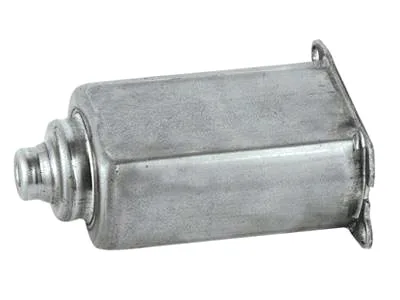
Dry, cold, and loud next to your ear: the window motor case environment
The power window regulator motor case lives in a deceptively mild environment – no road spray, no direct washing – that is harder than it looks. Door cavities condense daily, swing from -40°C mornings to cabin heat by afternoon, and sit centimetres from the occupant’s ear. A window motor case therefore has three jobs at once: survive condensation without draining drama, tolerate thermal cycling for fifteen years, and stay acoustically invisible in a cabin where the driver can hear everything. This page takes the three in turn.
Condensation without drainage
Doors are sealed assemblies; whatever moisture enters the cavity stays and cycles. A window motor case inside it breathes with every temperature swing, and the condensation film forms on the coldest surface – usually the case wall at dawn. Unlike a wiper case, it cannot rely on a drain notch or on periodic water immersion flushing salts away. The engineering answers: a coating system chosen for humid-static service (zinc-phosphate with a corrosion inhibiting oil, or e-coat, outperform plain trivalent zinc in cyclic humidity testing), a breather membrane where the design permits so the case equalizes rather than pumps, and a materials strategy that assumes the interior film exists – meaning no bare-steel contact between dissimilar fasteners and the case wall. The test that predicts this is cyclic humidity (per standards like the various OEM cyclic tests), and we run it on case material lots because steady-state salt spray simply does not reproduce the door’s failure mode.
Thermal cycling and the press-fit problem
Steel’s thermal expansion is modest, but a press-fit bushing in a thin-wall case amplifies it: cold mornings shrink the case wall away from the bushing, warm afternoons clamp it tighter, and fifteen years of the cycle Fatigues the interference joint. Our press-fit bands for window motor cases are validated across the full automotive thermal range with the bushing supplier’s actual material – not a generic steel-to-steel assumption – because sintered bushings and the case wall expand at different rates. The validation is a fixture test: cycled joints sectioned at intervals, measuring residual interference. It is unglamorous work that prevents the “window slower on cold mornings” warranty pattern that some motor populations famously show.
Cabin acoustics: the case as a speaker
Wiper noise fights road noise; window motor noise fights silence. A case that resonates at the motor’s torque-ripple harmonic broadcasts into a door panel that acts as a sounding board. The case’s acoustic levers, covered in depth on our casing page, apply with higher stakes here: modal placement (wall thickness chosen so the first circumferential mode misses the motor’s tonal frequencies), damping patches where modes land anyway, and joint design that decouples case vibration from the regulator and door panel. We run the modal tap test on first articles against the motor maker’s noise budget, and the test’s result is a drawing change – cheaper by orders of magnitude than an acoustic retrofit after launch. Window programmes that skip this step and “tune at the vehicle” pay for it in engineering weeks later.
Condensation cycling is not a leak
The case drawing with its mounting context (what it bolts to inside the door), the motor’s noise budget if one exists, the thermal and humidity specs, and volume. The acoustic conversation is the one to have early – the wall thickness decision is simultaneously structural, thermal and acoustic, and it is cheap to get right at die-design time.
Fastening strategy inside a plastic-heavy cavity
Window motor cases bolt into assemblies where their neighbours are brackets, glass guides and harness clips – mostly plastic. The case’s fastening features therefore serve two masters: metal insert nuts and welded studs suit plastic neighbours’ assembly but add operations; formed-in features (pierced tabs, extruded holes for thread-forming screws) keep the case single-process. Extruded holes deserve a note – drawing the case leaves the sheet capable of extruding a blind hole for a self-tapping screw in the same die, and that delete-the-nut move has become our default where the load allows. The choice interacts with disassembly too: serviceable window regulators prefer screw-in metal threads over snap features, and the case is where that preference gets engineered.
White corrosion powder inside the door – what is it?
Our cases show white corrosion powder inside the door – is that a leak?
No – it is condensation cycling on a zinc surface. The fix is a coating system rated for cyclic humidity, not a sealing campaign. We can show the cyclic-humidity comparison data.
Can you make the case quieter without changing the motor?
Usually yes, through wall thickness and damping – the case’s modal set is a design variable, and shifting it 300 Hz away from the tonal frequency is often a drawing change, not a redesign.
Do you supply cases with bushings fitted?
Yes, with the thermal-validated press fit – the same validation argument as above, delivered at the part level where it can be inspected rather than heard.
This part belongs to our Automotive Motor Components range. The automotive motor components pages collect the process notes, common materials and inspection points behind every product in the family.
Specifications
| Item | Power window regulator motor case |
|---|---|
| Brand | AUNOV |
| Designing | Driven by your drawing or a physical sample – unusual walls, threads or tolerances are feasibility-checked first; revisions are re-quoted once rather than silently absorbed. |
| Tooling | Dies, fixtures and gauges are made in our own toolroom, so die cost stays transparent, and first-article timing is measured from the tooling start date. |
| Samples | Pre-production samples come with a full inspection report, so any deviation is corrected at sample stage, and later batches are gauged back to the signed sample. |
| Materials | Stock list: carbon steel, 304 / 316 stainless steel, aluminium, brass; the final grade is fixed at the drawing review. |
| Surface finish | Plating, coating or polishing to suit the drawing – zinc, nickel, chrome, anodising, passivation or e-coat. |
| Processing | Coil blanking, progressive drawing through 3-5 stages with anneals between, trim and pierce, then deburr and finish. |
| Equipment | Mechanical presses from 5 to 250 T, hydraulic presses 250-500 T, annealing ovens, plus CNC turning and machining centres. |
| Tolerance | +/-0.01 mm on turned, milled or ground features; +/-0.03 mm on formed features; critical dimensions 100% gauged. |
| Delivery terms | FOB, CIF or DDP per Incoterms 2020, T/T or L/C, with D/P accepted on repeat business; call-off schedules are supported. |
Related Products


Request a Quote for This Part
Send a drawing or sketch — get material advice, tooling cost and a per-piece price within 24 hours (working days).