

What a power window switch actually has to do
Strip away the trim and a power window switch is a small mechanism that has to survive being pressed by a thumb, a knuckle, and occasionally a full hand, several times a day for the life of a car, while sitting inside a door that is wet, dusty, hot in summer and frozen in winter. The housing is the part that makes all of that possible: it locates the rocker or the push paddle, it holds the contact carrier at a fixed height, and it gives the connector somewhere solid to plug into. Get the housing wrong and the owner experiences it not as a housing problem but as a switch that feels mushy, rattles on a bumpy road, or stops working after a few winters.
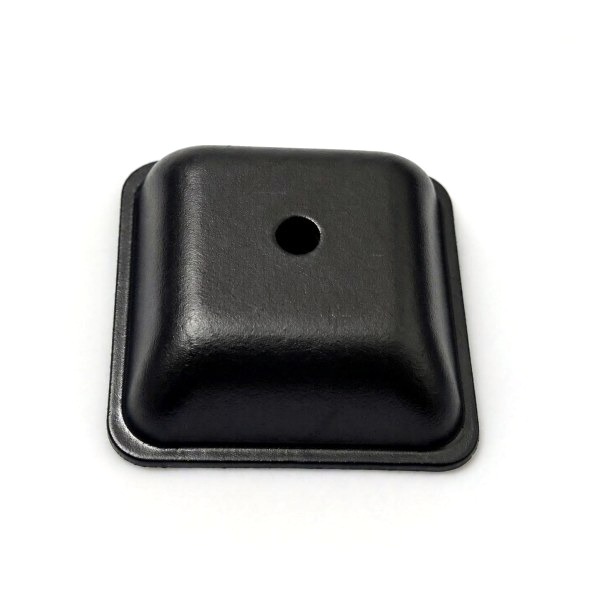
We draw these housings from steel and stainless steel on progressive and transfer tooling, and this page is about the design logic behind a switch housing rather than the switch electronics.
The door cavity is a hostile place
A car door is not a dry electronics box. It is a cavity that the window glass slides through, that drains rain through dedicated slots, and that in many designs lets a little water past the belt seal. Inside it:
- Condensation forms whenever the door is warm and humid inside and cold outside, and it runs down the inner panel onto whatever is mounted low.
- Dust and grit arrive with the water and stay behind when it drains away.
- Road salt reaches the door cavity in winter markets and accelerates corrosion on any bare steel edge.
- Tool and assembly damage happens at the plant: a switch housing that is too thin deforms when a harness is pushed home, and a deformed housing changes the feel of the switch for the rest of its life.
A housing intended for a door therefore needs a corrosion-resistant surface on both faces, not just the visible one, and a wall thick enough to take the connector insertion load without ovalising.
Why the housing sets the feel of the switch
Tactile feel is the customer’s only direct measurement of quality on a window switch, and it is dominated by geometry that the housing controls:
- Actuation force comes from the spring and the detent profile, but it is transmitted through the housing’s pivot or guide features. If the pivot is loose, the force varies from press to press and the switch feels vague.
- Travel is set by the gap between the paddle in one position and the housing stop in the other. The tolerance stack across the paddle, the contact carrier and the housing decides whether every switch in a batch feels the same or whether some are short and stiff.
- Return depends on friction between the paddle and the housing wall. A wall that is smooth and dimensionally consistent produces a clean return; a wall with a forming mark or a burr produces a sticky switch.
The lesson for a housing print is that the actuation-critical dimensions – pivot bore, stop faces, wall-to-wall clearance – deserve tighter tolerances than the outside of the housing, and we treat them that way rather than applying one tolerance to the whole drawing.
Material and finish for a door-mounted part
The material choice is decided by where in the door the switch sits and how long it must last:
| Carbon steel, plated | The usual choice. Zinc or zinc-nickel plating on all faces gives enough corrosion protection for a cavity that dries out; zinc-nickel for high-salt markets. |
|---|---|
| 304 stainless steel | For switches that sit in a wet path or in a premium vehicle where the extra cost is accepted for a part that will never corrode. |
| Aluminium | Light and corrosion-resistant in a dry cavity, but softer, so the connector seat and the pivot bores need inserts or a thicker wall. |
| Brass | Chosen where the housing also acts as a heat spreader or where a soldered connection is made to it. |
Plating choice is not only about corrosion. A trivalent passivate looks different from a hexavalent one, a zinc-nickel deposit is darker, and the visible band of the housing that shows through the trim bezel may need a specific appearance – so we confirm the cosmetic requirement before plating, not after.
The connector opening: the one place water gets in
Every housing has a hole in it for the connector, and that hole is the only route by which water and dust reach the contacts. Three design moves keep the cavity dry:
- A raised collar around the connector opening so that water running down the housing cannot flow into the bore. A collar formed in the same draw operation costs nothing extra; a flat opening invites the water in.
- A seal land on the collar face, sized for the connector’s own gasket or a separate O-ring, so the seal is squeezed against a controlled surface rather than a sheared edge.
- A drain path if the connector faces upward in the installed position – a small pierced relief at the low point of the connector well, so any water that does arrive leaves instead of pooling against the terminals.
We form the collar in-die and hold its face flat so the seal has a proper land; a domed or tilted collar face leaks because the gasket only touches on one side.
Rattle, trim gap, and the mounting interface
A switch housing is clipped into a bezel in the door trim, and the interface between housing and bezel decides two customer complaints. Rattle happens when the clip retention is too loose and the housing moves against the bezel on rough roads; a proud or sunken housing happens when the mounting face to bezel-face dimension drifts. Both are housing problems, and both are solved by controlling the retention features and the reference faces rather than by adding foam. We keep the clip features on a well-supported wall so they do not deflect under assembly force, and we hold the bezel-reference face to a tight flatness so the trim sits flush.
Temperature, humidity and long-term drift
A switch housing cycles from a freezing door in a Nordic winter to a sun-soaked door skin that can exceed 80 °C, and it does so while wet. Two effects matter over a vehicle’s life. First, a plated steel housing that is scratched during assembly will corrode from the scratch outward, so we deburr and handle these parts to protect the coating. Second, a plastic contact carrier inside the housing expands and contracts against a metal housing at a different rate; the housing must leave enough clearance that the carrier never binds at the cold end and never loses its preload at the hot end. We work that clearance band with the customer at design stage, because it is far cheaper than a field fix.
A power window switch housing is sized by its footprint, not diameter
- Footprint: 15-70 mm across.
- Depth: 8-40 mm.
- Wall: 0.5-1.5 mm.
- Features: rocker pivot bores or paddle guides, detent or stop faces, connector collar with seal land, clip/mounting features, drain relief.
Holding pivot bores so every switch feels the same
Can you hold the pivot bores so every switch feels the same? Yes – we treat the actuation-critical features as a separate tolerance group and check them on the first article with a pin gauge and the CMM.
Which material for a humid market? Zinc-nickel plated steel where the housing stays wet, or 304 stainless steel where a lifetime without corrosion is worth the cost.
Do you form the connector collar in the same operation? Yes, in-die, and we hold its face flat so the connector gasket seals on a proper land rather than a sheared edge.
Can you deburr and protect the plating? Yes – these parts are deburred and handled to avoid scratching the coating, because a scratch on a plated door part is the start of a corrosion site.
Specifying a power window switch housing
Tell us where the switch sits in the door, whether it will see standing water, the material and finish you need for that exposure, the switch mechanism you are locating, the actuation-critical dimensions and their tolerances, and the connector type. Those inputs fix the wall, the plating, the pivot and stop geometry, and the collar design – which is what makes a switch that still feels the same after a decade of daily use.
Draw ratio, wall thinning, radii and trim — the design decisions behind a part like this are worked through with numbers in our deep drawn covers guide, and the Precision Deep Drawn Parts pages collect the rest of the family.
Specifications
| Item | Precision sheet metal deep drawn power window switch housing |
|---|---|
| Brand | AUNOV |
| Designing | Your drawing sets the part – DFM notes are returned before any tooling is cut; the agreed version governs every later batch. |
| Tooling | Tooling is built and held under your part number, so no tooling step is outsourced, and the charge is refundable against agreed volumes. |
| Samples | Samples are issued for approval before the run, so the part is proven before it is made in volume, and mass production is gated on that approval. |
| Materials | Stock runs to carbon steel, 304 / 316 stainless steel, aluminium and brass; material substitutes are proposed only with your written approval. |
| Surface finish | Natural, plated or coated as the print decides; the agreed finish is logged, and thickness and adhesion are checked on the first article. |
| Processing | Multi-stage deep drawing with interstage annealing, trimmed and pierced in following dies; batch records are filed so a repeat order starts from approved data. |
| Equipment | Mechanical presses 5-250 T plus 250-500 T hydraulics, with in-line annealing, backed by CNC turning centres and a climate-controlled inspection room. |
| Tolerance | +/-0.03 mm on turned secondary features, +/-0.1 mm on as-drawn walls; dimensional reports accompany the first article. |
| Delivery terms | Delivery is quoted to your location: FOB, CIF or DDP, by sea or air as you prefer. |
Frequently Asked Questions
Why does the housing decide how the switch feels?
It locates the rocker or the push paddle and holds the contact carrier at a fixed height, so an error here never reads as a housing problem to the owner. It reads as a switch that feels mushy, rattles on a bumpy road, or stops working after a few winters, which is why the housing is the part worth drawing carefully.
Why is this part sized by its footprint rather than a diameter?
Because it lives in a door and has to agree with the trim opening and the mechanism it carries. The footprint and the mounting interface govern the design, and treating it as a round shell would optimise the dimension nobody assembles against.
Where does water actually get into a switch?
The connector opening. Everything else on the housing can be sealed soundly and the part still takes water in at that interface, so it is where the sealing strategy earns or loses the design.
How do you make every switch feel the same?
The pivot bores are held consistently in size and position, because the feel is a product of those relationships rather than of any single dimension. Holding them across progressive and transfer tooling is what keeps unit-to-unit feel from drifting.
Related Products



Request a Quote for This Part
Send a drawing or sketch — get material advice, tooling cost and a per-piece price within 24 hours (working days).