
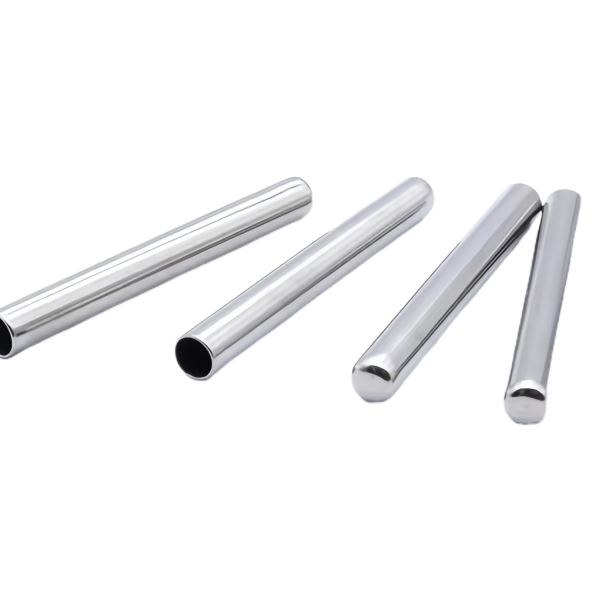
This is one closed-end housing tube supplied across a range of sizes, and it is bought that way because most sites do not have one size of port. A maintenance team holding this range can service several positions from a single part number, which only works if the sizes really do share their features.
The range exists because the plant has more than one port
A single-size tube is right when one machine is being built. A range is right when a plant is being maintained, because the ports fitted over the years are not all the same diameter or depth. Buying the range is an inventory decision as much as an engineering one: one supplier, one part family, one order, and the right size is on the shelf when a tube is pulled.
Sizes share their features so they can substitute
The range only earns its keep if the sizes are interchangeable in everything except their dimensions. The wall, the bore where the sensor sits, the closure and the material are held common, so the same sensor, the same fitting and the same tools work across every size. If the bore changed with the diameter, the range would need a matching range of sensors, and the inventory saving would disappear.
The small sizes are the hard ones to close
In a size range the difficulty is usually at the small end, not the large one. Closing a narrow tube leaves less room for the closure to be sound, and the tip thickness that governs response is a bigger fraction of a small section. We set the closure and the tip for the smallest member and let the larger sizes follow, because designing the other way round produces a range whose small sizes are the ones that fail or read slowly.
Ordering the range, and what to tell us
The useful information at RFQ is the port sizes in service, the medium and the temperature, and whether the tube has to be withdrawn for cleaning. That tells us the sizes to put in the range, the grade to make them in, and the wall to hold. Where a site is standardising, we will say which of their existing sizes can share a tube and which genuinely cannot.
How a size range is checked before it ships
Each size is gauged on the shared bore and closure and measured for its own dimensions, so a range that substitutes across the plant can be demonstrated rather than assumed.
First articles and retention samples are kept per size for the programme, so a reorder reproduces the same shared features and the same dimensions. On a range that is stocked as spares, that is what keeps the second order fitting the same ports.
Our Sensor Housings range is where this part sits. The sensor housings pages carry the process notes, common materials and inspection points behind every product in the family.
Where this part is used
Closed-end sensor housing tubes supplied in a size range serve level, flow and pressure sensor programmes that standardise on one closed-end geometry and order it across several diameters. We see them in fluid-power and process instrumentation, where the same housing family covers a product range and the size list comes as a schedule.
Multi-size families are a tooling question first and a product question second. Where the sizes share a die family the tool cost spreads across the range; where they do not, each size is its own programme and the quotation should show that clearly.
What we need to quote it
Send the size list with the expected volume per size, the closed-end wall specification per size, and whether the sizes may share a die family. If one size carries most of the volume, say so — it changes which size we optimise the tool around and which sizes we accept as secondary.
Specifications
| Item | Stainless Steel Closed-End Sensor Housing Tubes Multi-Size |
|---|---|
| Brand | AUNOV |
| Designing | Send the drawing, or a sample we can measure, you get a DFM review together with the quotation. |
| Tooling | Tooling designed and cut in house, stored under your part number. |
| Samples | Samples for approval come with a full dimensional report and mill certificate. |
| Materials | 304 / 316 stainless steel leads the stock list for this part, alongside carbon steel (SPCC / DC01), aluminium, brass and copper, with the final grade confirmed at the drawing review. |
| Surface finish | Finish options: plating, e-coat, powder coating, anodising or passivation, per your print. |
| Processing | Deep drawing in stages, in-line annealing where needed, pierced and machined on the same floor. |
| Equipment | Our press floor runs 5-250 T mechanical and 250-500 T hydraulic presses, in-house CNC cells and a temperature-controlled inspection room. |
| Tolerance | Tolerances to +/-0.1 mm as drawn, with machined features to +/-0.03 mm. |
| Delivery terms | FOB standard, DDP offered for EU and US, T/T or L/C, with D/P for repeat business, blanket orders and call-offs supported. |
Frequently Asked Questions
Why buy this housing tube as a range rather than as separate sizes?
Almost every site has more than one port. Holding the range means one qualification and one part family on the shelf, so maintenance can fit whatever they find at the plant. Buyers accept a slightly higher unit cost for that because the alternative is discovering the size they need is the one not stocked.
What has to stay identical across the sizes for that to work?
The features that meet the port. Thread form, shoulder geometry, the sealing face and the material have to behave the same in every member, otherwise each size becomes its own separate qualification. Interchangeability is never achieved by dimensions alone; it comes from holding the shared interfaces constant.
Why are the small sizes the difficult ones?
Closing the end gets harder as diameter falls. The material has to fold and weld to itself across a smaller section, tip eccentricity is more likely, and there is less room to correct anything. Ranges are therefore usually developed around the smallest member rather than the largest.
What do we need to know to quote a range properly?
Which sizes you actually use, roughly in what proportions, and which one is the master. That tells us where to start development, what tooling to build first, and whether the smallest or the most popular size sets the sequence. Without it, ranges get quoted as though every size carries equal work.
Related Products

Request a Quote for This Part
Send a drawing or sketch — get material advice, tooling cost and a per-piece price within 24 hours (working days).