
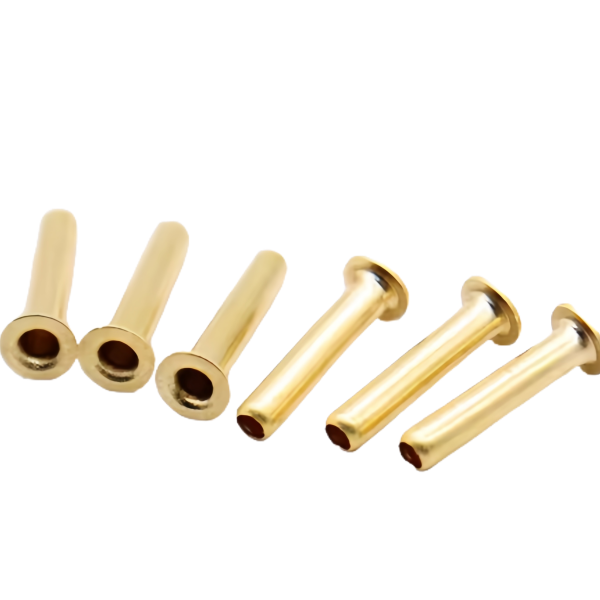
These are closed-end sleeves in brass, mounted by a flange. Brass is doing the thermal work and the flange is doing the mechanical work, and the part is worth specifying in brass only when the thermal side matters: a sleeve that protects the sensor but insulates it has solved one problem and created a worse one.
Brass is specified for the reading, not for the strength
Stainless Steel would be stronger and more corrosion-resistant, so where a sleeve is brass there is usually a response requirement behind it. Brass moves heat several times faster than stainless steel, and in a sleeve that carries temperature from the process to a sensor sitting inside, that difference is the reading. If the application needs the sensor to see a change quickly, brass is the reason the sleeve can be thick enough to be robust and still fast.
A sleeve protects the sensor and costs some response
Putting a sensor in any sleeve makes it slower than leaving it bare; the sleeve is worth it only where the alternative is a damaged sensor. The cost is two interfaces – the outside film and the inside gap between sleeve bore and sensor – and the second one is the one that is easy to get wrong. A sensor sitting in an air gap inside its sleeve is reading the sleeve, not the process. We hold the bore to the sensor’s fit and, where it matters, specify a conductive fill so the gap stops being an insulator.
The flange makes it serviceable
A flanged sleeve can be unbolted and withdrawn, which means the sleeve and the sensor can both be changed without draining or opening the vessel. That is the reason to choose a flanged sleeve over a welded-in pocket. The conditions it imposes are that the flange face has to seal under bolt load and the sleeve has to stay square to that face, because a sleeve that leans will bind on withdrawal instead of coming out cleanly.
Brass and dezincification
The one place brass needs care is in water, particularly warm chlorinated water, where the zinc can be leached out and leave a weak porous copper structure behind. Where the sleeve will see that service we specify a dezincification-resistant brass, or say plainly that stainless steel is the better answer despite the thermal penalty. This is a service-environment question, and it is asked at RFQ rather than discovered later.
How the sleeve is checked before it ships
The bore is gauged to the sensor fit, the closure is inspected, and the sleeve is checked for squareness to the flange it will be unbolted from.
First articles and retention samples are kept for the programme, so a reorder reproduces the same bore, the same tip and the same flange geometry. On a sleeve that has to be fast and serviceable at the same time, that is what keeps the second batch behaving like the first.
This part belongs to our Sensor Housings range. The sensor housings pages collect the process notes, common materials and inspection points behind every product in the family.
Where this part is used
Flanged closed-end sensor sleeves are used where a sensor body has to close one end and mount by a flange: level sensors, pressure sensors and position sensors in fluid systems where the closed end is the pressure boundary and the flange is the mounting face. Brass is chosen where the fluid is compatible and machinability matters.
Closing the end and flanging the other end on the same part means two different forming problems in one operation sequence, and the closed end has to stay flat enough to be a sealing or sensing surface after the flange is formed.
What we need to quote it
Send the flange standard and bolt pattern, the closed-end wall thickness and the flatness you need on it, and say whether the flange is a sealing face or only a mounting face. Add the working pressure, since that sets the closed-end thickness rather than the drawing usually doing so.
Specifications
| Item | Brass Flanged Closed-End Sensor Housing Sleeves |
|---|---|
| Brand | AUNOV |
| Designing | Send drawings, or send a sample to be measured, the quotation comes back with a manufacturability review attached. |
| Tooling | Dies designed and built in our own toolroom, stored under your part number. |
| Samples | First-article samples ship with dimensional data and material certification. |
| Materials | Brass is the primary stock for this part, alongside carbon steel (SPCC / DC01), 304 / 316 stainless steel, aluminium and copper, and the grade is fixed at the drawing review. |
| Surface finish | Plating, e-coat, powder coating, anodising or passivation as the drawing calls out, per the drawing. |
| Processing | Multi-stage drawing, annealed in line where wall thinning calls for it, pierced and finish-machined on the same floor. |
| Equipment | From 5 to 500 T of press capacity across mechanical and hydraulic lines; CNC turning and milling cells plus a climate-controlled CMM room. |
| Tolerance | Tolerances to +/-0.1 mm as drawn, +/-0.03 mm after machining. |
| Delivery terms | FOB is standard; DDP offered for EU and US, T/T or L/C, with D/P for repeat business, blanket orders and call-offs supported. |
Frequently Asked Questions
Why is brass chosen here, and what is it not chosen for?
It is chosen to move heat, because the element inside has to follow the process rather than merely survive it. It is not chosen for strength, and it is not chosen for pressure containment. Specifying brass for those reasons invites disappointment, since the properties that were paid for are not the ones being asked about.
What does putting the sensor inside a sleeve cost you?
Response. Every layer between the process and the sensing element adds thermal mass and an interface to cross, so protecting the sensor inevitably slows it. That trade is worth making deliberately rather than discovering later that a robust arrangement no longer reads quickly enough for the control loop it feeds.
Why add a flange to a sleeve at all?
Serviceability. The flange lets the assembly be removed and refitted without disturbing the plant, which matters on a sensor that eventually needs replacing. It costs material and a little complication, and it buys back every hour saved at the point somebody finally has to take the sensor out.
When does dezincification become something to write into the specification?
Whenever the brass sits in a conductive water for long periods, because selective removal of zinc leaves a weak, porous copper-rich structure behind. It is invisible from outside and progressive. Naming a dezincification-resistant composition at enquiry costs nothing and is considerably easier than replacing everything later.
Related Products


Request a Quote for This Part
Send a drawing or sketch — get material advice, tooling cost and a per-piece price within 24 hours (working days).