
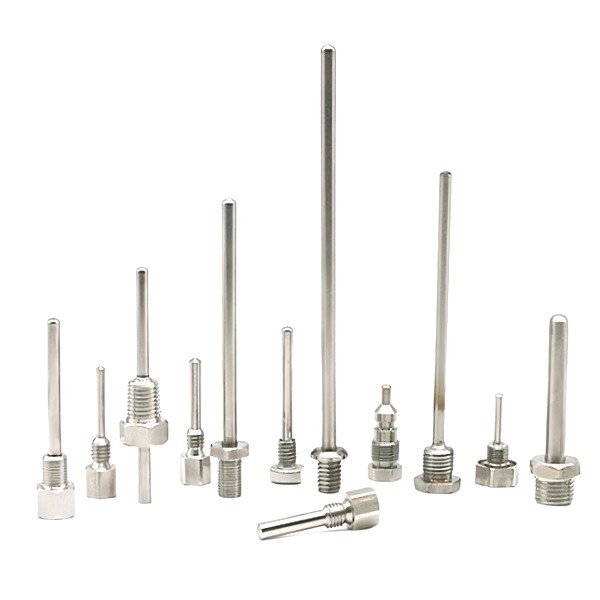
These are the same threaded probe fitting supplied across a range of stem lengths, and the reason a buyer takes them as a range is usually maintenance rather than measurement. One fitting thread fits every machine in the plant; the stem lengths differ because the ports do. Ordering the range means a single spare part number covers every position on the line.
One fitting thread, several stem lengths, one spare part number
The economy of an assorted stem set is in the spares cupboard, not in the probe. Because the thread, the seal seat and the tip are common across all lengths, a plant can hold one part number and still service ports of several depths. That is only true if the common features really are common: the lengths have to interchange in the same boss, with the same sealing arrangement, using the same tools. We treat the thread and the seat as fixed and vary nothing but the stem.
The seal seat is the feature that decides whether the range interchanges
A stem length range is worthless if each length needs its own sealing arrangement. The seat – whether it seals on a taper, a shoulder, or a captured gasket – is machined identically on every member, so the torque that seals a short stem seals a long one. It also means a replacement of a different length does not quietly change the sealing method in service, which is the failure that turns a simple swap into a leak investigation.
Choose the stem length from the port, not from the sensor
The stem is sized from the boss it screws into: how far the thread runs, how deep the boss is, and how much clearance sits behind it before the tip would bottom out or press into deposit. The sensor itself is usually the same across the range. Sizing the other way round – picking a length that looks right on the bench – is what produces a fitting that screws in fully and then reads the boss instead of the process, or one that stands proud because the thread bottomed before the shoulder seated.
What the installer meets on the port side
In the field the fitting has to go in with a spanner on the hex, in the space the machine actually provides, and it has to come out again after thermal cycling. Across-flats, hex height and the shoulder behind it are machined to a single geometry across all lengths, so the tool that fits one member fits them all and the grip does not change with stem length. A long stem needs more support while being threaded in; that is a handling instruction we pass on with the parts.
How a stem length range is checked before it ships
Every length is gauged on the shared thread and seat and then measured for its own stem, so an interchangeable range can be demonstrated rather than assumed.
First articles and retention samples are kept per length for the programme, so a reorder reproduces the same thread, the same seat and the same stem lengths. On a range whose value is that any member fits any position, that is what keeps the spare part a spare part.
Sensor Housings is the parent range for parts like this one; the overview page gathers the tooling logic, finishing options and tolerance notes that apply across the family.
Where this part is used
Assorted-stem-length probe fittings cover staggered-depth measurement in the same vessel or duct, which is how temperature profiles are actually taken in tanks, mixers and air handlers. HVAC and process plants use them where one order has to supply several depths against a shared port standard.
Length variation inside one family is the quiet risk. A longer stem needs more support through machining, cleaning and packing, and it is the longest item in the set that shows any straightness problem first.
What we need to quote it
Send the length schedule with quantities, and confirm the port standard is shared across the set. Tell us whether the lengths can be grouped by tool family, and whether the shortest items must run on the same press as the longest — if they do, we will plan the setup so a press change does not sit in the middle of the order.
Specifications
| Item | Thermowell Probe Fittings Assorted Stem Lengths |
|---|---|
| Brand | AUNOV |
| Designing | Send drawings, or send a sample to be measured, the quotation comes back with a manufacturability review attached. |
| Tooling | Dies designed and built in our own toolroom, held and maintained under your part number. |
| Samples | The first-article set ships with a full dimensional report and material certification. |
| Materials | Held stock: carbon steel (SPCC / DC01), 304 / 316 stainless steel, aluminium, brass and copper, with the final grade confirmed at the drawing review. |
| Surface finish | Plating, e-coat, powder coating, anodising or passivation, as called out on your print. |
| Processing | Multi-stage drawing, annealed in line where wall thinning calls for it, pierced and machined on the same floor. |
| Equipment | 5-250 T mechanical presses plus 250-500 T hydraulic presses, CNC turning and milling cells, a climate-controlled CMM room. |
| Tolerance | Drawn tolerances held to +/-0.1 mm, +/-0.03 mm after machining. |
| Delivery terms | Prices FOB, with DDP for EU and US on request, T/T and L/C accepted, D/P for established customers, call-off schedules and blanket orders supported. |
Frequently Asked Questions
Why would anyone buy one fitting across a range of stem lengths?
Maintenance rather than measurement. A plant with several duty points wants one part number covering all of them so the stores take one line and any technician can fit any position. Buyers accept paying for that convenience, provided the range genuinely interchanges, which turns out to depend on one feature rather than many.
Should the stem length follow the port or the sensor?
The port. Insertion depth has to reach representative flow, which usually means the centre third of the pipe, and that is set by the pipe rather than by the sensing element. Sizing from the sensor generates respectable-looking readings taken from a region that does not represent anything.
What actually decides whether a length range interchanges?
The seal seat. If every member of the range presents the identical thread, taper and shoulder geometry, then swapping one length for another changes nothing downstream. Vary that feature even slightly and each length effectively becomes its own part number, which defeats the reason for buying as a range.
What does the installer meet on the port side?
The practicalities that decide whether the job gets done properly: how far it winds in, what torque the fitting tolerates, whether a wrench reaches it in the space available, and whether it needs sealant or a crush washer. These cost nothing to agree in advance and are the usual source of rushed work on site.
Related Products


Request a Quote for This Part
Send a drawing or sketch — get material advice, tooling cost and a per-piece price within 24 hours (working days).