
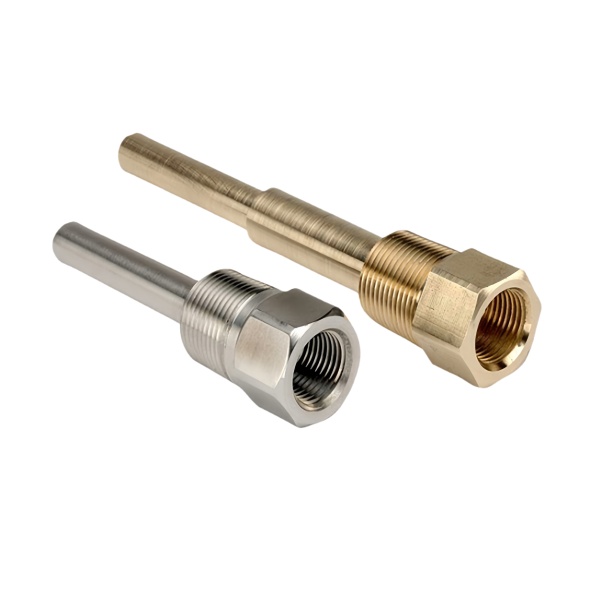
A brass and nickel plated thermowell hex fitting is a threaded fitting machined from brass and finished with a nickel plate, used to seat a thermowell in a port; the brass conducts and machines cleanly while the nickel adds a hard, corrosion-resistant, solderable surface. The Brass and Nickel Plated Thermowell Hex Fittings are threaded thermowell fittings machined from brass and finished with a nickel plate, each with a hex that secures it in the port. The pairing is deliberate: brass machines cleanly and conducts heat well, and nickel adds a hard, corrosion-resistant, clean surface that also conducts and solders reliably. But nickel plating a hex fitting is not a simple dip – the plating lands on the thread, on the hex corners and in the recesses, and it changes the dimensions of the very features that have to thread and seal. The engineering of this part is largely about reconciling the plating with the threaded and sealing geometry. This page covers the brass substrate, the nickel plate and the features the coating most affects.
Brass machines cleanly and conducts; nickel protects and connects
The brass substrate is chosen because it cuts to a clean thread and a smooth sealing face with light force, and because it carries heat from the thermowell to the mounting and, where relevant, to an electrical connection. The nickel plate is added because bare brass corrodes and because nickel gives a hard, stable, corrosion-resistant surface that also conducts and takes a solder joint. Together they make a fitting that is easy to manufacture, pleasant to seal and durable in service – as long as the plating is accounted for in the geometry.
- Brass takes a clean thread crest and a smooth seal land with light cutting, which is why it is favoured for small threaded fittings.
- Nickel adds corrosion resistance and a hard, clean surface, and its conductivity makes it acceptable where the fitting is part of a thermal or electrical path.
- The limitation is that nickel is a thin barrier; once it is scratched through, the brass underneath is exposed and the protection at that spot depends on the environment.
Plating grows the thread, and the thread has to fit after coating
The most consequential effect of plating a threaded fitting is that the nickel deposits on the thread flanks and crest, making the thread larger by roughly twice the coating thickness across the dimension. A thread that was cut and gauged to class before plating will be tight or interfered after plating, because the coating has eaten the clearance the class allowed. The thread therefore has to be cut to a pre-plate size that leaves the correct post-plate fit, and it has to be gauged in the plated condition, because that is the thread the port actually receives.
- Threads are cut to a calculated pre-plate size so the post-plate thread lands in class, rather than being cut to class and plated over.
- Post-plate thread fit is the deliverable, and we gauge it in the plated condition against the port it screws into.
- Where the fit is tight, we discuss masking the thread or plating after the thread is final, so the thread geometry is guaranteed rather than corrected for coating build-up.
The hex corners and the seal land are where coating is thinnest
Plating is naturally thickest on flat, easily-reached surfaces and thinnest at edges, corners and recesses – which is exactly where a hex fitting has its hex corners and, often, its sealing land. A hex corner with thin coating wears through and exposes brass at the point that takes the wrench load, and a sealing face with thin or uneven coating can seal inconsistently or corrode at the very surface that has to close off the port. We verify coating coverage at these features, not just on the easy surfaces.
- Coating thickness is checked at the hex corners and the seal land, because those are the edges and recesses where plating is thinnest.
- Where the seal land must be clean, we discuss masking it or a plating route that leaves it uniform, since an uneven coat on a sealing face seals unevenly.
- Handling after plating avoids scratching the hex and the seal face, because those are the protected surfaces that also take load.
The hex has to take torque through a plated, not bare, surface
The hex is the torque interface, and on a plated fitting the wrench bears on nickel, not on bare brass. Nickel is harder than brass, which is good for resisting rounding, but it is also thinner and can chip or flake at a corner if the torque is high or the corner is sharp. The hex geometry is specified so the plated surface takes the assembly load without chipping the coating off the corner, because a chipped hex corner is both a slipping risk and a spot where the brass is exposed.
- Hex corners are specified with enough radius that the plated surface takes load without the nickel chipping off the edge.
- Across-flats and depth are sized for the assembly torque, held against the plated condition rather than the bare brass.
- Where torque is high, we discuss nickel thickness at the corners, because a thin plate on a high-load corner is the one that chips.
How we verify a brass and nickel-plated hex fitting
Verification checks the features the plating changed most – the thread, the hex corners and the seal land – in the finished, plated condition.
- Post-plate thread: class and fit gauged in the plated condition against the port, confirming the coating build-up was accounted for.
- Seal land: surface finish and coating coverage confirmed, since this is the recessed surface that both seals and corrodes if thin.
- Hex: across-flats, depth and corner condition checked in the plated condition, against the torque and the coating’s chip resistance.
- Coating thickness measured at the hex corners and the seal land, the two places plating is thinnest.
- Material and plating records per lot, confirming the brass grade and the nickel thickness attached to the release.
- Fit and seal check: the fitting threaded into a gauge port and torqued, and the joint seal-tested before the run.
First articles and retention samples are kept for the programme, so a repeat run of the plated fitting is threaded, plated and gauged to the same post-plate geometry. On a part whose thread and seal have to work after a coating has grown over them, that verified plated condition is the only baseline that matters.
This part belongs to our Sensor Housings range. The sensor housings pages collect the process notes, common materials and inspection points behind every product in the family.
Specifications
| Item | Brass and Nickel Plated Thermowell Hex Fittings |
|---|---|
| Brand | AUNOV |
| Designing | Send us your 2D drawing, or mail a sample for measurement, our engineers reply with a manufacturability assessment and pricing. |
| Tooling | Dies engineered and produced in our own toolroom, stored under your part number. |
| Samples | Sample parts arrive with dimensional data and material certification. |
| Materials | Brass leads the stock list for this part, alongside carbon steel (SPCC / DC01), 304 / 316 stainless steel, aluminium and copper, with the final grade confirmed at the drawing review. |
| Surface finish | Surface treatment per the drawing: plating, e-coat, powder coating, anodising, passivation, fixed at the drawing review. |
| Processing | Deep drawing in stages, in-line annealing where needed, pierced and machined on the same floor. |
| Equipment | Press capacity from 5 to 500 T across mechanical and hydraulic lines, CNC turning and milling cells, a climate-controlled CMM room. |
| Tolerance | As-drawn tolerance +/-0.1 mm, with machined features to +/-0.03 mm. |
| Delivery terms | Prices FOB, with DDP for EU and US on request, T/T or L/C, with D/P for repeat business, blanket orders and call-offs supported. |
Related Products


Frequently Asked Questions
Why pair brass with nickel plating on a thermowell fitting?
Brass cuts to a clean thread and a smooth sealing face with light force and conducts heat well; nickel adds a hard, corrosion-resistant surface that also conducts and takes a solder joint. The pairing is deliberate, not cosmetic.
How does nickel plating affect the thread fit?
The nickel deposits on the thread flanks and crest, growing the thread by roughly twice the coating thickness. We cut the thread to a calculated pre-plate size and gauge it in the plated condition, because that is the thread the port actually receives.
Where is the nickel coating thinnest on a hex fitting?
At the hex corners and, often, the sealing land – exactly the edges and recesses where plating is naturally thinnest. We verify coating thickness at those features, not just on the easy flat surfaces.
How is the hex torqued without chipping the nickel?
Nickel is harder than brass, which resists rounding, but it is thin and can flake at a corner under high torque. We specify the hex geometry so the plated surface takes the load without chipping the coating off the corner.
Does nickel plating change how the fitting resists corrosion?
Nickel is a thin barrier; once scratched through, the brass underneath is exposed and protection at that spot depends on the environment. We handle the plated fitting to avoid scratching the hex and seal land, since those take both load and exposure.
Request a Quote for This Part
Send a drawing or sketch — get material advice, tooling cost and a per-piece price within 24 hours (working days).