
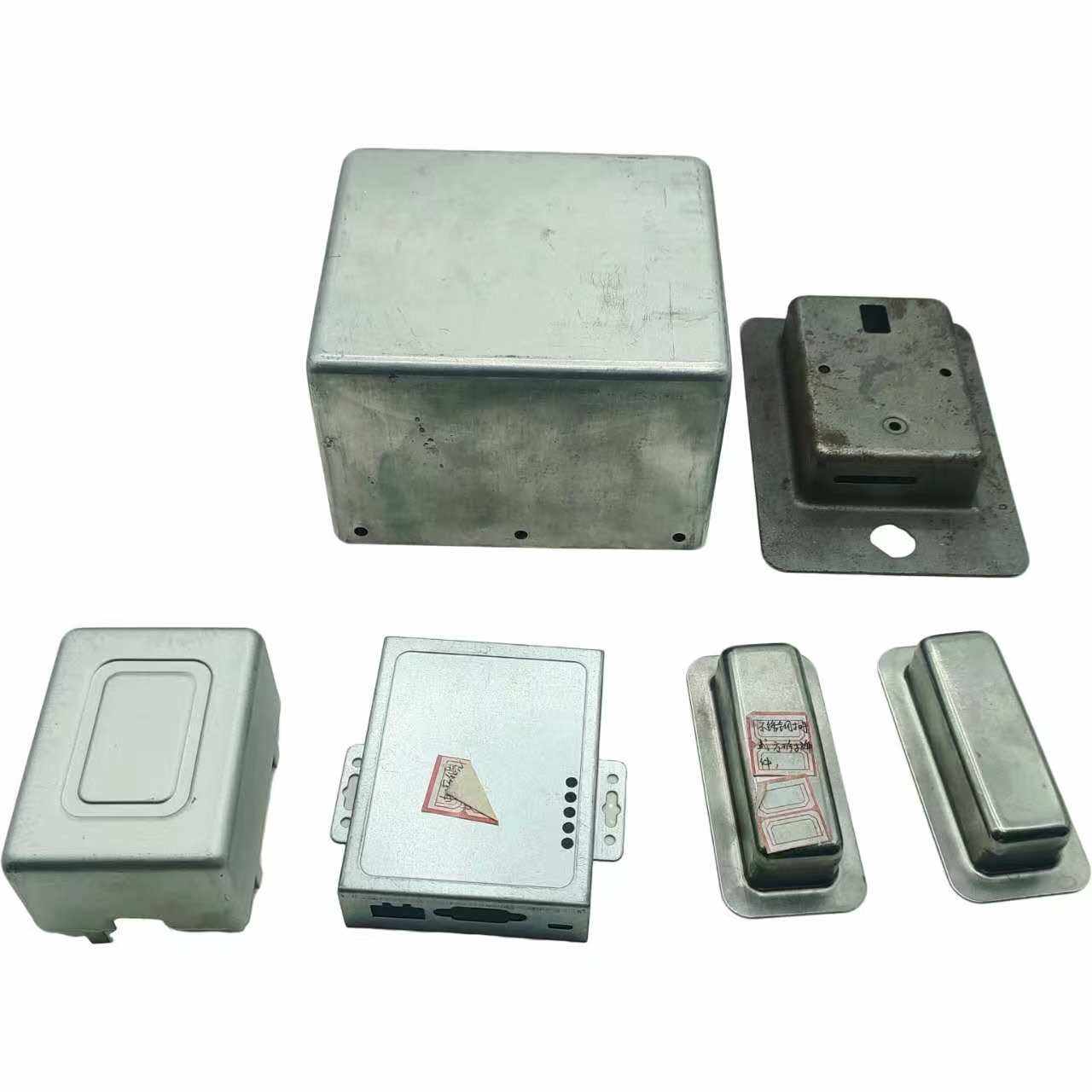
A junction box cover is a sealing surface first, not a lid
A deep drawn junction box cover has one job that outweighs every other: it has to present a flat, uninterrupted face to the gasket or the box it closes, so the enclosure stays rated for the environment it sits in. A cover that is dimensionally perfect on its outside but warped across its flange is a leak and a failed inspection, and on an electrical enclosure that leak is a safety and compliance problem, not a cosmetic one. We design the draw and the flattening around that flange from the first station, because a warp designed in cannot be tapped out later.
These are drawn on our mechanical presses in galvanized steel, with the as-drawn envelope at roughly +/-0.1 mm and any machined seat at +/-0.03 mm. The galvanized coating is applied to the stock before forming where the spec allows, or the part is coated after drawing where the geometry demands it, and the coating thickness is part of the dimension conversation from the start.
Because the cover’s function is the seal, we treat the order as a sealing part from the quotation stage: the coating class, the flange flatness and the hole positions are all quoted as requirements, not afterthoughts. That means a reorder is a repeat of a recorded draw and coating process rather than a redevelopment, and the galvanize mass and flange condition we approved first time are the ones we hold every time after.
The screw-hole condition is where a galvanized cover most often fails fitment. If the holes are pierced through the coating and left at bare size, the protection the box needs is missing exactly where the screw bites; if they are pierced before coating and not reamed, the screw binds. We state the hole condition per feature and we confirm it on the first article, because a cover that will not take its own screws cannot be installed.
Knockout retention force is a deliberate design value, not an accident of the pierce. Too tight and the electrician cannot break it out; too loose and it falls out in transit or lets the rating drop. We set the knockout score to a defined force and we verify it, because a knockout that fails either way fails the enclosure’s job.
The cost of a galvanized cover is mostly in the coating and the flatness, not the draw. A shallow draw is cheap; holding the flange flat through springback and keeping the zinc where it belongs is where the money goes. We quote the flatness call and the coating class as the cost drivers, so you can see what relaxing one would save before you relax it.
Galvanized steel and the coating thickness that fights every screw hole
Galvanized steel carries a zinc coating that is thick by plating standards, and that thickness is the first thing that fights the cover’s function. A cover that is pierced for screws or knockouts grows at every hole by roughly twice the coating thickness, and a screw that was a clearance fit before coating becomes a bind after it. The drawing has to say which holes are pre-coat and which are post-coat, and on a junction box cover the screw holes almost always have to be post-coat or masked, because the cover has to sit flush and the screws have to run free.
- We mask the screw holes where the spec calls for bare steel at the fastener, so the coating does not raise the head off the flange.
- We pierce knockouts after coating where possible, so the break-out edge is clean steel and the box stays corrosion-protected at the opening.
- We account for coating build on the flange face, because a thick zinc layer on the sealing plane is exactly what lifts the gasket and starts a leak.
- We confirm coating mass per area against the grade written on the drawing, since “galvanized” spans a wide range of protection levels.
Knockouts and fixing holes, and why they must be post-coat dimensions
A junction box cover usually carries both intended knockouts and the fixing holes that bolt it to the box. The fixing holes are the precision features: they must line up with the box, they must clear the screw and they must not be shifted by coating growth. We treat them as post-coat dimensions and we hold their position to a tighter band than the decorative outline, because a cover that will not line up with its box is a cover that cannot be installed.
Knockouts are a different problem. They are designed to be broken out in the field, and the score line has to be clean steel that fractures predictably without tearing into the flange. We set the knockout geometry so the break is controlled and the remaining edge is safe to handle, and we keep the knockout away from the sealing flange so breaking one never compromises the gasket plane.
For a cover that must stay sealed, we also decide early whether the galvanize is on the stock before forming or applied after, because forming after coating can craze or flake it at the draw radii. Where the geometry demands post-form coating we say so, and we account for the added thickness at every hole and on the flange, because that is the difference between a cover that seats and one that binds on its own finish.
Drawing a cover that stays flat: the flange, the draw and springback
Flatness on a drawn cover is won or lost at the flange. The draw pulls the centre down and leaves the rim as the reference plane, and aluminium or steel both spring back after the punch releases, so a flange that left the die flat can curl. We control this with a flattening or restrike station and, on tighter calls, with a slight over-form that relaxes into flat. The open face of the cover is the gasket plane, so we measure its flatness directly rather than inferring it from the wall.
- The flange width matters: a narrow flange warps more easily than a wide one, and we size the draw so the flange has enough section to stay put.
- Springback is predicted from the grade, and we lock the compensation that worked on the first article so repeats stay flat.
- The draw depth is kept shallow on a cover precisely so the flange stays stable; a deep draw fights the flat face the cover needs.
Zinc coating class against the environment the enclosure lives in
Not all galvanizing suits all duties. A cover in a dry indoor panel needs far less coating than one on an external wall or in a coastal plant, and overspecifying costs money while underspecifying loses the box to rust at the first winter. We read the service environment from the enquiry and recommend the coating class rather than defaulting, and where the environment is genuinely severe we will say so and propose a duplex system instead of plain galvanizing.
The failure mode worth knowing is that galvanized steel corrodes by consuming its zinc first, which is the protection working, but at a cut edge or a pierced hole the steel is exposed and that edge is where rust starts. We protect those edges by design, by where we place holes relative to the flange, and by any post-pierce treatment the spec allows, so the cover ages the way the enclosure rating promises.
How we verify a galvanized cover before it ships
A cover is verified as a sealing part, not as a pressing, because that is what it is. The routine:
- Coating mass check against the class on the drawing, confirmed from the material certificate and a coating measurement.
- Flatness measurement of the flange face, on a surface plate or CMM, because the gasket depends on it.
- Screw-hole position and clearance, checked post-coat so the cover lines up with the box and the fasteners run free.
- Knockout integrity, confirmed for clean break-out and safe remaining edge, away from the seal.
- First-article CMM report on the envelope and any machined seat, shipped with the samples.
- Edge corrosion check at pierced and cut features, to confirm the coating strategy protects the exposed steel.
The cover ships with its dimensional report and material certificate under your part number, and the draw and coating settings are archived so a repeat order is a repeat process rather than a redevelopment of the flange.
Send the cover drawing with the coating class, the flange flatness and the hole conditions stated, and we return a manufacturability review with the quotation plus a first article proving the seal face. Tell us the service environment, because that is what sets the galvanize class and decides whether plain galvanizing is enough.
Drawing a cover like this is a chain of decisions — draw ratio, wall thinning, radii and trim. Our deep drawn covers design guide works through each of them with worked numbers.
Specifications
| Item | Galvanized Steel Deep Drawn Junction Box Covers |
|---|---|
| Brand | AUNOV |
| Designing | Send the drawing, or a cover sample we can measure, you get a DFM review together with the quotation. |
| Tooling | Every die designed and built in our toolroom, held under your part number. |
| Samples | First-article samples of the cover ship with dimensional data plus material certs. |
| Materials | Carbon steel (SPCC / DC01) is the primary stock for this part, alongside 304 / 316 stainless steel, aluminium, brass and copper, per the drawing. |
| Surface finish | Finish options: plating, e-coat, powder coating, anodising or passivation, selected against the drawing requirement. |
| Processing | Multi-stage drawing, annealed in line where wall thinning calls for it, with piercing and finish machining under the same roof. |
| Equipment | Press capacity from 5 to 500 T across mechanical and hydraulic lines, in-house CNC cells and a temperature-controlled inspection room. |
| Tolerance | Drawn tolerances held to +/-0.1 mm, +/-0.03 mm after machining. |
| Delivery terms | FOB is standard; DDP offered for EU and US, T/T or L/C, with D/P for repeat business, blanket orders and call-offs supported. |
Frequently Asked Questions
Why is this cover specified for flatness before anything else?
Its job is to present a flat, uninterrupted face to the gasket or the box it closes, so the enclosure keeps the rating it was bought for. A cover that measures perfectly on the outside but bows across its flange is a leak and a failed inspection, and on an electrical enclosure that is a compliance problem rather than a cosmetic one.
Why must knockouts and fixing holes be post-coat dimensions?
The galvanized coating adds thickness, and it adds it to every thread and every clearance. A dimension taken before coating is the one that fights the screw on assembly, so those features are dimensioned in the coated state.
Can the warp be corrected after forming?
Not reliably. A warp designed into the draw cannot be tapped out later, which is why the draw and the flattening are planned around the flange from the first station rather than recovered afterwards.
Does the coating go on before or after forming?
Either, depending on what the specification and the geometry allow. Where it permits, the coating is applied to the stock before forming; where the geometry demands it, the part is coated after drawing. In both cases the coating thickness enters the dimension conversation from the start, and its class is chosen from the environment the enclosure has to live in.
Related Products

Request a Quote for This Part
Send a drawing or sketch — get material advice, tooling cost and a per-piece price within 24 hours (working days).