
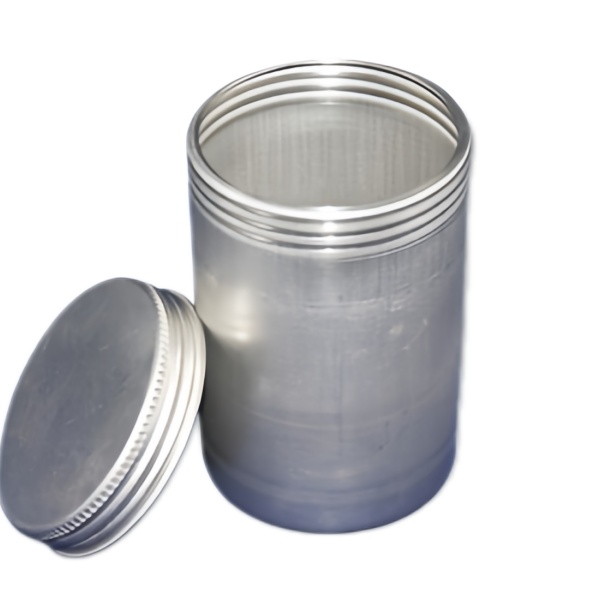
The Aluminum Deep Drawn Canister with Threaded Lid is a one-piece drawn body closed by a thread on the mouth and a matching lid, built from blanking through thread-forming and inspection on our own floor. The part lives or dies on the seal land and the thread, so the writing below covers the engineering decisions that actually control a leak-tight, reusable canister rather than the generic deep-drawing story.
Sizing the blank and the thread relief before the first draw
We start every canister from the mouth, not the base. The finished mouth outside diameter sets the final draw stage, and the thread relief – a shallow groove turned or coined just below the lip – has to exist in the tooling plan before the first blank is cut, because you cannot reliably add relief after the wall has work-hardened. For a typical 70 mm mouth canister we blank from 1.2 mm 3003-H14 aluminium at roughly 118 mm diameter, giving a first-stage draw reduction of about 38 percent. That number is deliberate: below 35 percent the press stroke is wasted on a shallow form, above 42 percent on 3003 you start fighting earing and local wall thinning at the punch radius.
The relief groove is sized to the thread crest, not the root. We hold the groove diameter 0.15 mm larger than the thread major so the rolled crest has material to displace into without raising a burr line on the seal face. Blank thickness is held to +/-0.03 mm because a 0.05 mm swing in stock changes the thread engagement depth by nearly a full turn over a 70 mm circumference, and that is the difference between a lid that seats on the first quarter-turn and one that cross-threads.
- The blank edge is sheared, not laser-cut, for this part: a clean sheared edge draws more consistently than a heat-affected laser edge, and we clock the burr to the inside so it does not print through the seal land.
- First-stage punch and die radii are opened to 4x material thickness at the corners; closing them saves a few microns of material but cracks the relief groove on the second stage.
Why the lid thread is rolled after forming, not cut first
The single biggest mistake we see on incoming canister drawings is a specification that threads be cut into the blank before drawing. You cannot cut a thread and then draw the wall past it – the draw tension stretches the pitched root into a taper and the lid will never seal. We form the canister to final shape, trim the mouth square, and only then roll the thread with a three-die head sized to the post-trim outside diameter.
Rolling displaces material rather than removing it, so the thread root is work-hardened and the crest is slightly raised – both good for a reusable lid thread that sees hundreds of cycles. We roll to a 2.0 mm pitch on the 70 mm canister, with the die set calibrated so the major diameter lands at 70.0 mm and the minor at 67.4 mm after rolling. Crest height is checked on the first article with a thread micrometer, and we reject any setup that rolls the minor below 67.2 mm because that is where the wall at the lip drops under 0.9 mm and the lid crush load drops with it.
- Trim the mouth to length within +/-0.1 mm so the thread start is consistent around the circumference.
- Roll with the canister supported on an internal mandrel so the thin lip cannot collapse as the dies close.
- Back off the top die 0.02 mm per 1000 parts; aluminium work-hardens the rolls and the major creeps up if you don’t.
Picking the aluminium grade for a sealed canister
For a canister that must stay sealed and corrosion-resistant without a heavy coating, 3003 is our default: it draws cleanly, takes a bright or hard anodise, and its manganese content gives enough strength at the work-hardened wall without cracking on the second draw. Where the contents are mildly acidic or the canister is washed in service, we move to 5052-H32, which sacrifices a little drawability for far better pitting resistance. We avoid 6061 for canisters unless the wall is thick, because its magnesium-silicide phases make the second draw stage unforgiving and the thread relief tends to tear.
Finish is chosen by the seal, not by looks. A hard anodise at 12-15 microns gives a durable seal-land surface that the lid gasket rides against for the life of the part; a clear anodise is cosmetic only and we say so on the quotation. Where the canister is painted or powder-coated, we mask the thread and the seal land, because coating inside the thread is the fastest way to guarantee a cross-threaded lid at assembly.
- 3003-H14 for general sealed canisters up to 90 mm deep.
- 5052-H32 where washdown or condensate is expected.
- Anodise the seal land; mask the thread – never coat into the pitch.
Holding the canister mouth round within the seal land
The mouth is where the canister earns its keep, so it is where we spend the machining budget. As-drawn aluminium holds roughly +/-0.1 mm on the body, but the seal land – the 2 mm wide flat just inside the thread – is machined after forming to +/-0.03 mm on diameter and held round within 0.05 mm total indicator reading. That roundness is what the lid gasket sees; a 0.1 mm out-of-round mouth leaks long before the thread shows any sign of trouble.
We measure the seal land on a climate-controlled CMM at first article and then gauge it in production with a air-ring comparator that reads the land diameter to 0.005 mm without touching the surface. The mouth squareness to the canister axis is held to 0.1 mm over the 90 mm height, because a cocked mouth forces the lid to tilt and loads the gasket on one side only.
- Seal land diameter: machined to +/-0.03 mm, roundness 0.05 mm TIR.
- Mouth square to axis: 0.1 mm over full height.
- Gauged every production run; CMM-measured on first article and on any die rework.
Where threaded canisters actually leak and how we prevent it
Leaks on a threaded canister almost never come from the thread itself – a properly rolled thread with a competent gasket seals fine. The real failure modes are three, and we design the inspection around them. First, a gasket that is nicked or seated on a dirty land leaks immediately; we supply the lid with the gasket pre-seated and bagged so the land is never handled. Second, a wall that thinned below 0.9 mm at the punch radius bursts under pressure test; we map wall thickness at the thinnest section on first article and sample it in production. Third, a mouth that went out of round during the trim lets the gasket bridge a low spot; this is caught by the air-ring gauge mentioned above, not by a visual check.
Our acceptance criterion is simple and written into the part plan: every canister is pressure-decay tested at 1.5 times service pressure for ten seconds, with a leak rate below 0.5 cc per minute written on the dimensional report. Any part that fails is quarantined and the die setting is reviewed before the run continues.
- Pre-seat and bag the lid gasket so the seal land is never touched by hand.
- Pressure-decay test every canister at 1.5x service pressure, 10 s hold.
- Reject on wall thickness under 0.9 mm at the thinnest section; review the punch radius if it recurs.
How we verify every canister before it ships
The inspection plan for a canister is short because the failure modes are few and specific. We do not weigh the part or measure things that do not affect the seal; we measure the things that do, and we do it the same way on every lot so a reorder starts from evidence that already worked.
- First article: CMM report on seal-land diameter, roundness and mouth squareness, plus a wall-thickness map at the thinnest section and a material certificate for the aluminium grade.
- Production: air-ring gauge on the seal land every run, thread major/minor checked with a thread micrometer on the first and last part of the run, and a pressure-decay test on every canister.
- Shipment file: dimensional report, material cert, and the pressure-test record travel with the batch under your part number.
Tooling is built in our own toolroom and held against your part number, so the relief groove, the trim length and the roll-die calibration are all archived with the drawing revision that produced them. A reorder is a press cycle and a gauge check, not a new development.
Choosing between drawing, machining and welding comes down to the shape of the part: the guide to deep drawn covers sets out where each route wins, and the overview page links through to the full Precision Deep Drawn Parts range.
Specifications
| Item | Aluminum Deep Drawn Canister with Threaded Lid |
|---|---|
| Brand | AUNOV |
| Designing | Send us your 2D drawing, or mail a sample for measurement, a manufacturability review comes back with the quotation. |
| Tooling | Dies engineered and produced in our own toolroom, stored under your part number. |
| Samples | Sample parts arrive with dimensional data and material certification. |
| Materials | Stock for this part leads with aluminium, alongside carbon steel (SPCC / DC01), 304 / 316 stainless steel, brass and copper, per the drawing. |
| Surface finish | Surface treatment per the drawing: plating, e-coat, powder coating, anodising, passivation, as called out on your print. |
| Processing | Progressive deep draw stages with in-line annealing as the draw ratio demands, pierced and finish-machined on the same floor. |
| Equipment | Mechanical presses 5-250 T, hydraulic presses 250-500 T, CNC cells plus a temperature-controlled CMM room. |
| Tolerance | Tolerances to +/-0.1 mm as drawn, +/-0.03 mm after machining. |
| Delivery terms | FOB is standard; DDP offered for EU and US, payment T/T or L/C, D/P for repeat accounts, blanket orders and call-offs supported. |
Frequently Asked Questions
Why is the canister designed from the mouth rather than the base?
The finished mouth diameter sets the final draw stage, and the thread relief has to be in the tooling plan before the first blank is cut. Relief cannot be added reliably once the wall has work-hardened, so starting anywhere other than the mouth means discovering the problem after it is expensive.
Why is the first draw reduction set near 38 percent?
It is a window rather than a preference. Much below 35 percent and the press stroke is being spent on a shallow form, while much above 42 percent on this aluminium brings earing and local wall thinning at the punch radius, both of which cost more than the extra stage would have.
Why is the lid thread rolled after forming rather than cut first?
Rolling after forming displaces material into the relief groove instead of removing it. The groove is sized to the thread crest rather than the root, held slightly larger than the thread major diameter so the rolled crest has somewhere to go without raising a burr across the seal face.
Where does a threaded canister actually leak?
At the seal land, not through the thread. Holding the canister mouth round within that land is what closes the joint, and keeping the stock thickness within its band is what stops the practical failure, which is a lid that cross-threads instead of seating on the first quarter turn.
Related Products


Request a Quote for This Part
Send a drawing or sketch — get material advice, tooling cost and a per-piece price within 24 hours (working days).