
Paint fails first at drawn radii: pre-treatment inside recessed geometry
Paint on a deep drawn enclosure does not fail the way paint on a flat panel fails, and almost every premature-failure case we are asked to diagnose starts at a radius. The paint system is really two systems – the conversion layer and the coating – and the conversion layer depends on chemistry reaching the surface. On a flat sheet, spray or dip phosphating wets everything uniformly. Inside a drawn enclosure, the rinse and conversion stages must reach into corners, wrap the flange return, and drain out of pockets; where pre-treatment under-deposits, the paint bonds to bare or partially converted metal, and that is the spot that blisters at six months while the flat walls still look new. Our pre-treatment route is therefore built around the corners, not the walls:
- Multi-stage cleaning – alkaline degrease, then acid activation where the forming lubricant is stubborn – with stage times set by the deepest cavity on the part family, not the average part.
- Immersion, not spray, for drawn parts. Spray lines miss recesses by geometry; a dip line with agitation floods every interior. We run immersion phosphate – zinc phosphate for corrosive duty, iron phosphate for indoor – because the bath goes where the paint will go.
- Rinse discipline counts double in a cavity: drag-out left in a corner becomes a salt reservoir under the paint. Counterflow rinses and a final DI rinse, with conductivity monitored, keep the enclosure interior as clean as the exterior.
- Drain orientation is engineered: parts rack so pockets drain, because an enclosure that carries bath from stage to stage in its floor contaminates every following tank.
Powder versus liquid on a drawn enclosure: film build on walls and corners
Powder and liquid behave completely differently on a three-dimensional drawn part, and the choice is a geometry decision before it is a color decision. Powder is applied electrostatically and builds where the field takes it: it wraps edges generously, reaches recesses poorly – the Faraday cage problem inside a deep enclosure – and runs heavy on outer corners while running thin on inner corners and the floor of a cavity. Liquid wets by contact: it reaches recesses more readily but sags on vertical walls when applied heavy, and its film builds are lower. The numbers make the trade concrete. Powder typically lays 60 to 100 µm in one pass; liquid enamel builds 20 to 40 µm per coat. A powder enclosure gets corrosion protection in one coat, but the interior may measure 30 to 50 µm where the walls measure 90 – acceptable when the interior duty is mild, a problem when it is not. Liquid handles the interior more evenly but needs two coats for equivalent protection, which costs a second bake cycle. “Powder coated inside and out” without a film-build number for the inside is a phrase, not a specification.
Masking strategy for gasket lands and threaded features
A painted enclosure is only as good as the masking plan, because paint goes everywhere and several places must stay bare. Gasket lands need bare or controlled-coating surfaces: paint under a gasket is compressible, micro-cracks over time, and destroys sealing reliability – and powder at 80 µm can make a flat land noticeably non-flat. Threaded features – weld-nut threads, tapped holes – must stay clear or the fastener strips cured paint and jams. Locating diameters and spigots that register the enclosure into the next assembly carry tolerances tighter than any film build. We build the masking plan from the drawing’s functional features, per part number:
- Plugs and caps for holes and threads – silicone plugs for pierced holes, caps for studs – rated for bake temperature and indexed to the hole map so none are missed; a missed plug is found at your assembly line, not in our paint shop.
- Tape or liquid maskant on lands and spigots: for flat gasket bands we mask the full land plus a small overlap, because paint creeps under tape edges and a ragged edge on a seal band is a leak path.
- Masking before pre-treatment or after? For gasket lands the default is before: the land gets pre-treated and stays bare metal, fine for indoor duty. For corrosive duty the land is often better coated and re-machined or re-qualified afterwards – a route decision made in the review, because it changes the masking stage.
- Edge discipline after cure: paint bridges over plugs and tears unevenly when they are pulled, so masked edges are cut clean and masked features are inspected on every part.
Color and gloss consistency across batches and part families
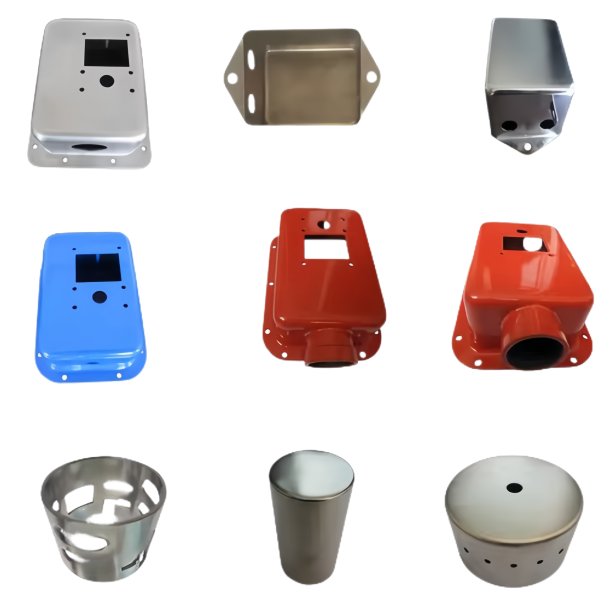
“Assorted” painted enclosures and cups usually means one platform in several sizes, painted to one color, shipping over months or years – and color drift between batches is the complaint that surfaces at final assembly, when three sizes stand side by side and one is visibly a different white. Three root causes drive the drift. Powder and paint lots differ: pigments vary slightly by production batch, and a color approved from lot one drifts a shade or two by lot five unless the supplier’s color tolerance is contractually tight. Film build shifts color: the same powder at 60 versus 100 µm reads differently in depth and gloss, and an enclosure whose walls and interior build at different thicknesses can mismatch within one part. Bake variance shifts gloss: over-bake drives gloss down and yellows whites; under-bake leaves gloss high but softness in the film.
We control the drift with the tools that work. Master color panels: every production batch is compared against a retained, signed master under controlled D65 light, not against the previous batch – comparing batch to batch lets drift accumulate one small step at a time, which is how a platform ends up two shades off its original. Instrumented checks where the platform demands them: spectrophotometer readings in L*a*b* with an agreed tolerance – typically ΔE around 1.0 to 1.5 for adjacent-part assemblies – turn “looks close enough” into a number. Film-build monitoring: thickness on walls, edges and interior per batch, because thickness is the variable we control that most affects appearance.
Adhesion, impact and humidity qualification on formed panels
Paint qualification for a drawn enclosure has to run on formed parts, and this is a corner the industry cuts quietly: submitting a flat test panel with the coating is standard practice and tells you almost nothing about the corners of the actual part. The qualification set we run for painted drawn families, agreed per application:
- Cross-hatch adhesion per ISO 2409 or ASTM D3359, on the flat wall and – the point – on the outer draw radius, where adhesion fails first. Acceptance class 0 or 1, both locations.
- Impact or cupping test per ASTM D2794 or ISO 1520 on formed areas: a coating that adheres flat but delaminates over a deformed radius will not survive assembly handling.
- Humidity resistance – 240 to 500 hours at 40 to 50 °C near saturation, blistering rated per ISO 4628, with the interior surface rated as well as the exterior because condensation attacks from inside.
- Salt spray where the duty is outdoor or wet: the painted system with scribe, run to the specified hours, creep-back from the scribe measured – a number, not a pass photo.
- Process verification, not just sample verification: because pre-treatment is the weak link inside a cavity, an occasional witness coupon from the production load is checked for coating weight in the recesses.
Qualification runs once per family and repeats when the process changes – a new powder lot lineage, a pre-treatment chemistry change, or a die re-cut that changes the draw radii.
How we verify paint coverage and adhesion on painted drawn parts
Every painted batch is released through a fixed routine:
- Film build per batch: thickness at fixed points – flat wall, outer radius, flange edge, enclosure interior – minimum five readings per zone, against the drawing’s film-build band. Interior readings below the agreed floor trigger a process correction, not a concession label.
- Color and gloss versus the retained master panel under D65 light, instrumented to ΔE tolerance where the platform requires adjacent-part matching.
- Masking integrity on 100 percent of parts: gasket lands, threads and locating features visually checked against the masking map; paint on a masked surface is reworked before shipment, and recurring bridging escalates the masking method.
- Adhesion sampling per batch: cross-hatch on a sample part’s wall and radius, or on witness coupons carried through the same line, rated to the agreed class.
- Cure verification: bake profile records per oven load filed with the batch, plus a solvent-rub or hardness spot check where the specification calls for it – an under-baked film looks finished and fails in service.
- Appearance inspection for runs, sags, orange peel on the drawn radii, inclusions and thin coverage at edges, against a boundary sample; visible interior surfaces get the same inspector attention as the exterior.
- Traceability: powder or paint lot, pre-treatment bath records, oven profile and inspection results filed together, so a field observation years later traces to the exact batch conditions.
Draw ratio, wall thinning, radii and trim — the design decisions behind a part like this are worked through with numbers in our deep drawn covers guide, and the Precision Deep Drawn Parts pages collect the rest of the family.
Specifications
| Item | Painted Deep Drawn Enclosures and Cups Assorted |
|---|---|
| Brand | AUNOV |
| Designing | Share your print, or send a part to be measured, you get a DFM review together with the quotation. |
| Tooling | Our own toolroom designs and builds every die, with your part number on the tool record. |
| Samples | Samples for approval come with a full dimensional report and material certification. |
| Materials | Held stock: carbon steel (SPCC / DC01), 304 / 316 stainless steel, aluminium, brass and copper, with grade selection confirmed at drawing review. |
| Surface finish | Zinc, nickel or chrome plating, e-coat, powder coat, anodising or passivation, fixed at the drawing review. |
| Processing | Progressive deep draw stages with in-line annealing as the draw ratio demands, pierced and finish-machined on the same floor. |
| Equipment | On the press side, 5-250 T mechanical and 250-500 T hydraulic; CNC turning centres and a climate-controlled CMM room complete the floor. |
| Tolerance | +/-0.1 mm as-drawn, +/-0.03 mm on machined surfaces. |
| Delivery terms | Standard terms FOB, DDP offered to EU and US, T/T or L/C, with D/P for repeat business, call-off schedules supported. |
Frequently Asked Questions
Why does paint on a drawn enclosure fail first at the radii?
The paint system is really two systems, a conversion layer and a coating, and the conversion layer depends on chemistry reaching the surface. Inside a drawn enclosure the rinse and conversion stages have to move into corners, wrap the flange return and drain out of pockets. Where pre-treatment under-deposits, the coating is bonded to bare metal, and that is the spot that blisters.
Powder or liquid for a three-dimensional drawn part?
It is a geometry decision before it is a colour decision. Powder lays 60 to 100 micrometres in one pass and wraps edges generously, but it suffers the Faraday cage problem inside a deep enclosure. Liquid reaches recesses better at 20 to 40 micrometres per coat, but needs two coats and a second bake for equivalent protection.
Can threads and gasket lands be kept free of coating?
Yes, and they usually should be. The masking strategy is agreed before the first run, so paint does not change thread fit and does not end up sitting between a gasket and its land.
How is colour held consistent across batches and part families?
A qualification run establishes film build, adhesion and colour for the family, with gloss and colour referenced on panels. It repeats whenever the process changes: a new powder lot lineage, a change of pre-treatment chemistry, or a die re-cut that changes the draw radii.
Related Products


Request a Quote for This Part
Send a drawing or sketch — get material advice, tooling cost and a per-piece price within 24 hours (working days).