
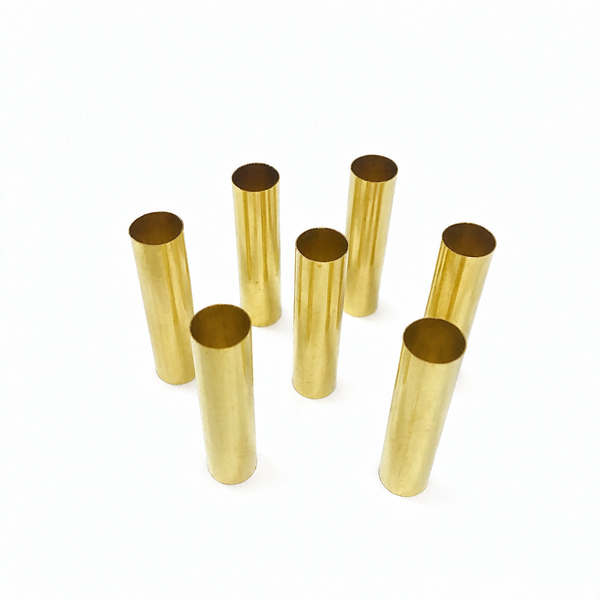
Why brass in a bundle: the header is the reason, not the capillary
A brass capillary bundle looks at first like a cost decision – brass capillaries being cheaper to finish than stainless steel – but the real engineering reason for brass in a bundle is almost always the header. The header block, plate or manifold that gathers dozens of small tube ends into one manifold is a machined part full of small holes, ports and often threads, and brass is the best small-port machining material there is: it drills, taps and reams at high speed with clean burr-free bores, it does not work-harden under the tool, and it can carry the bundle’s fittings and connections directly in the same piece. A brass bundle is a bundle whose tubes and headers can be joined into a genuinely integrated manifold.
Where that logic holds, the material choice is really a manifold choice:
- Brass throughout – capillaries and headers the same alloy family – gives the cleanest joining (braze filler wets both identically, no galvanic pair inside the assembly) and the easiest secondary machining (ports, threads and gauge connections in the header). This is the configuration for instrument manifolds, calibration rigs, gauge blocks and pneumatic distribution hardware.
- All-stainless steel with a machined stainless steel header is the corrosion-premium answer, and its cost is real: a stainless steel header with 60 small cross-drilled ports costs multiples of the brass equivalent, because every port in stainless steel is slower to drill and wears the tools faster.
Dezincification and the brass grade decision
The grade of brass in a wet-service bundle is a decision with a specific failure mode attached, and it deserves its own conversation because the failure is invisible until it is catastrophic. Dezincification is the selective dissolution of zinc from the brass in certain waters – soft, acidic, chlorinated, or high-chloride – leaving behind a porous, mechanically weak copper residue. A dezincified header holds its shape, passes a visual inspection and leaks or collapses under the first pressure event; we have seen manifolds that looked perfect and could be dented with a fingernail.
The grade logic, simplified to what a drawing needs:
- C36000 / CW614N (free-machining, ~36 percent zinc, lead-bearing): the machining benchmark, and the default for dry-service headers and instrument hardware. In wet service it is the most dezincification-prone of the common grades – its two-phase structure includes a zinc-rich phase that goes first. We quote it for air, gas, vacuum and non-aqueous service without hesitation, and we do not quote it for water.
- C26000 / CW509L (cartridge brass, ~30 percent zinc): single-phase, better cold-forming, and moderately better in water than the free-machining grade. The general-purpose drawn-brass choice for capillaries and formed parts.
- DZR grades (dezincification-resistant, e.g. CW602N with arsenic inhibition): the specified answer for potable, hot-water and chlorinated service, tested to the standard dezincification protocols and certifiable as such. DZR brass machines slower than C36000 – the same alloying that resists dezincification removes some of the free-machining behaviour – and the header cost delta is real but small against a dezincification field failure.
Brazing brass to brass with a phosphorus-bearing filler
Joining is the moment of truth in any capillary bundle, and brass-to-brass is the most forgiving joining problem in the family – which is not the same as a free pass. The standard route is torch or furnace brazing with a phosphorus-bearing copper-phosphorus or silver-phosphorus filler (BCuP family), and the phosphorus is doing chemistry: it self-fluxes the joint by reducing the copper oxides, so brass-to-brass joints can be made without a separate flux step, cleanly and repeatably.
The specifics that make brass bundle brazing work:
- Filler choice by service temperature: the phosphorus fillers are strong and self-fluxing, but they form brittle phosphides with nickel or iron, so a BCuP filler is for copper-to-copper and brass-to-brass joints only – never for joints to steel or stainless steel. Silver-bearing phosphorus fillers (BCuP-5 class) add wetting margin and joint ductility for thin gaps; the plain copper-phosphorus (BCuP-2 class) is the economical choice for robust clearances.
- Joint gap is the capillary variable: braze filler rises into a gap of roughly 0.05-0.15 mm by capillarity, and the header-to-tube fit is designed into the drilled hole size. We control the gap by matching header hole class to tube OD class, and the first article is sectioned to confirm the filler filled the gap rather than pooling or starving.
- Keeping the bores open: as with any capillary bundle, the filler must stop short of the bore mouth. In brass headers we give it a designed place to be: a counterbore or annular groove at each tube end meters the filler volume, and the tube insertion depth is fixtured so the bore mouth sits beyond the joint zone. Sectioned first articles verify filler depth per joint class, and the per-channel flow test after joining verifies that every bore survived.
The bundle’s heat path runs through the brass
Brass capillary bundles often exist for thermal reasons – sample coolers, condensers, small heat exchangers, temperature-conditioning manifolds – and when the bundle’s job is heat, the brass is not just a material choice but the heat-transfer plan. Understanding how the heat actually moves through the assembly changes what is worth specifying and what is not.
The heat path, from hot to cold in a typical bundle:
- Fluid inside the capillaries transfers through the tube wall – thin (0.15-0.5 mm), brass, and a negligible resistance compared to almost anything else in the chain. The wall’s thinness is why capillary bundles are effective: the area-to-volume is enormous and the wall drops almost no temperature.
- The outer surface of the capillaries transfers to whatever surrounds them – the shell-side fluid or gas, potted compound, or air. This is usually the governing resistance, and the bundle design lever here is spacing: tubes touching each other share dead airspace between neighbours; tubes at pitch have every millimetre of exterior exposed. Our assembly keeps the pitch with spacers where the duty justifies it.
- The headers act as heat sinks and couplers – a brass header at the bundle end is a fin and a mixing node at once, and the header-to-fixture thermal connection can matter more than the middle of the bundle. Where a sample cooler mounts by its header, the header’s contact area is part of the thermal design, and the review will ask what the header bolts to.
What this means for the drawing:
- Pitch is a thermal specification as much as a mechanical one. A “closely packed” bundle and a “spaced” bundle of the same tube count differ measurably in performance, and the bundle drawing should state the intent, not leave it to the assembly fixture.
- Temperature uniformity across channels – in a conditioning application, every channel should exit at the same temperature, which is a flow-uniformity statement in thermal clothing: the slow channel heats differently from the fast one. The bundle’s flow uniformity band is therefore a thermal spec, and it is verified channel by channel as described below.
Bore tolerance economics on a brass capillary
Brass capillaries are drawn to the same physics as any capillary, but the economics of the tolerance are different, and it is worth spelling out because the brass bundle is usually bought on value. The cost of a brass capillary bore rises in steps as the tolerance tightens, and knowing where the steps are turns a drawing from an expensive guess into an efficient specification.
The cost ladder, rung by rung:
- +/-0.05 mm bore at 0.5-2.0 mm bore size: standard plug drawing, gauged with pin gauges at both ends. This is the bread-and-butter tolerance and adds no premium.
- +/-0.03 mm: tighter pass schedule with an extra sizing pass and more frequent gauge checks – a modest premium, and the right specification when the bundle’s flow uniformity target is around +/-5 percent.
- +/-0.02 mm or flow-class verification per tube: the point at which every tube is individually flow-checked and matched – the population becomes the product. Necessary for calibration-grade bundles (flow dividers, sample splitters, dosing manifolds), where the spread between channels is the instrument’s accuracy figure.
How we verify every tube in a brass bundle
Brass bundle verification is population verification – every tube measured, every channel flow-tested, and the whole assembly certified as one product:
- Per-tube dimensional verification before assembly: bore by pin gauge at both ends, OD at stations, wall by section or ultrasonic on lot samples – with gauge forces stated, because brass is soft enough that a hard gauge reads wrong in its own favour.
- Per-tube flow check where the bundle is flow-specified: each capillary’s flow of filtered dry air at a stated differential, recorded individually; the population statistics (mean, spread, max-min) reported with the bundle as its uniformity certificate.
- Material identity per lot: PMI on every brass lot on receipt – grade confirmed against the order (free-machining, cartridge, DZR, low-lead) – and the header stock certified separately from the capillary stock even when the alloy is the same.
- Stress-relief record where the service is ammonia-adjacent or the customer specifies it: anneal time and temperature on the traveler, reported with the certificate.
- Sectioned joint on the first article: one brazed joint cut and examined for filler fill, gap wetting and bore-mouth clearance – the calibration check for the joining process, repeated on process changes.
- Post-assembly channel test: every channel of the finished bundle flow-tested against the acceptance band, which verifies both the bores and the joints – a blocked bore, a wicked joint or a cracked tube reads as an outlier immediately.
- Leak and pressure test per the drawing on pressure-duty bundles: pressure decay or immersion at proof pressure, 100 percent, hold time stated.
- Header verification: port positions against the header drawing, threads gauged, faces checked for flatness where they seal – the header is half the manifold and it is verified as a machined part in its own right.
- Finish record where the bundle is bright-dipped or passivated: the dip-and-flush sequence recorded, and the post-flush flow test standing as the cleanliness witness – because on a chemically polished bundle, the flow test is both.
- The certificate set per bundle: mill certificates for header and capillary stock, PMI records, per-tube flow records, channel test results, joint section record, and the leak/pressure record where applicable – one document package per serialised assembly.
Send the drawing, a sample, or the manifold concept – the review that comes back with the quotation states the grade proposed with the service it assumes, the joining method, the bore tolerance or flow class per tube, the population uniformity band, and the per-bundle verification list. The brass bundle is the catalogue’s best value in integrated manifolds, and it is priced and certified as an assembly, not as a handful of tubes.
This part belongs to our Deep Drawn Tubes & Sleeves range. The deep drawn tubes & sleeves pages collect the process notes, common materials and inspection points behind every product in the family.
Specifications
| Item | Brass Precision Capillary Tubes Bundle |
|---|---|
| Brand | AUNOV |
| Designing | Share your print, or send a part to be measured, a manufacturability review comes back with the quotation. |
| Tooling | Every die designed and built in our toolroom, held and maintained under your part number. |
| Samples | Sample parts arrive with a dimensional report and material certification. |
| Materials | Brass leads the stock list for this part, alongside carbon steel (SPCC / DC01), 304 / 316 stainless steel, aluminium and copper, with grade selection confirmed at drawing review. |
| Surface finish | Zinc, nickel or chrome plating, e-coat, powder coat, anodising or passivation, as called out on your print. |
| Processing | Staged deep drawing, with in-line annealing where the draw ratio requires, then pierced and machined in house. |
| Equipment | Mechanical presses 5-250 T and hydraulic presses 250-500 T, CNC cells plus a temperature-controlled CMM room. |
| Tolerance | Tolerances to +/-0.1 mm as drawn, machined features held to +/-0.03 mm. |
| Delivery terms | Prices FOB, with DDP for EU and US on request, T/T or L/C, D/P on repeat business, blanket orders and call-offs supported. |
Related Products



Request a Quote for This Part
Send a drawing or sketch — get material advice, tooling cost and a per-piece price within 24 hours (working days).