
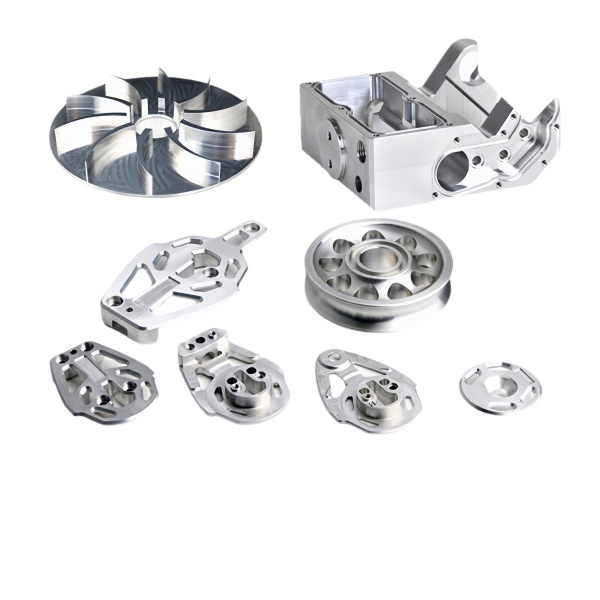
Impeller balance quality is the single most important factor in pump vibration and bearing life
A machined aluminum impeller—whether it is for a centrifugal pump, a blower, or a fan—rotates at speeds ranging from 500 RPM (large industrial pumps) to 30,000 RPM (small coolant pumps). At these speeds, even a small mass imbalance generates significant centrifugal force that transmits through the shaft to the bearings, causing vibration, noise, and accelerated wear.
The unbalance force is F = m × e × ω², where m is the impeller mass, e is the eccentricity (distance between the center of mass and the axis of rotation), and ω is the angular velocity in rad/s. For a 0.5 kg aluminum impeller at 3600 RPM (ω = 377 rad/s) with an eccentricity of just 0.01 mm (easily caused by uneven material removal during machining or by a casting core shift if the impeller is cast before machining), the unbalance force is F = 0.5 × 0.00001 × 377² = 0.71 N. This may seem small, but it is a cyclic force applied 60 times per second—exactly the frequency that excites resonances in pump housings and bearing supports.
We balance all machined impellers to G6.3 or better (G2.5 for speeds above 3000 RPM) using a single-plane static balance (for narrow impellers with width/diameter < 0.2) or two-plane dynamic balance (for wider impellers). Correction is done by removing material from the impeller shroud or hub at locations 180° from the heavy spot, using a drill end mill that removes material in controlled increments (0.05 g per pass for small impellers).
Gearbox housing bore alignment determines gear mesh quality and service life
The housing that encloses a set of gears must position the shaft bearings (and therefore the gear axes) with precise parallelism and center-distance accuracy. If the bores are not parallel (angular misalignment) or not at the correct center distance (positional error), the gear teeth will mesh with incorrect contact pattern—concentrating load on one edge of the tooth rather than distributing it across the full face width.
The effect on gear life is dramatic: a 0.02 mm/meter angular misalignment in a gearbox with 20 mm face-width gears can reduce the gear life by 50–70 % because the edge loading creates localized Hertzian contact stresses 2–3× higher than the designed value. For this reason, we machine gearbox housing bores in a single setup whenever possible: the workpiece is clamped once, all bores are bored or reamed without unclamping, and the resulting parallelism is limited only by the machine tool’s positioning accuracy (typically 0.005–0.01 mm over 100 mm span).
If the geometry prevents single-setup machining (bores on different faces or at angles that cannot be reached without re-clamping), we use a datum-based approach: the first bore is machined and used as Datum A; subsequent bores are positioned relative to Datum A using the machine’s probe system to measure the actual datum position before each cut. This reduces accumulated error compared to relying solely on the machine’s absolute positioning accuracy.
Aluminum selection between 6061-T6 and 7075-T6 affects both machinability and stress-corrosion resistance
For machined impellers and gearbox housings, the choice between 6061-T6 and 7075-T6 aluminum involves a tradeoff between strength, machinability, cost, and corrosion resistance:
- 6061-T6: Yield strength 276 MPa, ultimate 310 MPa. Excellent corrosion resistance (no stress-corrosion cracking risk in any environment). Machines well (tool life roughly 80 % of what you’d get in mild steel). Cost: lowest of the aerospace-grade aluminums (~3–4 USD/kg in bar stock). Our default choice for all aluminum impellers and housings unless higher strength is specifically required.
- 7075-T6: Yield strength 503 MPa, ultimate 572 MPa—nearly double 6061. Better fatigue strength for cyclic-loading applications (impellers at high RPM, gearbox housings under varying torque). However: susceptible to stress-corrosion cracking in humid or marine environments (the T73 temper improves SCC resistance but reduces strength by ~10%). Machines slightly harder than 6061 (tool life ~65 % of steel) due to higher strength. Cost: 30–50 % more than 6061 due to zinc alloying content and lower production volume.
We recommend 7075-T6 when the design calculation shows that 6061 cannot provide adequate safety factor (typically when the impeller peripheral speed exceeds 80 m/s or when the gearbox must transmit high torque in a compact envelope). We recommend 6061-T6 for all other cases, particularly when the part will be exposed to moisture or when cost is a significant factor.
Bearing seat tolerance in the housing determines whether the bearing fits correctly and runs true
The bore in a gearbox housing that receives a rolling-element bearing (ball bearing, roller bearing, or needle bearing) must be held to a tight tolerance that matches the bearing’s specified fit class. Most bearing manufacturers recommend an H7 fit (slight interference to line-to-line) for the housing bore when the bearing outer race rotates relative to the housing (common in planetary gearsets) or a G7/h6 clearance fit when the outer race is stationary.
We hold bearing bores to the tighter of: (a) the drawing-specified tolerance, or (b) ISO 286 H6 (+0.009/0 at 30 mm diameter) as our internal minimum for precision gearboxes. The H6 tolerance ensures that the bearing outer race seats concentrically with the bore axis within 0.005 mm, which keeps the shaft runout contribution from the housing below 10 % of the total allowable runout budget (the remaining 90 % is allocated to shaft runout, bearing internal clearance, and gear eccentricity).
How we verify an assembled impeller-and-housing assembly before shipping as a unit
When the order includes both the impeller and the gearbox/pump housing as a matched assembly:
- Impeller balance verification: Re-check balance after any post-machining operations (anodizing, painting, or assembly of blades if the impeller is built-up rather than solid). Confirm residual unbalance is within spec. Record balance correction locations.
- Housing bore inspection: CMM measurement of all bearing bores, seal bores, and pilot diameters. Verify parallelism (< 0.01 mm/100 mm span), position (center distance within ±0.01 mm of nominal), and cylindricity (0.01 mm TIR for bearing bores).
- Dry assembly test: Install bearings, shaft, and impeller (without seals or lubrication) and rotate by hand. Check for binding, roughness, or axial/radial play outside specification. Measure shaft runout at the impeller location with a dial indicator (< 0.02 mm TIR typical acceptance).
- Run-in test (if required): For assemblies that include our motor or that will be tested with customer-supplied motors: operate at rated speed for 30 minutes. Monitor bearing temperature (rise < 40 °C above ambient), vibration (velocity < 4.5 mm/s RMS per ISO 10816), and noise (no abnormal tones or knocking sounds).
- Preservation: Apply corrosion preventive to all bare aluminum surfaces, plug all openings with desiccant-filled plugs, and wrap in VCI (vapor corrosion inhibitor) film for shipment. Aluminum does not rust like steel, but it can develop surface oxidation (white powder) and galvanic corrosion where it contacts dissimilar metals—both of which are prevented by proper preservation.
CNC Machining Parts is the parent range for parts like this one; the overview page gathers the tooling logic, finishing options and tolerance notes that apply across the family.
Specifications
| Item | Aluminum CNC Machined Impellers and Gearbox Housings |
|---|---|
| Brand | AUNOV |
| Designing | Share your print, or send a part to be measured, the quotation comes back with a manufacturability review attached. |
| Tooling | Tooling designed and cut in house, stored under your part number. |
| Samples | Pre-production samples of the housing ship with a dimensional report and material certificate. |
| Materials | Aluminium is the primary stock for this part, alongside carbon steel (SPCC / DC01), 304 / 316 stainless steel, brass and copper, per the drawing. |
| Surface finish | Plating, e-coat, powder coating, anodising or passivation as the drawing calls out, selected against the drawing requirement. |
| Processing | Progressive deep draw stages with in-line annealing as the draw ratio demands, then pierced and CNC-machined in house. |
| Equipment | Our press floor runs 5-250 T mechanical and 250-500 T hydraulic presses, CNC turning centres and a climate-controlled CMM room. |
| Tolerance | Tolerances to +/-0.1 mm as drawn, with machined features to +/-0.03 mm. |
| Delivery terms | FOB standard, DDP offered for EU and US, T/T or L/C, D/P on repeat business, blanket orders and call-offs supported. |
Related Products



Request a Quote for This Part
Send a drawing or sketch — get material advice, tooling cost and a per-piece price within 24 hours (working days).