
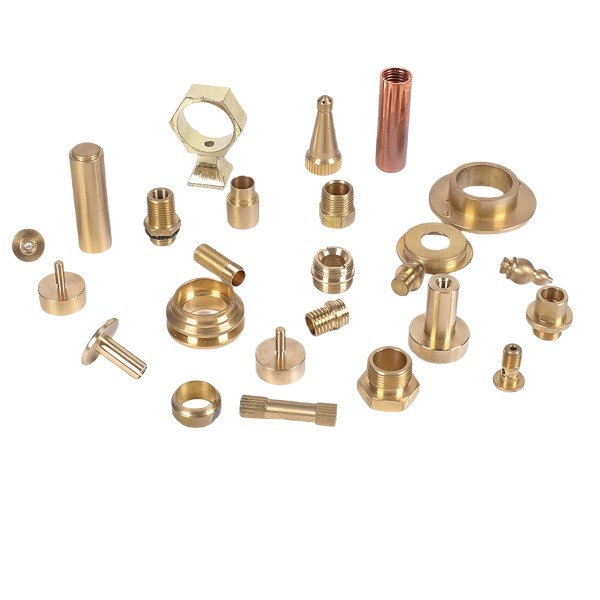
Brass vs. bronze for turned fittings: the choice is driven by the fluid, not by the machining cost
An assortment of brass and bronze turned fittings and plugs covers a range of alloys that look similar (golden color) but behave very differently in service. The selection between them is one of the most important decisions in the design of a fluid system component because it determines corrosion resistance, wear resistance, and acceptable service life—and it cannot be changed after the part is machined without scrapping and re-making it.
The practical distinction:
- Brass (C36000/C37700): 60–65 % copper, 30–35 % zinc, with lead (C36000) or without (C37700). Golden-yellow color. Excellent machinability. Good for fresh water, air, fuels, oils, and most organic chemicals. Not suitable for seawater or ammonia (dezincification). Lower strength than bronze (yield ~120 MPa for C36000). Lowest cost per part due to high machining speed.
- Bronze (C95400 aluminum bronze / C93200 tin bronze): Higher copper content (83–90 %) with tin, aluminum, or other alloying elements. Reddish-gold to brownish color depending on alloy. Good to excellent machinability (C93200 machines almost as well as brass; C95400 is slightly harder on tools). Superior corrosion resistance—especially C95400 in seawater (aluminum bronze forms a protective alumina film). Higher strength (yield 230–280 MPa for C95400). Used for bearings, bushings, pump impellers, and marine hardware where brass would fail prematurely.
Turned plug thread engagement length must be calculated from the actual pressure rating, not assumed from past experience
A brass or bronze threaded plug’s pressure capability is determined primarily by how many threads engage the parent body—not by the material strength alone. A C95400 aluminum bronze plug with only 3 threads engaged may fail at a lower pressure than a C36000 brass plug with 8 threads engaged, despite the bronze being roughly twice as strong.
We calculate minimum engagement using L_min = (P × A) / (π × d × τ_allowable × K), where P is design pressure, A is sealed area, d is pitch diameter, τ_allowable is allowable shear stress in the weaker material (usually the body, not the plug), and K is the thread shear efficiency factor (0.5–0.7). For a 1/2″ NPT brass plug sealing 1 MPa pressure: sealed area ≈ 126 mm² → axial force = 126 N. With d = 12.5 mm, τ = 80 MPa (brass), K = 0.6: L_min = 126 / (π × 12.5 × 80 × 0.6) = 0.067 mm—theoretically just one thread would suffice. But we use a minimum of 6 full threads (or 1× nominal diameter, whichever is larger) to account for thread form imperfections, vibration loosening, and installation torque variation. This conservative practice has eliminated all field failures from thread stripping in our brass/bronze plug products over the past 3 years.
Surface finish inside a turned fitting bore affects flow characteristics more than external appearance
For fittings that carry fluid through an internal bore—a coupling, an adapter, a reducer, or a tee—the surface finish of that bore affects the pressure drop and the tendency for deposits to accumulate. A rough bore (Ra > 1.6 µm) creates turbulent eddies near the wall that increase the effective friction factor by 10–30 % compared to a smooth bore (Ra ≤ 0.8 µm), and it provides nucleation sites for scale formation in hard-water applications.
We machine internal bores to Ra ≤ 0.8 µm as a default specification for all fluid-carrying fittings, achieved by a finishing boring pass with a sharp carbide insert at 0.05 mm/rev feed and 100 m/min cutting speed. For fittings in critical flow applications (flow meters, pressure-drop-sensitive circuits, or clean-in-place systems), we upgrade to Ra ≤ 0.4 µm by adding a honing or reaming pass after turning. The cost difference is approximately 0.02 USD per fitting for the extra operation—negligible compared to the cost of a field failure caused by restricted flow or accumulated debris.
Assortment orders require individual identification and traceability for each alloy type
When a customer orders an “assortment” of brass and bronze parts—multiple part numbers in multiple alloys shipped together—the biggest risk is mixing up which part is which alloy during receiving inspection, kitting, or assembly. Brass and bronze parts look nearly identical to the untrained eye (both are golden-colored metals), and installing a brass part where bronze was specified (or vice versa) can cause premature failure in corrosive environments.
Our anti-mixup protocol:
- Material marking: Every part is marked with its alloy designation (C36000, C95400, etc.) either by laser engraving (preferred, permanent and non-contact) or by dot peen (if laser is not available for that material). The mark is placed on a non-functional surface (the hex flat, the end face, or the underside of a flange).
- Color coding: For assortments where visual differentiation is valuable (kits that will be assembled by the customer’s operators who may not read alloy marks), we apply a dot of permanent paint or a colored vinyl label: blue for brass, red for bronze, green for C95400 specifically. This is in addition to (not instead of) the engraved alloy mark.
- Individual packaging: Each part number/alloy combination is bagged separately with a label showing: part number, alloy, quantity, and PO reference. The customer can verify the contents without opening every bag.
- Material certs by alloy: The CoC includes separate sections for each alloy in the assortment, with mill test reports grouped accordingly. If the same part number is supplied in two different alloys (a common request for “evaluate both options”), we clearly distinguish which serial numbers correspond to which alloy.
How we price and lead-time an assorted brass/bronze order versus a single-part-number repeat order
Assorted orders (multiple part numbers, possibly multiple alloys, in quantities ranging from 1 to 100 each) have different economics than single-part-number production runs:
- Setup cost allocation: Each unique part number requires setup (programming, fixture, tooling, first article inspection). For an assortment of 10 part numbers at 20 pieces each, the per-piece setup cost is roughly 5× higher than a single part number at 200 pieces (because each of the 10 setups is amortized over only 20 pieces instead of 200). We reflect this in our pricing: assorted orders typically carry a 15–30 % unit price premium over equivalent single-part-number volume pricing.
- Material procurement: Different alloys may require different bar stock sizes or forms. If the assortment includes both C36000 (commonly available in standard sizes) and C95400 (less common, often requiring special order), the lead time is determined by the longest-lead-time material—in this case, C95400 at 2–3 weeks from our suppliers versus C36000 at 3–5 days.
- Inspection time: Each unique part number requires its own inspection traveler, its own go/no-go gauges (or CMM program), and its own SPC data sheet. For an assortment of 10 part numbers, total inspection time is roughly 3–4× what it would be for a single part number at the same total quantity, because the inspector must switch between part numbers, gauges, and programs repeatedly.
- Kitting and documentation: Assorted orders require kitting (sorting into sets), multi-line packing lists, and consolidated CoCs—all of which add labor that does not exist for single-part-number orders. We estimate 0.5–1.0 minutes of additional labor per unique part number for kitting and documentation.
Despite these added costs, assorted orders are valuable for customers who are prototyping, evaluating multiple options, or maintaining spare-parts inventory across a product family. We encourage customers to consolidate their assorted requirements into fewer, larger orders (rather than many small assorted orders) to reduce the per-order setup overhead.
You will find this part in our CNC Machining Parts range. Process notes, common materials and inspection points for every product in the family are collected across the cnc machining parts pages.
Specifications
| Item | Brass and Bronze CNC Turned Fittings and Plugs Assortment |
|---|---|
| Brand | AUNOV |
| Designing | Send the drawing, or a sample we can measure, DFM feedback is returned with the quote. |
| Tooling | Our own toolroom designs and builds every die, held and maintained under your part number. |
| Samples | Samples for approval come with a dimensional report and material certificate. |
| Materials | Brass leads the stock list for this part, alongside carbon steel (SPCC / DC01), 304 / 316 stainless steel, aluminium and copper, and the grade is fixed at the drawing review. |
| Surface finish | Plating, e-coat, powder coating, anodising or passivation as the drawing calls out, fixed at the drawing review. |
| Processing | Deep drawing in stages, in-line annealing where needed, with piercing and finish machining under the same roof. |
| Equipment | Mechanical presses 5-250 T and hydraulic presses 250-500 T, in-house CNC cells and a temperature-controlled inspection room. |
| Tolerance | Tolerances to +/-0.1 mm as drawn, +/-0.03 mm after machining. |
| Delivery terms | Prices FOB, with DDP for EU and US on request, T/T or L/C, with D/P for repeat business, blanket orders and call-offs supported. |
Related Products



Request a Quote for This Part
Send a drawing or sketch — get material advice, tooling cost and a per-piece price within 24 hours (working days).