
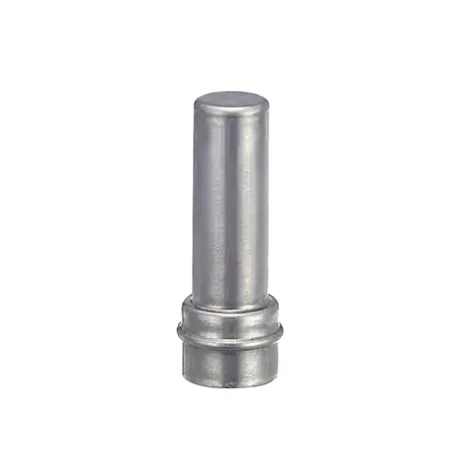
An oxygen sensor housing works in one of the most hostile places on a vehicle. It sits in the exhaust stream, it sees gas temperatures that climb past 900 degrees, it is taken from cold to full temperature in seconds on every cold start, and it is attacked from outside by road salt and from inside by combustion products. This page is about surviving that environment, which is largely a materials decision.
The grade follows where in the exhaust the sensor sits
There is no single exhaust-grade stainless steel, and the right one depends on the sensor’s position. Downstream of the catalyst, temperatures are moderate and a standard austenitic or a ferritic grade performs well for the life of the vehicle. Move upstream toward the manifold and peak temperatures rise enough that scaling and internal oxidation become the limiting mechanism, and the answer is a grade with higher chromium and often silicon or aluminium additions that form a more protective oxide. Because the grade decision drives formability, welding and service life together, we ask for the exhaust position and the expected peak temperature at RFQ rather than assuming one.
Thermal shock, not steady heat, is what cracks these
A housing that survives a soak at temperature can still fail in service, because the load it actually sees is cycling. Each cold start takes it from ambient to several hundred degrees in seconds, thousands of times, and that cycling concentrates stress at the threads, the sealing shoulder and the slots in the protection tube. Our designs keep those transitions generous and avoid sharp internal corners. Where the application is severe the housing is cycled hot and cold on a rig and inspected for cracks at intervals – a test that cannot be skipped on a high-temperature sensor, and one whose result has to be designed in rather than repaired afterwards.
The harder the grade, the more the drawing sequence has to change
Heat-resisting grades are chosen for the oxide they form, and that same chemistry makes them harder to draw than low-carbon steel; austenitics work-harden faster still and need slower draw speeds. The forming sequence – number of draws, intermediate anneal, lubrication – is planned around the specified grade instead of being assumed from a steel baseline. Getting this wrong shows up as cracking in the draw or as a part that formed but is already at the limit of its ductility.
Protection tube: enough gas, not too much
Most sensors carry a slotted shroud that shields the ceramic from direct impingement and water splash while still letting gas reach the element. Its slots are a compromise in both directions: too little open area and the sensor’s response lags the exhaust, too much and the element is exposed to splash and particulates. They are formed to the sensor maker’s design, held on slot width and position, and verified on first articles – and because the tube sits in the hottest part of the gas path, it is made in the same heat-resisting grade as the housing rather than a convenient one.
How a housing is checked before it ships
Material certification is tied to the part, the slot geometry is measured on first articles, and the features that carry thermal cycling are inspected for the transitions the design called for.
First articles and retention samples are kept for the programme, so a reorder is made in the same grade and to the same geometry. On a part whose service life is a materials decision, that is what keeps the second batch lasting like the first.
This part sits inside our Sensor Housings range. Across the sensor housings pages you will find the process notes, common materials and inspection points behind every product in the family.
Specifications
| Item | Oxygen sensor housing |
|---|---|
| Brand | AUNOV |
| Designing | Send drawings, or send a sample to be measured – samples are reverse-measured into a controlled drawing; changes are priced before they are made. |
| Tooling | Tooling is quoted once and held – reorders are priced on the part, not on the die. |
| Samples | Pre-production samples come with a full inspection report, so the approved first article becomes the gauge reference, and production starts only after your written sign-off. |
| Materials | Materials held include carbon steel, 304 / 316 stainless steel, aluminium and brass; special grades are sourced to the drawing when volumes justify. |
| Surface finish | Plating, powder coating, anodising or polishing, per the print; the finish is inspected with the dimensional report on the first article. |
| Processing | Drawn shell with machined seats and threads where the print calls for them; batch records are filed so a repeat order starts from approved data. |
| Equipment | Press line for drawing, CNC cells for finishing, backed by CNC turning centres and a climate-controlled inspection room. |
| Tolerance | +/-0.02 mm on machined seats, sealing faces flat to drawing; finer bands confirmed from capability data before quoting. |
| Delivery terms | FOB, CIF or DDP per Incoterms 2020, T/T with deposit and L/C for larger runs; each volume tier carries its own quoted price. |
Frequently Asked Questions
Why does the position in the exhaust decide the stainless steel grade more than anything else?
Because the same description covers very different duty. Upstream, near the manifold, the metal sees the hottest gas and the sharpest swings. Further downstream it runs cooler, but it spends far more of its life wet with condensate, which brings an entirely different corrosion problem. Choosing a grade without saying where the sensor sits means selecting against the wrong enemy, and each of the two mistakes costs money in a different direction.
If the metal survives steady heat, why is thermal shock what actually cracks a housing?
Steady heat lets expansion even itself out. Thermal shock does not: the outer skin changes temperature before the section behind it has, so it tries to grow against restraint and cycles in and out of yield. Splash on a hot pipe delivers this several times a minute in ordinary driving. That is why a housing qualified only at temperature still fails on the vehicle, and why cycling rather than steady state is what a validation has to reproduce.
How much gas does a protection tube need, and who decides it?
Enough for the element to read representative gas quickly, and no more. Larger openings make the sample more representative but also expose the element to water, particulates and stream velocity, all of which shorten its life. That trade-off belongs to whoever owns the sensor’s response specification, so it is far better asked at enquiry than optimised by whoever happens to draw the tube.
What does choosing a harder grade do to the drawing sequence?
It lengthens it. Alloys that hold their strength at exhaust temperature generally work harden faster and tolerate less reduction per pass, so reaching the same geometry takes more stages and more interstage annealing. That surfaces as tooling cost and lead time rather than piece price, which is why the grade belongs in the drawing review instead of being settled after tooling has started.
Related Products


Request a Quote for This Part
Send a drawing or sketch — get material advice, tooling cost and a per-piece price within 24 hours (working days).