
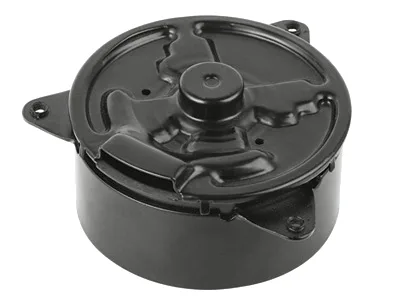
A warm wind motor enclosure is more than the drawn shell: vents, drainage, flange pattern and stiffness all get designed into the part before the die is cut. This page is the design-side view for HVAC engineers – what to build into the enclosure, what each feature costs to draw, and where drawn shells beat rolled-and-welded fabrication.
Designing the features in, not onto
Every feature below can be formed in the die sequence – the question is deciding them early, because they change the die:
- Vent slots and louvres. Pierced in-die to the flange datum. Louvres can be lanced-and-formed for stiffness; plain slots for maximum open area. Edge burr direction matters for airflow – and is controlled in the die.
- Drainage. A condensing appliance needs a path for condensate out of the shell. A single drain hole at the low point of the flange costs nothing in the die and saves a warranty conversation.
- Flange pattern and stiffness. Bolt holes pierced in-die; where the flange spans a wide opening, a formed step or lip adds rigidity without adding a bracket.
- Cable entry. A lanced tab or a pierced grommet bore, positioned to the assembly datum.
- In-die marking. Part number and date code stamped in the same hit for traceability.
Drawn shell vs rolled-and-welded enclosure
| Aspect | Deep drawn shell | Rolled + welded |
|---|---|---|
| Seam integrity | Seamless – no weld to crack or leak | Weld seam along the wall |
| Repeat consistency | Die-controlled | Operator and fixture dependent |
| Unit cost at volume | Low (press cycle) | Higher (rolling, welding, straightening) |
| Size flexibility | Limited by press and die | Nearly unlimited |
| Best territory | Volume appliances, Ø up to ~300 mm | One-offs and very large shells |
Noise and vibration notes
Two enclosure behaviours are worth designing for. A shell that is too flexible rings – a formed step or a stiffening lip in the draw quiets it without adding parts. And an asymmetric vent pattern can interact with blade-pass frequency; symmetric or paired vent layouts avoid the worst of it. Neither is fixable by tolerance – both are die-stage decisions.
Verification
First article CMM-measured against the print: envelope, flatness, hole location as the named checks. Shaft-bore runout and flange flatness gauged on production runs under the agreed sampling plan; salt-spray testing backs the coating choice for wet locations. ISO 9001 certified production with mill certificates per heat.
From quote to repeat order
Send drawings, or a sample to be measured – a manufacturability review comes back with the quotation, and changes are priced before they are made. Tooling is built in our own toolroom and held under your part number, so a repeat order starts from the same approved data, with first article, drawing revision and material cert travelling with each batch.
Our deep drawn covers guide puts numbers to the design decisions behind a part like this — draw ratio, wall thinning, radii and trim; the Precision Deep Drawn Parts pages collect the rest of the family.
Condensation paths inside a warm-air enclosure
A warm-wind motor enclosure lives in moving air that cools and condenses, so the inside of the shell sees moisture the outside never does. We design a drain path or a low-point weep that lets condensate leave instead of pooling on the winding, and we specify the internal finish so water sheets off rather than clinging. Where the enclosure wraps a heating element, we keep the internal wall clear of features that trap droplets and we radius the corners so a film cannot sit in a pocket. The finish choice, powder coat versus plating, is made for the plenum side first and the cosmetic side second, because a flaking interior coating is a contamination and insulation risk the exterior never faces.
Service access: how the enclosure opens and reseals
Most failures in the field are fixed by reaching the motor, not by replacing the shell, so the enclosure is designed to open. We prefer a removable panel with a captured gasket over a crimped shut can wherever the duty allows it, because a resealable joint keeps the IP rating through repeated service. The fasteners are chosen so a technician can open it with standard tools and the same clamp load is restorable, which matters more than shaving a cent off the hardware. Where sealed construction is required, we document that the enclosure is a replace-on-service part and size the wall so it survives handling without denting.
Field dent resistance
The enclosure is handled, dropped, and leaned on in installation, so we pick a gauge and a coating that resist denting without adding weight that strains the motor mount. A small increase in wall thickness often costs less than the field returns a thin shell generates.
Thermal rating and the motor duty cycle
The enclosure sets how much heat the motor can shed, so its design has to match the duty cycle, not just the nameplate. A cover that is fine on a short-cycle warm-wind motor can overheat one that runs continuously, because the same shell that traps condensate also traps heat. We check the enclosure against the worst-case run time and the ambient the motor sees, and we open the wall or add stand-offs where the temperature rise threatens the winding class. The thermal limit is stated in the quotation alongside the IP rating, because a sealed enclosure that cooks the motor is worse than a vented one that stays cool.
Specifications
| Item | Warm wind motor enclosure |
|---|---|
| Brand | AUNOV |
| Designing | Quotation follows the print, not a catalogue – samples are reverse-measured into a controlled drawing; changes are priced before they are made. |
| Tooling | Dies, fixtures and gauges are made in our own toolroom, so a die can be re-cut against the approved drawing, and maintenance is tracked against the part number. |
| Samples | Samples are issued for approval before the run, and production starts only after written sign-off. |
| Materials | Standard stock: carbon steel (SPCC / DC01), 304 / 316 stainless steel, aluminium, brass; grade and temper are confirmed in writing before tooling. |
| Surface finish | Natural, plated or coated as the print decides; the agreed finish is logged, and thickness and adhesion are checked on the first article. |
| Processing | Multi-stage deep drawing with interstage annealing, trimmed and pierced in following dies; in-process checks sit between stages, not only at the end. |
| Equipment | Mechanical presses from 5 to 250 T and hydraulic presses 250-500 T, with in-line annealing furnaces; first articles and batch samples are checked on the CMM. |
| Tolerance | +/-0.05 mm on drawn diameters, tighter bands confirmed against the drawing; critical dimensions carry CMM data with the shipment. |
| Delivery terms | Incoterms FOB as standard with DDP on request; sea and air options priced with the order. |
Related Products
Frequently Asked Questions
Why is it cheaper to design features into the die rather than onto the part?
Every feature added afterwards carries handling, a fixture and a station, and each one also adds another opportunity to accumulate error. A feature formed in the die costs cycle time and almost nothing else, and it repeats because the tooling decided it. That is why the drawing review is the last point at which this is a cheap conversation.
Drawn shell or rolled-and-welded – what decides it?
The seam, mainly. A drawn shell has no joint to leak, corrode or lose concentricity along its length, and it suits volume once tooling exists. Rolling and welding requires far less tooling and adapts to large diameters and small batches, but every seam then becomes an inspection point and the roundness follows the seam rather than the tool.
Where does condensation actually go inside a warm-air enclosure?
Wherever the geometry lets it sit. Once the unit stops, the shell cools while moisture remains, so unless the inside drains and vents the enclosure starts corroding from within, usually unnoticed until it perforates. Drainage paths and the position of any low pocket are therefore design features rather than consequences of the shape.
What turns a first quotation into a repeat order?
Whether the second batch matches the first. That depends on keeping the signed sample and its measurement record as reference, updating the controlled drawing when anything changes, and running repeat orders against that drawing rather than against whoever remembers the job. Price differences matter less than reproducibility once production has started.


Request a Quote for This Part
Send a drawing or sketch — get material advice, tooling cost and a per-piece price within 24 hours (working days).