
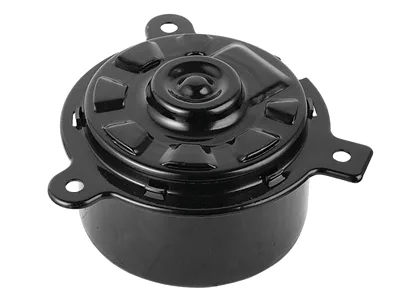
The Electric Warm Wind Motor Can is the drawn shell for HVAC blower and warm-air fan motors: it shields the windings, guides the cooling air and carries the motor through its mounting flange. This page covers the HVAC-specific engineering – the air path, condensing environments and the runout checks that keep these small motors running quiet.
Role in the air path
Unlike a sealed industrial enclosure, a warm-wind motor can is deliberately part of the airflow. The shell surrounds the winding overhang while vent openings let cooling air pass; the flange mounts the motor in the duct or fan scroll. Three consequences for the drawn shell:
- Vent slots are functional geometry. Slot area, position and edge form affect noise as much as cooling. They are pierced in-die, deburred, and positioned to the flange datum.
- The flange is the mounting datum. Its flatness decides how the motor sits in the scroll; a warped flange shows up as impeller rub. Flange flatness is checked at first article and on production sampling.
- Balance matters. An asymmetric vent pattern or an off-centre draw can unbalance the rotor assembly. Shell concentricity to the shaft-bore datum is what keeps the assembly inside its vibration grade.
Condensing environments and the finish decision
Warm-air appliances cycle temperature and humidity; the can sees condensation on the inside as well as the out. Material and finish are matched accordingly:
- Carbon steel SPCC / DC01 with zinc plating plus e-coat – the volume answer; salt-spray testing backs the coating choice for wet locations, and the report travels with the batch.
- 304 stainless steel – for appliance lines where the premium is acceptable and no coating line is wanted at all; as-drawn finish.
- Aluminium – where weight or thermal behaviour dominates; anodised or natural.
The checks that keep it quiet
HVAC motor can noise complaints are usually traced to two things, so they are the named inspections:
- Shaft-bore runout. Measured at first article and gauged in production. Runout here becomes rotor misalignment, and rotor misalignment becomes the hum the customer hears.
- Flange flatness. The mounting interface; checked per sampling plan so the motor sits square in the scroll.
Bearing-bore size and spigot runout – the standard motor end-cover checks – are measured as well where the can carries the bearing seat.
Volume production route
Multi-stage deep drawing with interstage annealing, trimmed and pierced in following dies; degreased and gauged before finishing. Mechanical presses 5-250 T and hydraulic presses 250-500 T cover the range; process settings are archived with the part number, and every reorder is gauged back to the signed first article – not to a memory of it.
Shipment and terms
First-article samples come with a full inspection report; production starts only after your written sign-off. Call-off schedules are supported. Torque, leak or pressure tests can be written into the quality plan where the appliance programme requires them.
Drawing, machining and welding each win on different geometries; the guide to deep drawn covers works through those boundaries, and the full Precision Deep Drawn Parts range is reachable from the overview page.
The can as part of the air path, not just a shell
An electric warm-wind motor can is not a container; it is a section of the duct. The inlet and outlet bosses are positioned so the airflow sweeps the winding instead of shortcutting past it, and the internal shape is kept clear so no pocket stalls the flow. We treat the can’s internal contour as an aerodynamic feature on units where the motor sets the air volume, because a cramped interior costs performance the fan cannot recover. The bosses are drawn with the body so there is no seam at the pressure point, which is also why the can leaks less than a welded equivalent at the same wall.
Scratch and dent resistance in handling
The can is the visible part of the motor and the one most likely to be scuffed on a bench, so the finish is chosen for both corrosion and cosmetic survival. We specify a coating that hides minor handling marks without thickening to the point that the can binds in its housing, and we radius the rim so a drop lands on an edge that will not crease. Where the can slides into a bracket, we keep the outside diameter true so it seats without forcing, because a forced fit is how a thin shell dents and then rattles.
Acoustic note of the can
A thin can rings; we break that resonance with a damping feature or a die-managed wall variation so the motor does not sing at a single annoying frequency. This is a perceived-quality item that costs little and is noticed immediately when missing.
Specifications
| Item | Electric Warm Wind Motor Can |
|---|---|
| Brand | AUNOV |
| Designing | Send drawings, or send a sample to be measured – samples are reverse-measured into a controlled drawing; changes are priced before they are made. |
| Tooling | Dies, fixtures and gauges are made in our own toolroom, so die cost stays transparent, and maintenance is tracked against the part number. |
| Samples | Pre-production samples come with a full inspection report, so the part is proven before it is made in volume, and production starts only after your written sign-off. |
| Materials | Stock runs to carbon steel, 304 / 316 stainless steel, aluminium and brass; mill certificates and heat numbers accompany the first article. |
| Surface finish | Zinc, nickel or chrome plating, anodising, passivation or e-coat; the finish is inspected with the dimensional report on the first article. |
| Processing | Multi-stage deep drawing with interstage annealing, trimmed and pierced in following dies; batch records are filed so a repeat order starts from approved data. |
| Equipment | Mechanical presses from 5 to 250 T and hydraulic presses 250-500 T, with in-line annealing furnaces; first articles and batch samples are checked on the CMM. |
| Tolerance | +/-0.05 mm to +/-0.1 mm across the part, wall thickness held to print; critical dimensions carry CMM data with the shipment. |
| Delivery terms | FOB, CIF or DDP per Incoterms 2020, T/T with deposit and L/C for larger runs; call-off schedules are supported. |
Related Products
Frequently Asked Questions
Why is this can described as part of the air path rather than as just a shell?
Because the openings are functional rather than decorative. Cooling air passes through them across the winding overhang, so their size, shape and position decide how much flow reaches the hot parts and how much noise the airflow makes. Treating them as ventilation holes applied afterwards usually degrades both numbers at once.
How does a condensing environment decide the finish?
The part spends its life alternating between wet and dry rather than sitting permanently in either, and that cycling is harder on coatings than steady wetness would be. Resistance to wet adhesion and to repeated drying therefore matters more than a single immersion figure. The weakest point is usually where the coating is thinnest, which is why coverage at edges gets specified separately.
What actually gets checked to keep one quiet?
Consistency, mainly. Edge condition at the openings, since a ragged boundary generates tone, symmetry of the opening pattern, and runout of the rotating assembly relative to the shell. None of these are dramatic individually, and together they decide whether airflow noise reads as a rush or as a whine.
Why do packing and shipment matter more for this part than usual?
Because it is thin, pierced and dimensionally tied to airflow. A dent that nobody notices can move a clearance enough to change how it sounds, and the damage usually happens between the press and the installation rather than in service. Agreeing how they are separated, packed and stacked is part of specifying the part.

Request a Quote for This Part
Send a drawing or sketch — get material advice, tooling cost and a per-piece price within 24 hours (working days).