
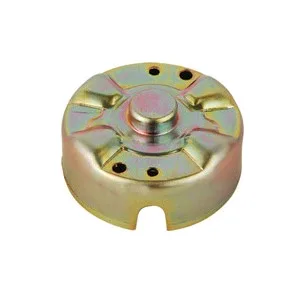
End shields: the part that carries the shaft and the load
An electric motor’s end shield – the closure at the shaft end, also called the end bell or bearing housing – does more than close the motor. It centres the shaft bearing relative to the stator, carries the radial and axial loads the shaft transmits, sometimes directs cooling air, and mounts whatever the motor drives. A metal forming electric motor end shield produced from sheet rather than cast from aluminium is a different engineering proposition, and this page covers how we form the shield to do all those jobs – with attention to the loads and the bearing seat that make it work.
The bearing seat: the shield’s most demanding feature
The shield’s central feature is the seat that holds the shaft bearing or bushing, and its accuracy determines the motor’s air gap and running characteristics. A seat whose position drifts relative to the shield’s mounting face shifts the rotor, opening or closing the air gap asymmetrically; a seat that is not round or not square lets the bearing bind. Forming an end shield from sheet means producing that seat as a formed boss with a qualified bore – and the accuracy required usually mandates a finishing operation: coining to size the bore and establish roundness, or a sizing or ironing pass. We hold the seat’s diameter to the bearing’s fit band, its squareness to the mounting face, and its position to the same datum the mounting face uses, verifying all three on first articles with the metrology the customer’s gauges use. For shields with high radial loads, the seat’s boss is thickened locally by the blank’s design, since adding material where the load concentrates is the cheapest way to buy stiffness.
Carrying load through a formed structure
An end shield carries the shaft’s radial load (from belt or gear pull) and any axial thrust, plus the motor’s own vibration reactions. Sheet-formed shields handle this with geometry rather than mass: formed ribs radiating from the bearing seat to the mounting face, a generous fillet where the boss meets the shield’s plane, and a mounting face stiff enough not to bow under the load. Our designs shape the load path so it runs from the seat through ribs to the mounting bolts with as few bends as possible, because every bend in a thin sheet is a compliance point. Where the pull is heavy, we will recommend a thicker blank or a locally reinforced boss, and we will show the numbers rather than assert equivalence with a cast shield.
Ventilation and cooling
Many end shields also shape the motor’s cooling airflow: formed apertures, deflecting lips or a louver pattern that admits air while excluding dust and spray, and the shield’s role as a fan housing’s back plate. Forming these in the same die that produces the shield’s structure means their position and area are set by tooling, and their geometry can be designed for the flow the motor needs rather than added as an afterthought. Where the customer’s thermal analysis specifies an opening area and a deflection, we form to it and verify the openings’ dimensions on first articles. A shield that chokes the airflow runs the motor hot and shortens insulation life – a failure that looks like an electrical problem but originates in a forming detail.
Where sheet-formed shields beat castings – and where they do not
Sheet-formed shields win on cost at volume, weight for equal stiffness (steel’s modulus and thin sections beat cast aluminium in specific stiffness for these shapes), toughness under handling and vibration, and the freedom to form ventilation features integrally. Casting wins where the shield needs thick bosses, conformal internal shapes, or an integrated terminal box, and for low volumes where the tooling economics favour a casting pattern. The honest comparison depends on the shield’s complexity and volume; we quote the formed version where it closes and say so when a cast design is the better engineering choice. Replacement programmes are a common case: a service shield that was cast is often reproduced more cheaply and just as accurately as a formed part.
Coining or sizing is what closes the gap
The shield drawing with the bearing seat diameter, fit band, squareness and position; the mounting interface; the shaft loads (radial and axial) if known; ventilation requirements (opening area, deflection); the material and thickness; the finish spec; and volume. We return a forming plan, a finishing route for the bearing seat, and a sample schedule – typically three to five weeks after die approval, with first articles carrying seat metrology, squareness and position, and ventilation feature verification.
Can a formed shield hold a bearing seat like a casting?
Can a formed shield hold the bearing seat as accurately as a casting? Yes with a finishing operation – coining or sizing establishes the bore to the fit band and squareness; the quote names that operation and its cost, because pretending a formed seat is accurate as-formed would be dishonest.
Our motor runs hot – is the shield’s ventilation the cause? It can be, if the formed openings are undersized or misdirected. Send the shield and the motor’s thermal data; we will compare the openings against the specified area and check the deflection geometry.
Do you supply shields with the bearing installed? On qualifying volumes, yes – the bearing or bushing pressed and gauged to your seat print, which moves the delicate press fit to the part level where it can be verified before assembly.
The design decisions behind a part like this — draw ratio, wall thinning, radii and trim — are worked through with numbers in our deep drawn covers guide, and the Precision Deep Drawn Parts pages collect the rest of the family.
Specifications
| Item | Metal forming electric motor end shields |
|---|---|
| Brand | AUNOV |
| Designing | Quotation follows the print, not a catalogue – a manufacturability review comes back with the quotation; the approved drawing is kept as the controlled master. |
| Tooling | Dies, fixtures and gauges are made in our own toolroom, so die cost stays transparent, and ownership is confirmed on the quotation. |
| Samples | Prototype and pre-production samples are provided against the drawing, so any deviation is corrected at sample stage, and later batches are gauged back to the signed sample. |
| Materials | Materials held include carbon steel, 304 / 316 stainless steel, aluminium and brass; grade and temper are confirmed in writing before tooling. |
| Surface finish | Finish selected from the drawing: plating, coating, anodising or passivation; the agreed finish travels with the part number. |
| Processing | Deep drawing on maintained presses, blank size and lubrication logged per run; every stage is logged against your part number. |
| Equipment | 5-250 T mechanical presses, 250-500 T hydraulic presses and annealing furnaces in line, with CNC turning centres for secondary operations and CMM inspection. |
| Tolerance | +/-0.05 mm on flange and rim dimensions, wall controlled by the draw; critical dimensions carry CMM data with the shipment. |
| Delivery terms | FOB Ningbo or Shanghai, payment by T/T, L/C at sight or D/P; sea or air freight is quoted to your door. |
Frequently Asked Questions
Why is the end shield described as carrying load rather than closing the motor?
Because it locates the shaft. The shield centres the bearing relative to the rest of the machine, so every load the shaft takes passes through this part on its way to the frame. Calling it a closure undersells its job, and specifying it like a cover is how shields arrive dimensionally fine and noisy or short-lived in service.
What makes the bearing seat the most demanding feature?
It asks several things at once from the least favourable place on the part. The fit has to be correct in size, round enough to load the bearing evenly, and square to the face it sits in – and all three have to hold after forming rather than after machining. On a formed part the seat is also where springback shows most, so it is rarely acceptable as-formed.
When do sheet-formed shields beat castings, and when do they not?
Formed sheet wins on weight, cycle time, dimensional consistency and the absence of porosity, which suits volume production with a defined duty. Castings still win where geometry has to be genuinely three-dimensional, where mass is needed for damping or heat sinking, or where thick sections must carry load in several directions. The choice follows the duty rather than habit.
Why does coining or sizing close the gap?
Forming leaves springback, and on a bearing seat springback is the whole difference between a fit and a clearance. A coining or sizing operation works that local area past its elastic limit so the dimension it settles at is the dimension you specified. It costs a station and buys the accuracy that makes everything else about the shield worth having.
Related Products



Request a Quote for This Part
Send a drawing or sketch — get material advice, tooling cost and a per-piece price within 24 hours (working days).