
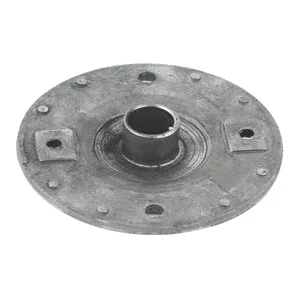
Unit cost is where a stamped DC motor cover is won or lost. This page is the cost-side companion to the DC design page: what actually drives the price of a stamped cover in volume, which DFM changes move the number most, and where cutting cost genuinely hurts.
The four real cost drivers
- Material – typically 40-60% of unit cost. Decided by strip layout (nesting on the coil), gauge, and grade. A re-nest that lifts utilisation from 78% to 88% is usually worth more than any press-speed gain.
- Press cycle – seconds multiplied by volume. One-pass progressive production is the floor; every secondary handling step adds disproportionately on small parts.
- Secondary operations. Every time a part leaves the press for tapping, deburring or welding, cost and tolerance stack up. Consolidating features into the die is the single most effective DFM lever.
- Tooling amortisation. Itemised as its own line and refundable against agreed volumes; at DC-motor volumes it fades to noise, below them it dominates the first-year price.
DFM changes that move the number
| Change | Effect |
|---|---|
| Relax non-mating tolerances to as-drawn ±0.1 mm | Removes machining operations; machining only bearing bore and spigot keeps the motor’s needs met |
| Move threads into the die (in-die tapping) | Deletes a handling step and a fixture; hole position improves |
| Open corner radii toward 4× sheet thickness | Fewer draw stages, less thinning scrap, lower draw force |
| Round the blank corners on the nest | Better draw-in, less trimming allowance, higher utilisation |
| Standardise the finish to the duty, not the catalogue | Zinc or e-coat where stainless steel is not actually required |
Where cost cutting genuinely hurts
Two places are false economies and we will say so at quotation:
- Under-specifying the bearing bore route. Holding a bearing seat as-drawn to save the turning op shows up as noise and bearing life claims later.
- Skipping the sampling plan. “Ship it and hope” costs one assembly-line stoppage to erase every saving.
How our quotation shows this
Tooling, piece price at your annual volume, and any secondary operations are itemised separately, so you can see exactly what each DFM decision is worth. Design changes are priced before they are made – never silently absorbed – and the manufacturing record is archived so a repeat order starts from the same approved data.
Batch integrity
Route cards follow each batch through the shop; first articles ship with dimensional report and material certificate; production batches are inspected on the sampling plan agreed at approval, under ISO 9001 certification.
Drawing a cover like this is a chain of decisions — draw ratio, wall thinning, radii and trim. Our deep drawn covers design guide works through each of them with worked numbers.
Venting and thermal relief without breaking the seal
A DC motor cover is not a sealed can unless the application is submersible. Most fractional-horsepower drives shed their heat through the end cover, so we plan a breather path or a stand-off shoulder that lets air move while still blocking dripping water and settling dust. The vent decision is made on the print, not in the field: a pressed-in breather, a perimeter labyrinth, or a controlled gap at the flange face. We model the motor’s worst-case temperature rise against the cover’s surface area and finish, then pick the path that keeps the winding below its class limit without inviting ingress. If the duty is genuinely sealed, we skip the vent and instead thicken the wall so the cover acts as a heat sink through conduction to the mounting surface.
Mounting face and bearing seat: where the cover meets the motor
The cover only does its job if the pilot diameter that locates it on the stator stack is held concentric to the stamped body, and if the bolt circle lands true. We treat the pilot and the bolt holes as the primary datums and stamp to them, not to the outer edge. On covers that carry a bearing boss, that boss is drawn and then skive-turned in a second op so the bore runs true to the pilot within a few thousandths. Flatness of the mounting face is checked with a straightedge and feeler because a warped flange leaks at the gasket, not at the bolt. We document the bolt torque and the washer type in the quote so the assembly line repeats the same clamp load the sample was validated at.
Edge condition at the air gap
The cut edge of the cover that faces the rotor is deburred and, on smaller bores, given a light break so a lifted edge cannot throw a spark into the winding. This is a cheap operation that prevents a costly failure, so it is in the standard routing rather than left to inspection. We also radius the inner lip where the stator leads exit, because a sharp edge chews the lead insulation during every heat cycle.
Specifications
| Item | Stamping DC motor cover |
|---|---|
| Brand | AUNOV |
| Designing | Send drawings, or send a sample to be measured – samples are reverse-measured into a controlled drawing; the approved drawing is kept as the controlled master. |
| Tooling | Dies, fixtures and gauges are made in our own toolroom, so a die can be re-cut against the approved drawing, and maintenance is tracked against the part number. |
| Samples | First-article samples of the cover ship with dimensional data and material certs. |
| Materials | Carbon steel (SPCC / DC01), 304 / 316 stainless steel, aluminium, brass and copper – the grade is matched to the duty of this cover. |
| Surface finish | Surface treatment matched to the duty: plating, coating or polishing; the agreed finish travels with the part number. |
| Processing | Deep drawing from coil or blank, with in-process annealing so walls thin evenly; batch records are filed so a repeat order starts from approved data. |
| Equipment | Mechanical presses from 5 to 250 T and hydraulic presses 250-500 T, with in-line annealing furnaces, backed by CNC turning centres and a climate-controlled inspection room. |
| Tolerance | +/-0.03 mm on turned secondary features, +/-0.1 mm on as-drawn walls; GD&T per drawing, PPAP-style reports on request. |
| Delivery terms | FOB, CIF or DDP per Incoterms 2020, payment by T/T, L/C at sight or D/P; price breaks tie to annual volume. |
Related Products
Frequently Asked Questions
What are the cost drivers worth having itemised separately?
Tooling, piece at your annual volume, secondary operations and any inspection or documentation beyond the standard. Seeing them separately is what makes a design decision legible: moving a feature into the die moves money from one line to another rather than simply removing it. Quotes that present a single number hide exactly the trade-offs you are trying to make.
Which design changes actually move the number?
The ones that remove operations. Fewer draw stages, features formed rather than added, a stock grade instead of a special one, tolerances relaxed where nothing functions, and fewer pieces pulled for extra checks. Each is small on its own and compounding together, which is why reviewing them alongside the quotation rather than after it produces the best result.
Where does cost cutting genuinely hurt?
In the places where the saving only shows up later. Cheaper die steel and less maintenance shows as dimensional drift over the run. Skipping interstage annealing shows as inconsistent walls. Reducing inspection shifts the cost to you at your goods inwards. These are real reductions, they are just reductions in reliability rather than in price.
How do you vent a sealed cover without breaking the seal?
By making the vent a designed path rather than an opening. Air has somewhere intended to go, and anything meant to stay out – water, dust, brush debris – has a path it cannot take, which usually comes from shielding and orientation rather than from location alone. An unplanned hole, added to solve heat, generally becomes the entry route you did not want.


Request a Quote for This Part
Send a drawing or sketch — get material advice, tooling cost and a per-piece price within 24 hours (working days).